How professionals can stay relevant in an agentic AI world?

TL;DR:Agentic AI is transforming how work gets done by automating tasks and workflows, not eliminating the need for professionals. To stay relevant, individuals must develop AI orchestration, critical thinking, domain expertise, Responsible AI awareness, and continuous learning habits. Success in 2026 will come from combining human judgment with AI capabilities.
AI is changing again, just when professionals were getting comfortable using tools like ChatGPT and Copilot, a new wave is emerging, Agentic AI. Unlike traditional AI that simply responds to prompts, AI agents can plan, make decisions, and complete multi-step tasks with minimal human input.
Naturally, that raises an important question, “If AI can do more on its own, where do professionals fit in?”
The answer isn't working harder than AI. It's learning how to work with it.
In the Agentic AI era, the most valuable professionals won't be those who know the most tools. They'll be the ones who can guide AI, apply human judgment, solve business problems, and turn AI capabilities into real outcomes.
But before we discuss the skills that will matter most, it's important to understand what Agentic AI actually is and why it's creating such a significant shift in the workplace.
What is Agentic AI?
Most AI tools today work in a straightforward way, you give them instructions, and they provide an output.
Agentic AI takes things much further, Instead of handling a single task, AI agents can:
- Understand goals
- Break them into smaller tasks
- Use different tools
- Make decisions
- Execute actions
- Adapt based on outcomes
Also Read: What is Agentic AI?
How does agentic AI change the future of work?
For decades, many jobs revolved around processing information, executing procedures, and managing repetitive tasks.
Professionals were often valued for:
- Information access
- Process execution
- Operational efficiency
- Specialized expertise
As AI becomes capable of handling more execution-focused work, professional value is shifting and increasingly, organizations will reward capabilities such as:
- Strategic thinking
- Creativity
- Decision-making
- Contextual judgment
- Problem-solving
- Leadership
- Relationship management
The Key Shift here is, “Agentic AI automates tasks. It does not automate accountability”.
Businesses will still need professionals who can define goals, evaluate outputs, manage risks, and make decisions that align with organizational priorities.
The future belongs to people who can combine AI capabilities with human judgment.
The biggest mistake professionals are making today
Many professionals are still learning AI as a tool but, Organizations, however, are beginning to use AI as part of larger workflows.
The Difference
| AI User | AI-Ready Professional |
| Uses AI occasionally | Integrates AI into daily work |
| Writes prompts | Designs workflows |
| Completes tasks faster | Improves business outcomes |
| Experiments with tools | Builds repeatable systems |
| Focuses on features | Focuses on outcomes |
This transition is where career differentiation will happen.
The professionals who stay relevant won't necessarily be the ones who know every AI tool. They'll be the ones who understand how AI creates business value.
Five skills that will matter more than ever in an agentic AI world
1. AI orchestration skills
In the future, professionals won't just use AI.
They'll manage AI-powered workflows.
This means knowing how to:
- Define objectives
- Assign tasks
- Monitor outputs
- Evaluate performance
- Improve workflows
Think of yourself as a manager of AI systems rather than simply a user of AI tools.
2. Critical thinking and judgment
AI can generate answers.
Humans decide whether those answers should be trusted.
Professionals will increasingly need to evaluate:
- Accuracy
- Business relevance
- Risks
- Trade-offs
- Long-term consequences
As AI autonomy grows, human judgment becomes more valuable.
3. Domain expertise
AI can access information.
Professionals provide context.
A marketing professional understands customer behaviour.
An HR leader understands workforce challenges.
A finance professional understands risk and compliance.
The most valuable people will be those who combine industry expertise with AI literacy.
4. Responsible AI and governance
As AI agents become more common, organizations must address:
- Privacy
- Security
- Bias
- Compliance
- Transparency
- Human oversight
Professionals who understand these areas will play an increasingly important role in AI adoption.
Responsible AI is becoming a business skill, not just a technical one.
5. Continuous Learning
The biggest mistake professionals can make is assuming AI is something they learn once.
Future-ready professionals develop:
- Learning agility
- Curiosity
- Adaptability
- Experimentation habits
In a rapidly evolving landscape, the ability to learn may be more valuable than expertise in any specific platform.
Also Read: Key Agentic AI Skills to Work in 2026
From prompting to managing AI agents: the new career progression
Most professionals are somewhere between awareness and experimentation.
But the future career journey may look something like this:
Stage 1: AI Awareness
"I know what AI is."
Stage 2: AI Usage
"I use AI tools."
Stage 3: AI Application
"I solve problems using AI."
Stage 4: AI Workflow Design
"I create AI-powered processes."
Stage 5: AI Agent Orchestration
"I coordinate people and AI systems to achieve outcomes."
The greatest career opportunities will likely emerge in the final two stages.
What does an AI-ready professional look like in 2026 and beyond?
Use this checklist to evaluate your readiness.
AI-Ready Professionals:
- Use AI regularly in their work
- Automate repetitive tasks responsibly
- Evaluate AI outputs critically
- Understand AI limitations
- Apply AI to role-specific challenges
- Build AI-assisted workflows
- Understand AI risks and governance
- Continuously learn emerging capabilities
How professionals can start preparing today?
Understanding Agentic AI is important. Building practical capability is what creates career impact.
1. Build AI fundamentals
Develop an understanding of:
- AI Literacy
- Generative AI
- Agentic AI
- Responsible AI
A strong foundation makes it easier to evaluate future technologies.
2. Gain hands-on experience
Use AI consistently in your work.
Explore how it can help you:
- Research faster
- Communicate better
- Analyze information
- Improve productivity
- Support decision-making
3. Solve real workplace problems
Start asking:
- Which tasks consume most of my time?
- Where do bottlenecks exist?
- What repetitive work can be automated?
- Which processes can be improved?
The fastest way to learn AI is through application.
4. Follow a structured learning path
As Agentic AI evolves, many professionals struggle with a common problem: knowing what to learn and how to apply it.
This is where structured learning pathways become valuable.
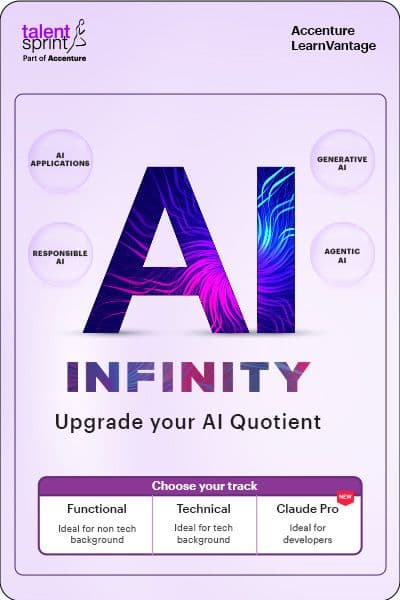
For example, AI Infinity is designed to help learners move from AI awareness to practical application through hands-on learning. Rather than focusing on a single platform, it provides exposure to more than 20 AI tools and covers AI Literacy, Generative AI, Agentic AI, and Responsible AI concepts. The program also offers separate Functional and Technical tracks, allowing learners to choose a pathway aligned with their professional background and goals.
It includes:
- Live learning from AI experts
- Hands-on experience across 20+ AI tools
- 12 industry-relevant projects
- 20 skill-based assignments
- Functional and Technical learning pathways
- Self-paced learning resources
- Continued access to updated content
These elements focus on helping learners apply AI in workplace scenarios rather than simply understanding the technology conceptually.
The future belongs to AI-augmented professionals
The professionals who thrive in an Agentic AI world won't necessarily be the best programmers or the most advanced prompt engineers.
They'll be the people who can combine:
- Human judgment
- Domain expertise
- Strategic thinking
- Business understanding
- AI capabilities
to create outcomes that neither humans nor machines could achieve independently.
Agentic AI isn't making professionals irrelevant. It's redefining what makes them valuable.
Those who learn to guide AI, challenge its outputs, make informed decisions, and continuously adapt will remain indispensable in the workplace.
And as AI becomes a core workplace capability, building these skills through practical application and continuous learning will be essential. Whether through self-directed experimentation or structured learning pathways such as AI Infinity, the goal remains the same: moving from simply using AI to creating meaningful value with it
Frequently Asked Questions
Q1. Will AI Agents Replace My Job? What You Actually Need to Know?
AI agents are more likely to automate tasks than replace entire jobs. Roles built around repetitive, predictable work may change significantly, but professionals who contribute strategic thinking, decision-making, creativity, and domain expertise will remain valuable. The future of work is expected to be centered on human-AI collaboration rather than complete workforce replacement.
Q2. How to Stay Employable When AI Agents Can Do Your Work?
To remain employable, focus on developing uniquely human skills such as critical thinking, leadership, communication, and problem-solving. Build AI literacy, learn how to work alongside AI tools, and apply them to real business challenges. Continuous learning and adaptability will be essential as workplace technologies continue to evolve.
Q3. What Skills Will Matter Most in an Agentic AI World?
The most valuable skills will include AI orchestration, critical thinking, domain expertise, Responsible AI knowledge, communication, and continuous learning. Professionals who can guide AI systems, evaluate outputs, and connect AI capabilities to business outcomes will have a stronger competitive advantage than those focused solely on tool usage.
About the Author
TalentSprint
TalentSprint, Part of Accenture LearnVantage, is a global leader in building deep expertise across emerging technologies, leadership, and management areas. With over 15 years of education excellence, TalentSprint designs and delivers high-impact, outcome-driven learning solutions for individuals, institutions, and enterprises. TalentSprint partners with leading enterprises and top-tier academic institutions to co-create industry-relevant learning experiences that drive measurable learning outcomes at scale.
Explore Our Programme
Advance your career with the right program