
What Every Leader Should Know About Agentic AI Before It Disrupts Their Industry?

Somewhere in your industry, a decision was just made without a human in the room.
Not a prediction. Not a recommendation. A decision executed, logged, and moved on from. That is the quiet shift agentic AI has already triggered, and most leaders are still calibrating to a version of AI that only answers questions.
The numbers make the urgency hard to ignore. Gartner expects 40% of enterprise applications to embed AI agents by the end of 2026, and Capgemini estimates agentic AI could unlock up to $450 billion in economic value by 2028. Yet only a fraction of organisations has moved beyond pilots.
This is the gap that will define the next era of leadership. Not who adopts AI, but who understands it deeply enough to redesign how their business decides, operates, and competes.
This blog is a leader's guide on what agentic AI really is, why 2026 is its tipping point, how it is already reshaping industries, and what every leader must do now before disruption arrives uninvited.
From Generative AI to Agentic AI: Understanding the shift
Most leaders have made peace with generative AI. Agentic AI will unsettle that peace.
Traditional AI predicts. Generative AI creates. Agentic AI decides and acts pursuing goals across systems with minimal supervision. It is the first technology that behaves less like a tool and more like a coworker.
The implication is significant. For decades, technology either automated tasks or supported human effort. Agentic AI does both at once, quietly reshaping decision rights, workflows, and accountability.
What does Agentic AI mean for Leaders?
Agentic AI refers to autonomous systems that perceive context across data and applications, reason through how to break a goal into steps, act across enterprise platforms like CRM, ERP, and supply chain, and learn from outcomes to self-correct over time. Unlike traditional or generative AI, it does not just predict or produce it decides and executes, turning static enterprise systems into dynamic ecosystems that adapt in real time, without waiting for the next release cycle or human handoff.
How Agentic AI Is Already Reshaping Industries?
Agentic AI is no longer a horizon technology. Sectors from healthcare to consumer goods are already moving past experimentation and using agentic AI to streamline workflows, accelerate decisions, and solve challenges that traditional automation could not touch.
The disruption looks different in every industry but the direction is the same: from AI that advises to AI that acts.
- Healthcare: Agentic AI is moving beyond pattern recognition into active patient care. It monitors real-time vitals, triggers clinical alerts, supports treatment planning, assists in referrals, and even files insurance claims without constant human oversight freeing clinicians to focus on judgment-heavy work.
- Manufacturing: Where traditional AI flags issues for humans to act on, agentic AI detects faults, decides next steps, and triggers repairs or production shifts on its own. It adapts workflows in real time, manages inventory dynamically, and drives sustainability through smarter resource use.
- Financial Services: Banks and insurers are deploying agents for real-time fraud mitigation, credit risk evaluation, and customer service routing. Agents can pause suspicious payments, rebalance portfolios in response to market shifts, and execute decisions at machine speed though oversight and accountability remain active leadership questions.
- FMCG (Fast-Moving Consumer Goods): Multi-agent systems are helping brands respond to fast-changing market dynamics autonomously managing stock, detecting sales fraud, and enforcing safety compliance. The advantage is no longer just prediction, it is coordinated action across the value chain.
What Every Leader Must Know Before the Disruption Hits?
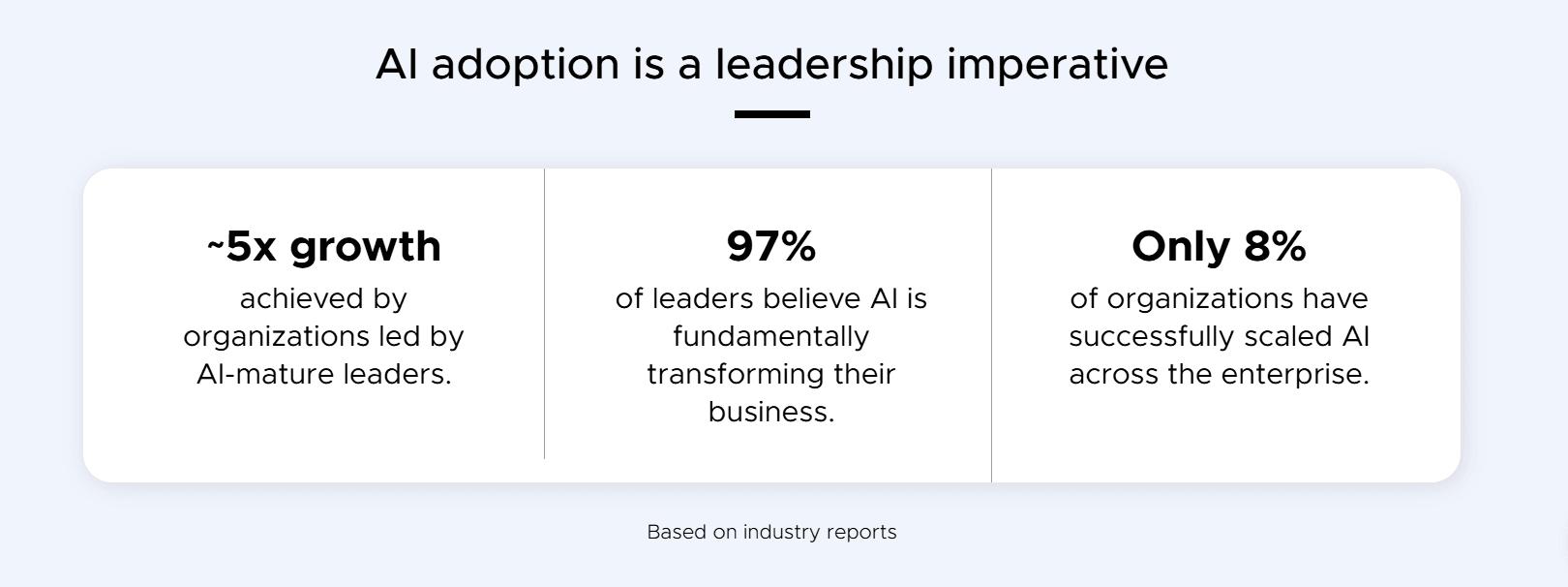
Knowing what agentic AI is matters far less than knowing what to do about it. By the time disruption shows up in the P&L, the choices that mattered will have already been made by competitors, by regulators, or by default. Four imperatives separate the leaders who will shape the agentic era from those who will simply react to it.
1. Rethink workflows, not just tools. Most agentic AI failures are workflow failures in disguise. Layering agents on broken processes only produces marginal gains. Start with the highest-friction workflows, redesign them around what agents do best continuous decisions, multi-system coordination, exception handling and treat the redesign as a leadership exercise, not a technology project.
2. Build governance and trust early. Autonomy without oversight is the fastest route to risk. Define clear decision rights, make every agent’s action traceable and reversible, and treat governance as a shared C-suite responsibility too cross-functional to sit inside any single silo.
3. Prepare the workforce for human-agent collaboration. Agents are a new category of teammates, and most workforces are unprepared to lead, evaluate, or correct one. Reskill mid-managers to direct agents, redefine performance around outcomes orchestrated rather than tasks completed, and communicate transparently silence is the most underestimated risk in adoption.
4. Get the data and integration foundations right. Agents are only as effective as the data they can trust and act on. Most stalled programmes are stalled by infrastructure, not ambition.
The leaders who get these four foundations right will not just survive the disruption they will quietly define what their industry looks like on the other side of it.
The New Leadership Playbook for the Agentic Era
Agentic AI marks a quiet but decisive shift from automation to orchestration. These systems are not replacing humans; they are reassigning value, removing friction, and accelerating decisions faster than teams ever could alone.
For leaders, that changes the job description itself. The real opportunity is not doing more with less, but redeploying human potential toward creativity, customer connection, and innovation work that strategy actually moves on.
The new playbook rests on three shifts:
- From managing technology to orchestrating intelligence lead the redesign of work, not just the rollout of tools.
- From job titles to skills build adaptive workforces; move people to where they create the most value.
- From compliance-led trust to strategic trust earn it through transparency, accountability, and clear human oversight.
Agentic AI will not replace people. But it will replace leaders who fail to reimagine what people can do.
Why must leaders upskill now?
The agentic era introduces a vocabulary most leadership teams have never had to operate in agentic architectures, multi-agent orchestration, human-in-the-loop governance, responsible AI. These are no longer engineering concepts; they are boardroom concepts. The leaders who cannot speak this language fluently will struggle to set direction, evaluate risk, or challenge what their technology teams bring to the table.
This is the gap that purpose-built executive programmes are designed to close. The Executive Programme in AI for Business by IIM Calcutta is built for senior professionals who want to lead AI initiatives without needing a technical background helping them understand how AI systems work, where they create value, and how to translate AI capabilities into business strategy, governance, and competitive advantage.
The intent is not to make leaders coders. It is to make them conversant, confident enough to ask the right questions, set the right guardrails, and make the right calls.
Because in the agentic era, AI fluency is no longer a technical skill, it is a leadership skill.
The leaders who invest in structured AI fluency today will be the ones quietly shaping their industries tomorrow.
Frequently Asked Questions
1. What Is Agentic AI and Why Should Businesses Care?
Agentic AI refers to autonomous systems that reason, decide, and act across enterprise platforms to achieve defined goals. Businesses should care because it shifts AI from answering questions to executing decisions quietly redrawing how work gets done, who decides, and where competitive advantage forms.
2. Can Agentic AI Work Across Every Industry?
Yes, though the form differs. In finance, agents underwrite and detect fraud; in healthcare, they triage and coordinate care; in manufacturing, they adapt supply chains in real time. Technology is industry-agnostic, but the advantage belongs to leaders who tailor it to their sector's speed, precision, and scale.
3. What Does Agentic AI Mean for Leadership Roles?
It changes the job itself. Leaders move from directing tasks to orchestrating intelligence, setting goals for agents, governing their autonomy, and protecting decisions that should stay human. In the agentic era, leadership is measured less by control and more by clarity of intent.
4. Are Companies Truly Ready for Agentic AI Implementation?
Most are not and the gap is rarely about ambition. Readiness depends on four foundations: redesigned workflows, clear governance, an upskilled workforce, and trustworthy data infrastructure. Companies running pilots without these in place tend to stall long before scale.
5. Is Agentic AI Just Hype or Real Business Value?
About the Author
TalentSprint
TalentSprint, Part of Accenture LearnVantage, is a global leader in building deep expertise across emerging technologies, leadership, and management areas. With over 15 years of education excellence, TalentSprint designs and delivers high-impact, outcome-driven learning solutions for individuals, institutions, and enterprises. TalentSprint partners with leading enterprises and top-tier academic institutions to co-create industry-relevant learning experiences that drive measurable learning outcomes at scale.
Explore Our Programme
Advance your career with the right program