Is Your Business Actually AI-Ready? A Leadership Framework to Assess Analytics Maturity

TL;DR:AI readiness is not just about adopting technology. It requires strong strategy, trusted data, scalable infrastructure, governance, talent and a change-ready culture. Leaders must assess readiness, understand maturity and build analytics fluency to move AI beyond isolated pilots, scale high-value applications and turn investment into sustainable enterprise-wide business value.
AI has moved from the IT roadmap to the boardroom agenda. Leaders across functions now ask how AI can sharpen decisions, open new revenue streams and build lasting competitive advantage.
But using AI and being ready for it are two different things. Nearly 9 in 10 organisations say they use AI in at least one business function, yet close to two-thirds have not begun scaling it across the enterprise.
The opportunity is real, and so is the gap. For senior leaders, the question is no longer whether to invest in AI. It is this: Is your business actually AI-ready?
AI Readiness vs. AI Maturity: What's the Difference?
People often use the two terms interchangeably, but they answer different questions.
AI readiness asks whether an organisation can start implementing AI effectively. AI maturity asks how well that AI is already running and creating value.
Readiness is the foundation, and maturity is the journey that follows. Leaders need both views: readiness before committing budget, and maturity before scaling beyond pilots.
Without this clarity, organisations risk investing in tools before building the capabilities those tools need.
Why so many AI initiatives stall at the pilot stage?
Many organisations believe they are further along with AI than they really are. Around 42% of companies rate their AI strategy as "highly prepared," yet feel underprepared on infrastructure, data, risk management and talent.
The effect shows up in results. A 2025 report found that 95% of enterprise AI pilots fail to deliver measurable P&L impact.
The usual causes are familiar:
- Scattered data across systems and teams
- Unclear ownership of AI outcomes
- One-off experiments that never become repeatable processes
The encouraging part is that these are not mainly technology problems. They are leadership opportunities. Organisations that close the gap do it by building leaders who can connect data to decisions.
The Leadership Framework: Six Pillars of AI Readiness
Use these six pillars to take an honest look at your organisation's readiness:
| Pillar | What it means | Leadership self-check |
| Strategy and | AI use cases are tied to clear business goals | Can we explain how each AI initiative supports a strategic priority? |
| Data foundations | Data is accessible, clean and trusted | Do decision-makers trust the data in front of them? |
| Technology and infrastructure | Systems can support AI at scale | Can our current architecture take a pilot into production? |
| Governance and responsible AI | Ownership, risk and ethics are clearly defined | Who is accountable when an AI-driven decision goes wrong? |
| Talent and skills | Leaders and teams are fluent in analytics | Can our leaders interpret and challenge analytical insights? |
| Culture and change readiness | People see AI as an opportunity, not a threat | Are our teams willing to adopt new ways of working? |
Getting the technology right is only part of readiness. Employee readiness, including skills, mindset and openness to change, is part of it too, not an afterthought.
The Five Stages of Analytics and AI Maturity
Maturity frameworks usually place organisations on a path from basic awareness to full transformation. Here is a simple view:
| Stage | What it looks like | The leader's priority |
| 1. Awareness | Interest in AI, with little structured activity | Build shared understanding and identify business problems |
| 2.Experimentation | Isolated pilots within individual teams | Set success metrics and ownership for each pilot |
| 3.Operationalisation | Some use cases in production | Standardise data, governance and processes |
| 4. Scaling | AI embedded across several functions | Align investments with the enterprise strategy |
| 5. Transformation | AI shapes the business model and daily decisions | Keep innovating and govern responsibly |
Organisations further along this curve usually have cleaner data pipelines, defined governance, trained talent and active leadership backing.
Genuine readiness is still rare. Only 13% of organisations qualify as top-tier AI-ready "Pacesetters"(Source: Cisco AI Readiness Index, 2025).
Where does your organisation sit today?
A Quick Self-Assessment for Leaders
Answer yes or no to each question:
- Is every AI initiative linked to a measurable business outcome?
- Do leaders trust and regularly use data when making decisions?
- Can your infrastructure support moving a pilot into production?
- Is there a clear owner for AI governance and risk?
- Do functional heads understand the basics of predictive and prescriptive analytics?
- Do you have, or can you build, a high-performing analytics team?
- Do employees see AI as a tool that supports their work?
- Do you review AI performance regularly rather than once?
How to read your score:
- 0–3 yes: Early stage. Focus on strategy and data foundations.
- 4–6 yes: Developing. Strengthen governance, talent and scale.
- 7–8 yes: Scale-ready. Focus on transformation and continuous improvement.
Why Leaders Need AI and Analytics Capabilities?
Stronger analytics and AI capabilities will enable leaders to turn growing volumes of data into strategic decisions that shape growth, innovation, and enterprise value. These capabilities help leaders to:
- Guide analytics and AI teams towards strategic business priorities
- Uncover new growth opportunities through data and AI-driven insights
- Evaluate AI-generated recommendations with strategic judgement
- Embed analytics and AI across products, processes, people, and operations
- Scale high-value use cases from functional adoption to enterprise impact
- Build a data-driven organisation where AI augments leadership judgement
How the strategic leadership programme in analytics with AI builds AI-ready leaders?
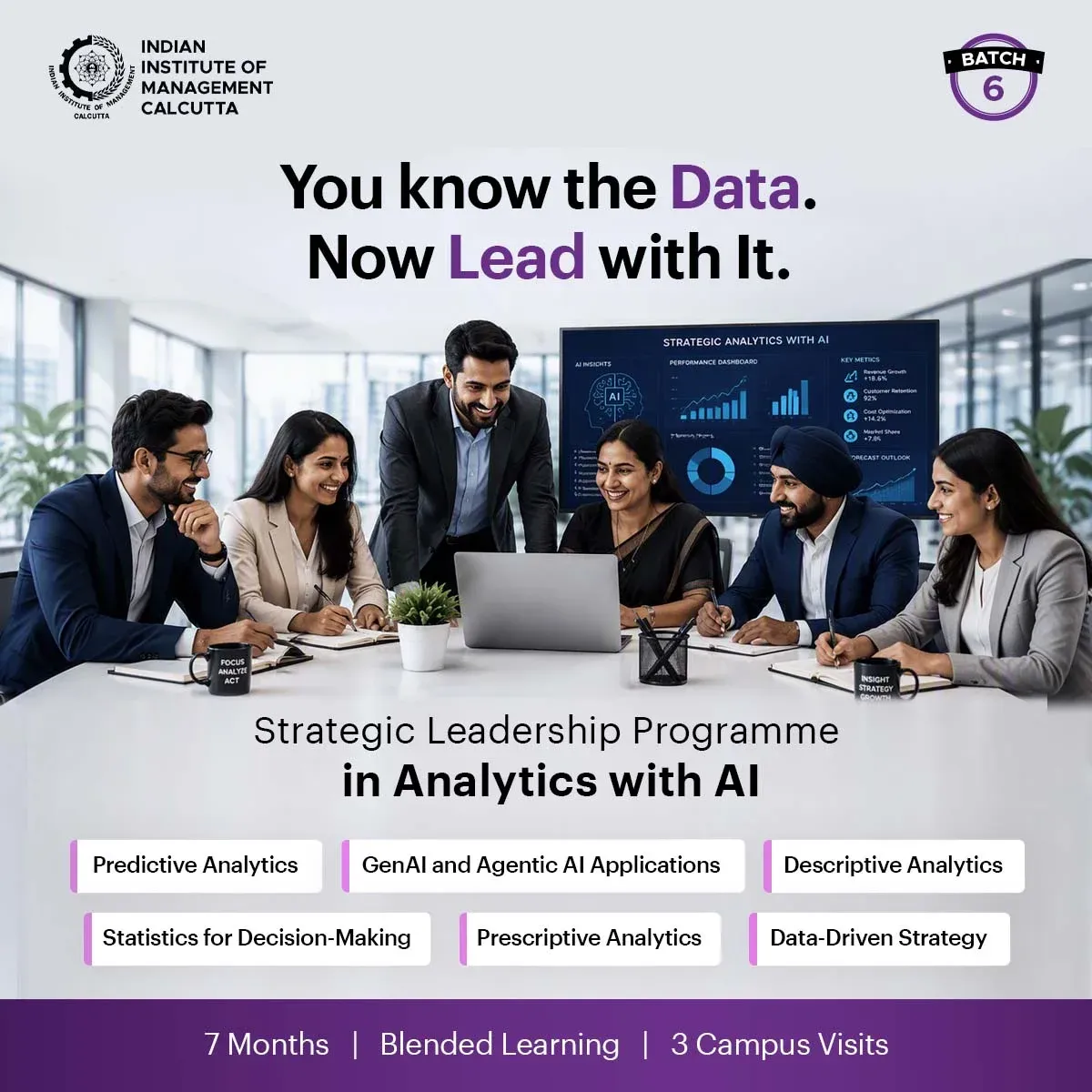
The Strategic Leadership Programme in Analytics with AI from IIM Calcutta is built to develop exactly this capability. The curriculum starts where this framework does, with a module on assessing analytics and AI readiness in your business.
Participants learn to:
- Build a data-driven organisation, and build and lead high-performing analytics and AI teams
- Apply statistical thinking to business decisions
- Use predictive analytics and machine learning for forecasting and pattern discovery
- Make strategic decisions using simulation, decision analysis and game theory
- Understand NLP and LLMs, including an overview of transformer and GPT architecture
- Apply analytics across functions, including people analytics, AI-enabled marketing, financial forecasting and risk, and operations optimisation
The result is a leader who can judge readiness, prioritise investments and guide AI from pilot to enterprise impact.
Programme Format and Who It's For
- Duration: 7 months
- Format: 75% in-person learning on campus and 25% live online sessions
- Campus immersion: Three five-day visits to IIM Calcutta
- Industry exposure: Industry and guest sessions with experts
- Recognition: IIM Calcutta Executive Education alumni status
Ideal for: senior leaders, functional heads, executives and entrepreneurs with 8+ years of experience who want to turn analytics and AI into strategic decisions without becoming data scientists.
Conclusion
AI readiness is not a box you tick once. It is an ongoing leadership discipline, and organisations that review and strengthen their maturity regularly are the ones that turn AI spending into lasting value.
The leaders who build analytics fluency now will define how their organisations compete, innovate and grow. The technology is already here, and leadership is what turns it into advantage.
If you are ready to lead that shift, the Strategic Leadership Programme in Analytics with AI from IIM Calcutta can help you get there.
Explore the programme and apply for the next cohort.
Frequently Asked Questions
1. What is AI readiness?
AI readiness is an organisation's ability to adopt, scale and govern AI in ways that produce measurable business outcomes.
2. How is AI readiness different from AI maturity?
Readiness shows whether you can begin implementing AI. Maturity shows how well your AI is already performing and scaling.
3. How can leaders assess analytics maturity?
By reviewing six pillars: strategy, data, technology, governance, talent and culture. Then place the organisation on a five-stage maturity scale.
4. Do senior leaders need technical skills to lead AI initiatives?
No. Leaders need analytics fluency, meaning the ability to frame problems, interpret insights and guide AI-driven decisions.
About the Author
TalentSprint
TalentSprint, Part of Accenture LearnVantage, is a global leader in building deep expertise across emerging technologies, leadership, and management areas. With over 15 years of education excellence, TalentSprint designs and delivers high-impact, outcome-driven learning solutions for individuals, institutions, and enterprises. TalentSprint partners with leading enterprises and top-tier academic institutions to co-create industry-relevant learning experiences that drive measurable learning outcomes at scale.
Advance your career with the right program