What Is Digital Lending? How Technology Is Changing the Credit Journey

TL;DR:Digital lending uses technology to simplify the credit journey, from application and verification to underwriting, approval, and disbursal. By leveraging automation, alternative data, AI, and digital platforms, lenders can make credit processes faster, more accessible, and data-driven while improving borrower experiences and enabling more informed lending decisions.
Not long ago, getting a loan meant visiting a branch, filling out stacks of forms and waiting weeks for a decision. Today, a borrower can apply from a smartphone, get verified in real time and receive funds within hours, sometimes minutes.
This is more than a new channel for an old product. Digital lending is changing how credit is designed, assessed, delivered and governed. For leaders in banking, financial services and FinTech, understanding this shift is now a strategic necessity.
This guide explains what digital lending is, how technology is reshaping each stage of the credit journey, and what it means for the leaders shaping the future of financial services.
Also Read: What Is Fintech? An Expert Guide to Financial Technology
What is digital lending?
Digital lending is the use of technology to manage the entire loan lifecycle, from origination and underwriting to disbursement and repayment. Instead of separate manual steps, a single platform connects every stage, so the data a borrower submits at application flows straight through to credit decisioning, disbursement and servicing.
The momentum is significant. Industry research projects that the global digital lending platform market will grow at a compound annual rate of about 29% between 2026 and 2033. Smartphone adoption, big data and the demand for instant financial services are driving this growth.
| Dimension | Traditional Lending | Digital Lending |
| Access | Branch visits, working hours | Anytime, anywhere, via web or app |
| Speed | Days to weeks | Hours or minutes |
| Documentation | Paper-heavy | Minimal, digitally verified |
| Risk assessment | Mostly credit history | Credit history plus alternative data |
| Cost to serve | High manual effort | Lower through automation |
| Reach | Limited for underserved segments | Broader, including remote populations |
How is technology reshaping the credit journey?
Digital lending redesigns every touchpoint in the borrower's journey.
1. Application
The journey starts with a digital application on a website or mobile app. Borrowers can upload identity proof and bank statements in minutes.
2. Verification
APIs connect to external databases to check identity and financial information in real time, replacing manual document checks.
3. Credit Decisioning
This is where digital lending stands apart. Beyond traditional credit scores, AI and machine learning models can analyse alternative data, such as utility payments and transaction history, to build a fuller risk profile. This can support fairer decisions for people with little or no credit history.
4. Disbursement
Automated decisions can be made within minutes. Approved loans can be signed with e-signatures and funded directly into the borrower's account, sometimes on the same day.
5. Repayment and Servicing
Repayments can be automated through direct debits, and borrowers can track their loan status through personalised dashboards.
The result is a credit journey that feels as smooth as any other digital experience, which is what customers now expect.
The Technology Stack Behind Digital Lending
Several technologies work together to power modern lending:
- Artificial intelligence and machine learning: improve risk assessment and automate underwriting.
- Big data analytics: strengthen credit scoring and enable personalised loan offers.
- APIs and cloud computing: make FinTech integration easy and lending operations scalable.
- Blockchain: improves security, transparency and fraud prevention.
- Robotic process automation (RPA): handles repetitive tasks to improve efficiency.
- Digital identity and compliance tools: reduce fraud risk and support regulatory compliance.
For leaders, the key insight is that AI is becoming the decision engine of lending, supporting forecasting, credit scoring, risk management and fraud detection. Competitive advantage increasingly depends on how well an organisation uses data, not just how much capital it can lend.
India's Digital Public Infrastructure: The Base for Digital Lending
India offers a strong example of how shared digital infrastructure can speed up lending innovation. UPI, Aadhaar, DigiLocker and the Account Aggregator framework together make up an ecosystem that supports digital identity, payments, document access and consent-based data sharing.
On top of this foundation sit newer process innovations such as the Open Credit Enablement Network (OCEN) and the Unified Lending Interface (ULI). These are designed to make credit more open, interoperable and accessible.
The lesson for decision-makers is clear: when the infrastructure is shared, competition moves to experience, intelligence and trust.
The Value Created for Borrowers and Lenders
Digital lending creates value on both sides of the transaction.
For borrowers:
- Faster approvals and disbursement
- Access to credit at any time, from anywhere
- Greater inclusion for people with limited credit history
For lenders:
- Lower operating costs through automation
- The ability to handle more applications with better accuracy
- Wider reach into underserved and remote markets
What this means for financial services leaders?
Digital lending calls for a new leadership mindset:
- Think of lending as a decisioning capability. Data, models and governance now matter as much as products.
- Combine finance and technology fluency. Leaders need to understand credit risk and AI, as well as business models and platforms.
- Design for the customer journey. Speed and simplicity are now baseline expectations.
- Lead through ecosystems. Partnerships, co-lending and shared infrastructure demand collaborative strategies.
- Build trust at scale. Responsible AI, security and compliance must grow alongside innovation.
Building Leadership Capability for the Next Era of Credit
As lending becomes intelligent and ecosystem-driven, professionals need a structured way to understand both the technology and the strategy behind it.
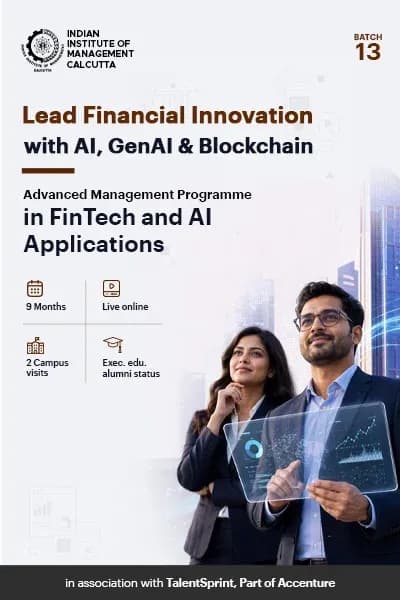
The Advanced Management Programme in FinTech and AI Applications by IIM Calcutta, in collaboration with TalentSprint, is designed for this need. Its curriculum covers LendingTech innovations and business models, including OCEN, Account Aggregator, ULI, FLDG, co-lending and P2P platforms. It also covers India's FinTech ecosystem, digital payments and RegTech. The programme is delivered over nine months through live sessions, two 3-day campus immersions at IIM Calcutta and a capstone project grounded in real business contexts.
For leaders who want to shape the future of credit rather than react to it, it is a natural next step.
Conclusion
Digital lending is redefining the credit journey, from paper to platforms, from intuition to intelligence and from limited access to broader inclusion. Technology has made credit faster and more personal. The real differentiator, however, will be how responsibly institutions use data, manage risk and build trust.
For financial services leaders, the opportunity is significant: to design credit experiences that are smooth for customers, sustainable for businesses and inclusive for society. The future of lending belongs to those who can combine financial judgement with technological vision.
Frequently Asked Questions
1. What is digital lending?
Digital lending uses technology to manage the full loan lifecycle, including application, verification, underwriting, disbursement and repayment, through digital platforms.
2. How is digital lending different from traditional lending?
Traditional lending relies on branch visits, paperwork and manual checks. Digital lending offers faster approvals, minimal documentation and access anytime, anywhere.
3. How does AI improve credit decisions?
AI and machine learning analyse traditional and alternative data to build fuller risk profiles. This enables faster and potentially fairer credit decisions.
4. What role does the Account Aggregator framework play?
It is part of India's digital infrastructure. It enables consent-based sharing of financial data, which supports better-informed lending decisions.
5. What is co-lending?
Co-lending is a partnership model in which banks and NBFCs jointly provide loans, combining their capital and their reach.
About the Author
TalentSprint
TalentSprint, Part of Accenture LearnVantage, is a global leader in building deep expertise across emerging technologies, leadership, and management areas. With over 15 years of education excellence, TalentSprint designs and delivers high-impact, outcome-driven learning solutions for individuals, institutions, and enterprises. TalentSprint partners with leading enterprises and top-tier academic institutions to co-create industry-relevant learning experiences that drive measurable learning outcomes at scale.
Explore Our Programme
Advance your career with the right program