How Digital Payments Are Transforming Consumer and Business Transactions?

TL;DR:Digital payments have gone from a convenience to core financial infrastructure. Consumers get fast, secure everyday transactions. Businesses get quicker settlement, clearer cash flow and new revenue models. AI, real-time rails and tokenisation are driving the next wave, so leaders need to treat payments as a strategic capability built on trust.
A decade ago, paying for groceries meant reaching for a wallet. Today, a quick scan settles the bill in seconds. India alone has over 700 million active UPI QR codes, and almost 90% of small and medium-sized businesses use at least one digital payment method.
Digital payments have moved from convenience to core infrastructure. They are changing how consumers spend, how businesses get paid and how money moves through the economy. Behind every smooth transaction sits a fast-changing ecosystem of AI, open banking, blockchain and security.
So how exactly are digital payments transforming everyday transactions, and what does this mean for leaders shaping the future of finance? Let's explore.
What are digital payments and how do they work?
Digital payments are transactions where money moves between a payer and a payee through electronic channels instead of cash or cheques.
Behind every tap or scan, a quick sequence takes place:
- Initiation: The customer pays by card, app or QR code.
- Capture: A payment gateway securely collects and encrypts the payment details.
- Authorisation: The processor sends the request to the customer's bank for approval.
- Settlement: The approved funds are transferred to the merchant's account.
Common forms include cards, UPI, mobile wallets, net banking and QR-based payments. Together, they make transactions faster and easier to track, and people can use them anytime, anywhere.
How are digital payments changing the way consumers pay?
Digital payments have become part of everyday life. In August 2026, India's UPI handled a record 24.51 billion transactions worth ₹29.82 lakh crore, up 22% in volume from a year earlier. Most of that growth came from small everyday payments. The average transaction fell to about ₹1,217, which shows how people now use UPI for routine spending. The shift is global too. About nine in ten consumers in the US and Europe made digital payments in the past year.
This shift is reshaping consumer behaviour in three keyways:
- Convenience comes first: One in five digital wallet users often leave home without a physical wallet.
- Payments come earlier in the purchase: Options like buy now, pay later now influence what people buy, not just how they check out.
- Access is wider: More banks are joining UPI, including smaller and regional lenders, which brings more people into the digital economy.
For consumers, the outcome is clear payments are fast and secure and fit easily into daily life.
How are digital payments transforming business transactions?
For businesses, digital payments are no longer just a convenient way to get paid. They are changing how organisations operate, manage money and compete.
Faster settlement, leaner operations: Digital transactions settle in hours or even seconds, not days. With less cash to count, store and deposit, businesses spend less on cash handling and make fewer errors. Automated reconciliation matches payments to invoices without manual effort, so finance teams can focus on more valuable work.
Clearer cash-flow visibility: Every digital transaction creates a real-time record. Businesses can track money coming in and going out as it happens, forecast more accurately and base decisions on data instead of estimates.
New business models: Digital payments are making new things possible. Cardless cross-border payments let customers pay directly from their bank accounts. Open banking allows instant lending decisions at the point of purchase. As a result, payments are becoming a route to new products and revenue streams.
Stronger B2B transactions: Digital invoices with built-in payment options help businesses collect payments sooner. Treasury teams get better control over cash, and businesses of every size can trade with partners and customers across borders.
The takeaway: payments are no longer back-office plumbing. They are a strategic lever for growth.
What technologies are powering the next wave of digital payments?
Payments are becoming invisible. As checkout moves inside apps and software, value is shifting from the screen to the systems underneath: verifying identity, managing consent and routing each payment intelligently.
AI and agentic commerce: AI already helps payment providers detect fraud, process payments more efficiently and target marketing more precisely. The bigger change is AI agents that can choose a purchase and the way to pay for it. India is preparing a framework for AI agents to make small UPI payments without approval for each one, starting with everyday buys like groceries. A planned registry would verify and monitor these agents.
Real-time, connected rails: More than 70 countries already settle domestic payments in seconds. Project Nexus aims to link these national systems through a single connection instead of a separate link for each country, so most cross-border payments arrive within 60 seconds. India's central bank is one of its founding partners.
Blockchain and tokenisation: Blockchain is moving from pilots to real-world use, bringing faster settlement and freeing up cash. Stablecoins are being used more for cross-border payments and remittances, though volumes are still small. Many countries are also advancing central bank digital currencies, and tokenisation is moving towards commercial use.
Mobile wallets everywhere: Digital wallets now account for 56% of global e-commerce value and a third of in-store spending. QR codes in Asia-Pacific and Latin America and NFC in Europe are bringing payment apps to physical stores.
Why are security and trust central to digital payment growth?
As more transactions move online, trust becomes the foundation that digital payments grow on. Every smooth payment depends on customers and businesses believing their money and data are safe.
A wider range of threats: As payments go digital, threats are becoming more sophisticated. They include ransomware, denial-of-service attacks and business email compromise.
A three-part defence: Strong cyber security rests on three pillars. Security prevents and detects threats. Vigilance spots attacks quickly. Resilience helps organisations recover and keep operations running.
Regulation and privacy that support growth: Clear regulation, strong data privacy and transparent practices give customers the confidence to pay digitally. Far from slowing innovation, they give it a stable foundation to scale.
In the end, trust is what turns digital payments from a convenience into an everyday habit.
What should business leaders prioritise in a digital-first payments economy?
Payments are the most valuable part of financial services, generating $2.5 trillion in revenue from 3.6 trillion transactions worldwide. That makes payments too important for leaders to leave to the back office.
Treat payments as a strategic capability: How money moves now matters as much as how much moves. The design choices organisations make today will decide who leads payments over the next decade.
Build skills that blend finance and technology: Nearly nine in ten finance leaders expect AI to transform their profession within two years, yet only 8% feel very well prepared. A shortage of skilled talent is the biggest barrier to adopting new technology.
Balance innovation with risk: Leading players are building compliance into their systems, with transparency designed in from the start so that users and regulators can understand every transaction.
Think like an entrepreneur: Payments change fast, so curiosity, learning agility and comfort with ambiguity are essential. Standalone advantages are fading, and success now depends on working within wider ecosystems.
Leaders who combine financial know-how, technology fluency and strategic vision will be best placed to shape what comes next.
What does the future of digital payments look like?
The next era of payments will be defined less by how fast money moves and more by how smartly it moves. Global payments revenue is projected to reach $3.2 trillion by 2030. That growth will come more from efficient operations, smarter pricing and technology than from transaction volume alone.
Three shifts will shape what comes next:
- The phone becomes the default wallet: Payment apps are on track to handle 46% of global in-store spending by 2030, worth $15.6 trillion.
- Local systems go global: UPI, Brazil's Pix and China's Alipay are expanding across borders. Customers increasingly expect their home payment method to work wherever they shop.
- Payments fade into the background: Cross-border payments are becoming a feature built into other services rather than a product of their own.
For providers, the next cycle will be won on pricing power, new products and how well they put data and AI to work.
Preparing to lead the digital payments shift: IIM Calcutta's FinTech and AI Programme
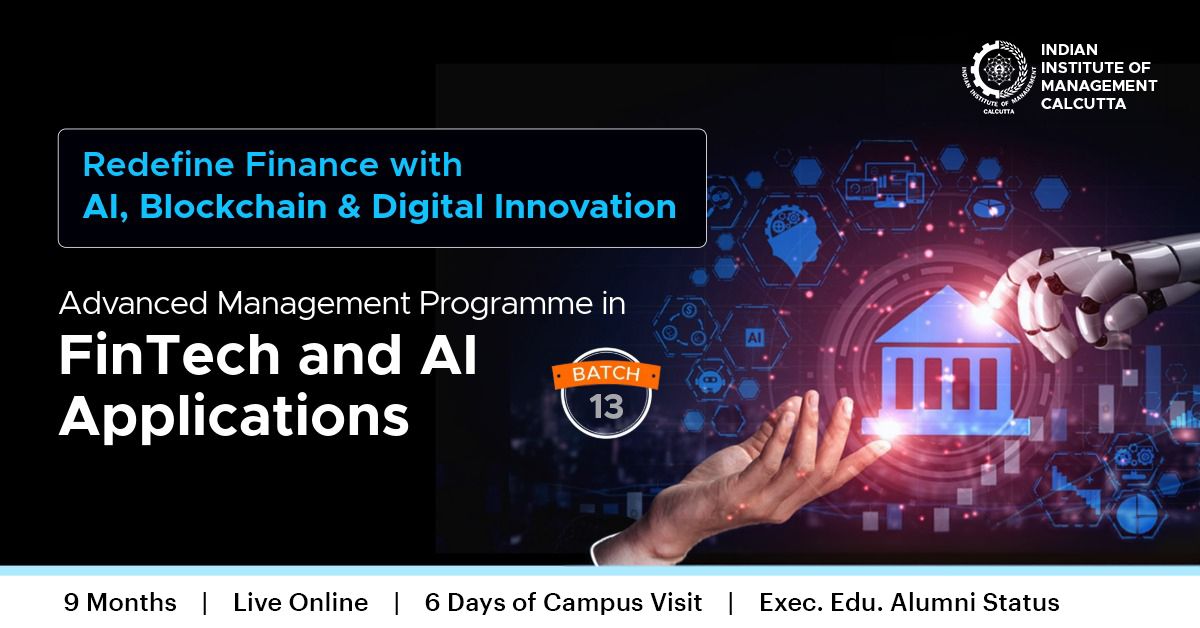
Digital payments now sit where finance, technology and strategy meet. The professionals who lead them need fluency in all three, and the Advanced Management Programme in FinTech and AI Applications by IIM Calcutta, offered with TalentSprint, is built to provide it. It is India's first and longest-running FinTech course.
Participants study how B2C, C2C and B2B payment systems have evolved, including digital wallets, UPI, digital currencies and NFC/QR-based payments. The programme also covers LendingTech, InsurTech, WealthTech and RegTech.
AI applications covered:
- Machine learning, deep learning and advanced AI for forecasting and credit scoring
- AI-driven risk management and fraud detection
- GenAI and Blockchain/DLT as the twin engines reshaping finance
Programme highlights:
- 9 months of weekend classes, all live with IIM Calcutta faculty and industry experts
- Two 3-day campus immersions at IIM Calcutta
- Hands-on learning with industry-grade tools, plus a capstone project
- IIM Calcutta executive education alumni status and a community of 1,150+ FinTech alumni
Conclusion
Digital payments have quietly rewritten the rules of everyday commerce. What began as a faster way to pay has become the infrastructure that connects consumers, businesses and economies. A quick scan now settles a grocery bill, speeds up a supplier payment and brings first-time users into the formal financial system.
The next chapter will be even more transformative. AI agents, connected real-time rails and tokenised money will make payments smarter, more global and increasingly invisible. Yet technology alone will not decide who leads. Trust, sound regulation and the right talent will.
For professionals across banking, FinTech and technology, the opportunity is clear: understand how money moves, and you shape how business grows. Courses like IIM Calcutta's Advanced Management Programme in FinTech and AI Applications help build that mix of financial, technological and strategic fluency. The future of payments will belong to leaders ready to build it.
Frequently Asked Questions
1. How are digital payments transforming business transactions?
Digital payments settle in hours or even seconds, not days. They cut the cost of handling cash and automate reconciliation. They also give finance teams a real-time view of cash flow. Beyond running more efficiently, they open up new business models, such as instant lending at checkout and cardless cross-border payments. That makes payments a strategic lever for growth.
2. What is agentic commerce, and how will it affect digital payments?
Agentic commerce means AI agents that can choose a purchase and pay for it on a user's behalf. India is preparing a framework for AI agents to make small UPI payments without approval for each one, starting with everyday purchases like groceries. A planned registry would verify and monitor these agents.
3. How can businesses protect digital payments from fraud and cyber threats?
Strong protection rests on three pillars: security that prevents and detects threats, vigilance that spots attacks early, and resilience that keeps operations running if something goes wrong. Clear regulation, data privacy and transparency then build the customer trust that digital payments depend on.
About the Author
TalentSprint
TalentSprint, Part of Accenture LearnVantage, is a global leader in building deep expertise across emerging technologies, leadership, and management areas. With over 15 years of education excellence, TalentSprint designs and delivers high-impact, outcome-driven learning solutions for individuals, institutions, and enterprises. TalentSprint partners with leading enterprises and top-tier academic institutions to co-create industry-relevant learning experiences that drive measurable learning outcomes at scale.
Explore Our Programme

Advance your career with the right program