Future-Proof Your Career: How Executive MBAs Build Skills for a Changing Economy

Businesses today operate in a rapidly changing, technology-driven global economy and the rules of career growth are being rewritten faster than most professionals can keep up.
AI is reshaping job categories, global supply chains are being redrawn, and industries once considered recession-proof banking, IT services, consulting, healthcare are restructuring around automation and AI-native business models. As companies adopt AI-led workflows and expand across borders, professionals with functional depth are increasingly competing with peers who bring broader managerial capabilities to the table.
For working professionals with three or more years of experience, this raises an uncomfortable question: If the economy keeps changing, what exactly are you building your career on?
Promotions are no longer rewards for tenure. They are bets organizations place on people who can lead through ambiguity, decide with incomplete data, and operate fluently across business, technology, and people. These capabilities are rarely built on the job they are built through structured, high-intensity learning.
This is where an Executive MBA earns its relevance not as another credential, but as a deliberate system to future-proof your career.
What "Future-Proofing" mean in 2026?
Future-proofing isn't about predicting the next disruption it's about building the capability to lead through it. For working professionals, that means staying relevant, promotable, and impactful across economic cycles, not just the current one.
Three forces are reshaping careers simultaneously:
- Technological disruption: AI is moving from tool to co-worker, changing how decisions are made and value is created.
- Structural economic shifts: Sustainability, clean tech, and cross-border complexity are redrawing industry maps.
- Organizational redesign: Flatter, hybrid, cross-functional teams are replacing traditional hierarchies.
Individual courses and certifications can patch specific gaps, but they don't build the integrated capability today's economy demands. Future-proofing requires a structured blend of strategic thinking, digital fluency, financial acumen, and leadership judgment the kind of layered capability that only a rigorous management program can systematically develop.
The 6 future-proof skills an executive MBA builds
A well-designed Executive MBA doesn't just add knowledge it rewires how you think about business. It stretches functional experts into enterprise thinkers, replaces intuition with structured judgment, and builds integrated capability across strategy, technology, and people.
Six future-proof skills stand out in a changing economy:
1. Strategic Thinking and Business Decision-Making: As industries evolve and business models shift, leaders need the ability to see beyond short-term challenges. An Executive MBA develops strategic thinking by strengthening your understanding of finance, operations, markets, and competitive strategy. This broader perspective helps you evaluate complex situations, make informed decisions, and identify growth opportunities in an increasingly unpredictable business environment.
2. Executive Communication and Leadership Influence: In today's interconnected organizations, great ideas only create impact when they are communicated effectively. An Executive MBA helps professionals refine their communication skills, enabling them to align teams, influence stakeholders, and drive consensus across functions. The ability to communicate with clarity and confidence becomes a critical leadership advantage in times of change.
3. Emotional Intelligence and Collaborative Leadership: Technical expertise alone is no longer enough for leadership success. Executive MBA programs emphasize emotional intelligence, helping professionals build self-awareness, empathy, and stronger interpersonal skills. These capabilities enable leaders to foster trust, improve team collaboration, and create high-performing work environments where people can thrive.
4. Change Leadership and Transformation Management: Organizations today face constant disruption from technology, market shifts, and evolving customer expectations. An Executive MBA prepares leaders to navigate uncertainty, manage change effectively, and guide transformation initiatives with confidence. Through real-world projects and collaborative learning, professionals gain practical skills to lead organizations through periods of transition.
5. Global Mindset and Cross-Cultural Agility: Business challenges increasingly span geographies, cultures, and markets. An Executive MBA exposes professionals to global business perspectives, diverse peer groups, and international management practices. This broader outlook helps leaders make better decisions, work effectively across cultures, and succeed in an increasingly global economy.
6. Innovation and Future-Focused Problem Solving: The ability to adapt and innovate is becoming a defining leadership skill. Executive MBA programs encourage professionals to challenge assumptions, embrace emerging technologies, and develop creative solutions to complex business problems. This innovation mindset helps leaders remain relevant and create value in rapidly changing industries.
Also Read: What Makes a New Age IIM online MBA Degree Relevant for Tomorrow’s Leaders?
How IIM Jammu EMBA Is Designed for the Changing Economy?
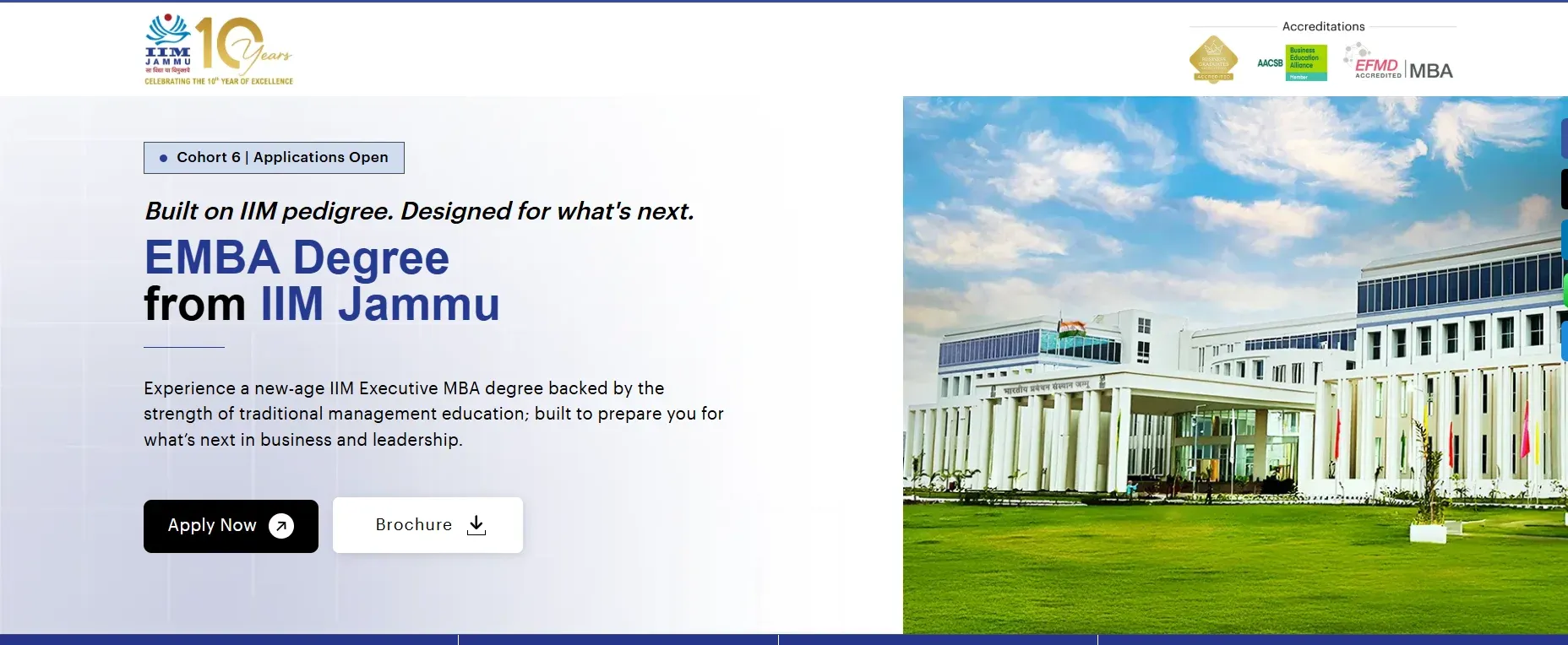
Future-proofing a career requires a program built for how businesses will run tomorrow not just how they ran yesterday. The IIM Jammu Executive MBA is engineered around exactly that principle: IIM pedigree combined with a forward-looking, innovation-led approach to management education, purpose-built for professionals navigating a dynamic business landscape.
Here's what makes the program a serious lever for career resilience:
IIM-Grade Rigour, Without Pressing Pause: A 2-year blended program delivered through live online classes and campus immersions at IIM Jammu designed so working professionals can grow without stepping away from their careers.
A Curriculum That Reflects the Economy You'll Lead In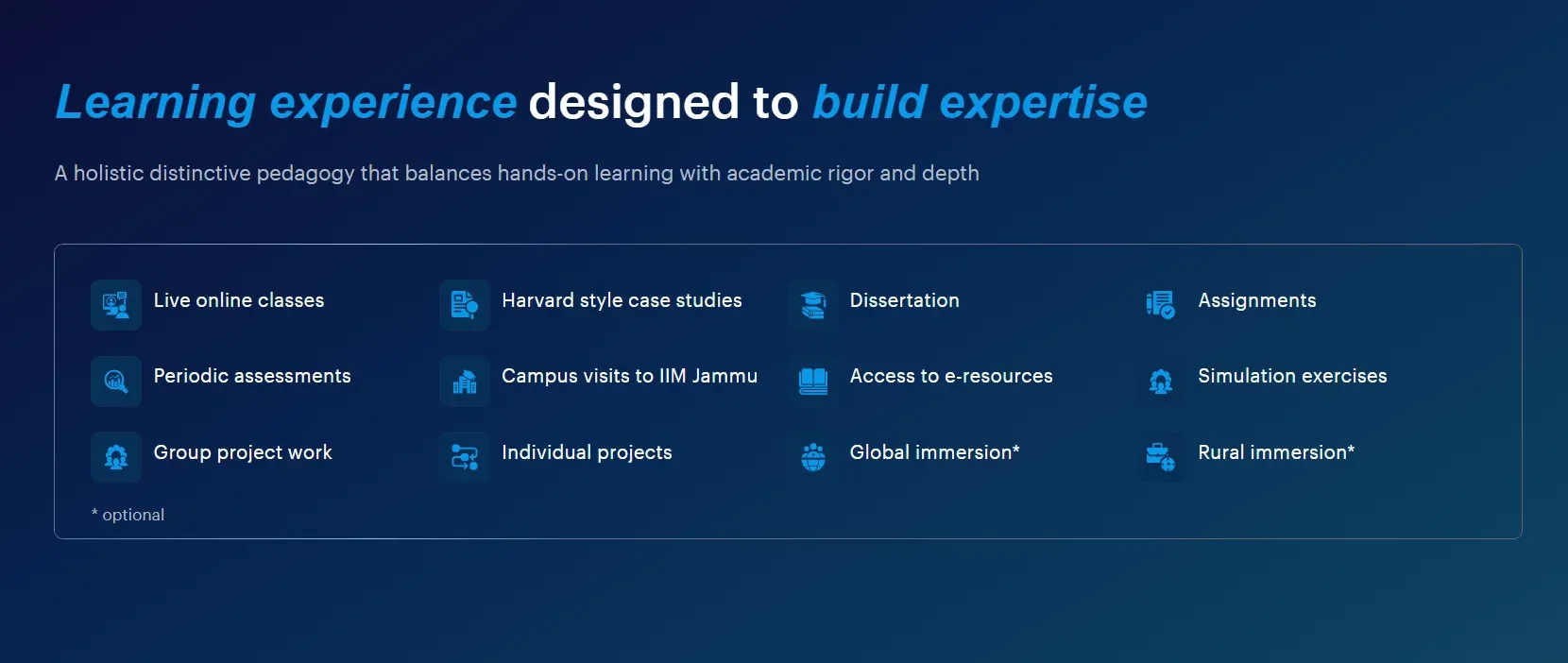
- Year 1 – Foundations of Management: Economics for Managers, Organizational Behaviour, Quantitative Techniques, Management Accounting, Business Modelling, Marketing Management, Business Research Methods, Operations Management, Corporate Finance, HRM, Strategic Management, Entrepreneurship & New Venture Planning, and Ethics, Governance & Legal Aspects of Business.
- Year 2 – New-Age Specializations: Choose from General Management, Economics, Finance, IT Systems & Analytics, OB & HRM, Operations, Marketing, or Strategy allowing professionals to double down on the domain that best aligns with their career direction.
Pedagogy Built for Application, Not Just Absorption: Learning is layered across Harvard-style case studies, live online classes, simulation exercises, group and individual projects, a dissertation, periodic assessments, and campus visits to IIM Jammu, with optional global and rural immersions for real-world perspective.
Learning Goals Mapped to a VUCA Economy: The program's official learning goals are explicitly tuned to today's business realities enhancing global business acumen, developing critical and creative thinking, building entrepreneurial and managerial skills, and shaping ethical, socially oriented leaders who can formulate strategic responses to VUCA environments.
Eligibility Designed for Career-Stage Fit: Open to professionals with a bachelor's degree and a minimum of 3+ years of work experience spanning industry, corporates, government, armed forces, NGOs, and entrepreneurs ensuring a cross-industry cohort that mirrors the real business world.
In a decade defined by disruption, this is what a future-proof management education looks like rigorous, applied, industry-relevant, and built around the working professional.
What an EMBA equips you with?
An Executive MBA translates classroom rigour into on-the-job capability. Six outcomes stand out:
- Ready to transition into managerial and leadership roles: Build the strategic mindset and business fluency that senior positions demand.
- Own and manage P&L responsibilities with confidence: Understand how revenue, cost, and capital decisions shape business outcomes.
- Apply strategic and cross-functional decision-making: Connect the dots across finance, operations, marketing, and people to make better calls.
- Decode and solve complex business challenges: Break down ambiguous, high-stakes problems into structured, actionable solutions.
- Lead, influence, and align diverse teams: Drive results across hybrid, cross-cultural, and cross-functional teams through influence, not authority.
- Drive and implement innovation within your organization: Spot opportunities, challenge the status quo, and turn ideas into measurable business impact.
Together, these outcomes mark the shift from being a strong performer to becoming a credible business leader.
Conclusion
The economy will keep changing. Industries will keep reshaping. AI, globalization, and new business models will continue to rewrite the definition of what a "safe" career looks like. The professionals who thrive won't be the ones who predict the next disruption they'll be the ones who've built the capability, credibility, and confidence to lead through it.
That's the real promise of an Executive MBA. Not a certificate, not a title upgrade, but a structured shift in how you think, decide, and lead an investment in career optionality that compounds across every future pivot, promotion, and possibility.
The IIM Jammu Executive MBA is built for exactly this journey combining IIM-grade rigour, new-age specializations, and applied learning to prepare working professionals for the businesses of tomorrow. If you're serious about future-proofing your career, the best time to start is before the economy forces the decision.
Explore the IIM Jammu Executive MBA and take the next deliberate step toward the career you want to lead.
Frequently Asked Questions
1. Is an Executive MBA worth the investment for my career?
Yes. An EMBA builds strategic thinking, leadership judgment, and cross-functional capability delivering compounding career optionality that far outweighs the two-year investment in time and cost.
2. Can an MBA help me switch careers successfully?
Absolutely. An EMBA builds cross-functional credibility, exposes you to diverse industries, and equips you with the strategic lens needed to pivot into general management, strategy, finance, or entrepreneurship.
3. Will networking during MBA actually help my career?
Yes. A cross-industry cohort and lifetime IIM alumni network open doors to mentors, collaborators, and opportunities that continue to accelerate your career long after graduation.
4. Is an MBA still relevant for career changes in today's economy?
More than ever. As AI and disruption reshape industries, an EMBA builds the adaptive leadership, digital fluency, and strategic judgment needed to stay relevant and future-proof.
About the Author
TalentSprint
TalentSprint, Part of Accenture LearnVantage, is a global leader in building deep expertise across emerging technologies, leadership, and management areas. With over 15 years of education excellence, TalentSprint designs and delivers high-impact, outcome-driven learning solutions for individuals, institutions, and enterprises. TalentSprint partners with leading enterprises and top-tier academic institutions to co-create industry-relevant learning experiences that drive measurable learning outcomes at scale.
Advance your career with the right program