How an Executive MBA Prepares You for Leadership Roles?

TL;DR:An Executive MBA prepares you for leadership by strengthening strategic thinking, decision-making, and people management skills. It combines real-world case learning with peer insights, enabling professionals to apply concepts immediately, build cross-functional expertise, and confidently lead teams, drive business outcomes, and navigate complex organizational challenges.
Organisations today expect their leaders to do more than manage teams. They expect strategic thinking, financial ownership, cross-functional decision-making, and the ability to navigate uncertainty capabilities that are rarely built through day-to-day work. This is precisely why high-performing professionals often find themselves stuck between being great at their jobs and being ready for leadership.
An Executive MBA bridges this gap. It's not just a degree it's a structured transformation that equips professionals with the mindset, frameworks, and skills that leadership demands.
Here's how it does that and why it matters for your career.
The Leadership Gap Most Professionals Don't See Coming
Early in your career, growth follows a clear formula, building expertise, deliver results, get rewarded. But somewhere in the mid-career stretch, the rules quietly change. Leadership roles don't ask for more of what you've already been doing. They ask for something entirely different the ability to think across functions, own P&L outcomes, make decisions with incomplete information, and lead people with diverse priorities.
Most professionals plateau here. Not because they lack ambition or capability, but because they lack structured exposure to these competencies. Add a VUCA, AI-driven business environment to the mix, and the leadership bar keeps rising. This is precisely where a structured Executive MBA stops being an academic choice and becomes a career multiplier.
Also Read: Leading in a VUCA World
What Makes an Executive MBA Different from a Traditional MBA?
A traditional MBA is built for those stepping into the business world. An Executive MBA is built for those already shaping it. The difference is not just in who attends, but in how the learning is designed, delivered, and applied.
The Executive MBA reflects this distinction in every element of its structure:
- Designed for working professionals. No career pause, no relocation, no compromise on momentum. Professionals continue leading at work while sharpening how they lead.
- A blended format that fits real lives. Live online classes provide flexibility through the week, while on-campus immersion at IIM Jammu offers the depth, networking, and rigour of a residential experience.
- Peer learning with cross-industry cohorts. Classrooms filled with mid-to-senior professionals from diverse sectors turn every discussion into a case study and every peer into a long-term network.
- A two-year journey of applied learning. The programme balances academic rigour with real-world application, ensuring that what is learned on Monday can influence decisions by Friday.
The result is an MBA that does not interrupt a career. It elevates it.
Also Read: Executive MBA vs MBA: What’s the difference?
How an EMBA Builds Leadership Capabilities?
Leadership is not a title you earn. It is a capability you build, deliberately, across years of learning, application, and reflection. An EMBA programme is structured to develop this capability across five interconnected dimensions, each one shaping a different layer of how senior professionals think, decide, and lead.
1. Strategic Business Acumen
The Year 1 foundation, covering Economics for Managers, Management Accounting, Quantitative Techniques, Business Modelling, Marketing, and Operations Management, builds the lens to see business holistically. Leaders stop thinking in functional silos and start connecting decisions across the value chain, the shift that separates a manager from a business leader.
2. Decision-Making and Problem Solving
Harvard-style case studies, simulations, and periodic assessments train professionals to make structured decisions when data is incomplete and stakes are high. The programme sharpens strategic thinking in VUCA conditions, moving leaders from reactive problem-solving to deliberate, evidence-informed decisions under pressure.
3. People and Organisational Leadership
Modules like Organisational Behaviour, Human Resource Management, and Maximizing Happiness build the human side of leadership that processes alone cannot teach. Leading people, navigating motivation, conflict, and culture, is the real test of senior roles, and the programme prepares professionals to lead teams that truly perform.
4. Ethical and Globally Aware Leadership
Modules on Ethics, Governance and Legal Aspects of Business, supported by optional Global and Rural Immersions, build socially conscious, globally informed leaders. This reflects the programme's goal of creating leaders who generate value for both organisations and society, where ethical clarity and global perspective are now non-negotiable.
5. Specialisation for Future-Ready Leadership
Year 2 specialisations span General Management, Economics, Finance, IT Systems and Analytics, OB and HRM, Operations, Marketing, and Strategy. Choosing the right track sharpens a leader's identity and career trajectory, deepening expertise in the area that will define their next decade, where general leadership becomes distinctive leadership.
Also Read: Reasons to Apply for an EMBA in 2026
What leadership readiness looks like after an EMBA?
Leadership readiness is not abstract. It shows up as tangible signals that recruiters and organisations actively look for future leaders:
- Ready for managerial and leadership roles. Equipped to step into senior positions with the strategic lens and confidence the role demands.
- Capable of owning P&L responsibilities. Prepared to drive business outcomes, not just functional ones, with end-to-end ownership.
- A prestigious IIM Jammu EMBA degree. A learning edge that translates classroom rigour into real, measurable workplace impact.
Is the IIM Jammu EMBA right for you?
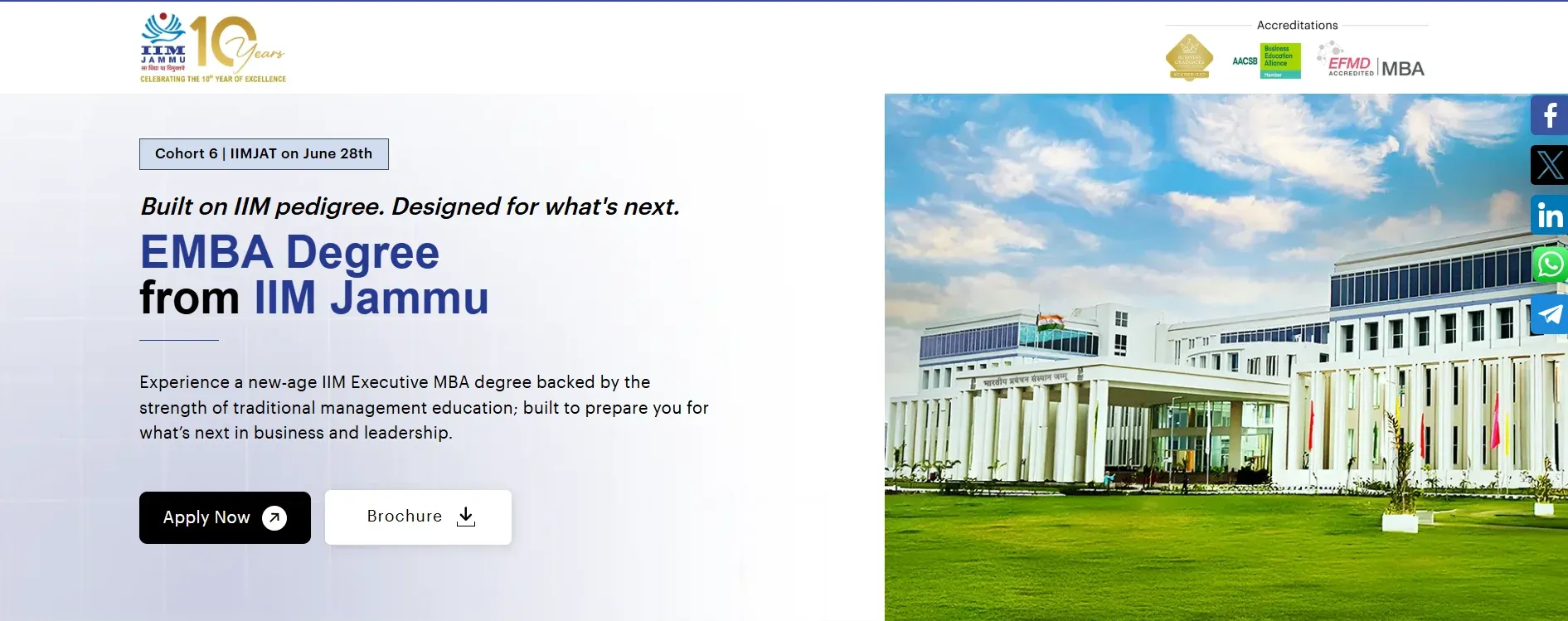 The IIM Jammu Executive MBA is designed for professionals with 3+ years of work experience who are ready to step into their next chapter, mid-career professionals, aspiring leaders, entrepreneurs, and those preparing for cross-functional or P&L roles.
Before you decide, ask yourself:
- Am I hitting a ceiling that more experience alone will not break?
- Do I want to move from functional expertise to enterprise leadership?
- Am I ready to invest two years in building the lens, network, and credentials that define senior careers?
If the answer is yes, this programme is built for you.
The IIM Jammu EMBA Where Leadership Meets Structured Learning
Everything discussed so far, the shift from execution to strategy, sharper decision-making, the human side of leadership, ethical clarity, and future-ready specialisation, points to one truth. Leadership capability is built deliberately, not accidentally. The IIM Jammu Executive MBA is designed around exactly this principle.
Here is what makes it a natural fit for professionals ready to step up:
- A two-year blended programme designed for working professionals, balancing live online learning with on-campus immersions at IIM Jammu.
- A curriculum that spans core management and new-age specialisations, equipping leaders for both today's business realities and tomorrow's disruptions.
- Applied learning at its core, through Harvard-style case studies, simulation exercises, a structured dissertation, and immersive campus experiences that turn concepts into judgement.
- Outcomes aligned with senior roles, leadership readiness, the confidence to own P&L responsibilities, and the ability to make strategic decisions in ambiguous environments.
It is less about adding a credential and more about building the capability that the credential represents.
For professionals who are ready to move from execution to leadership, this is a structured pathway to get there.
Frequently Asked Questions
1. What Leadership Skills Does an EMBA Actually Teach You?
An EMBA builds strategic thinking, data-driven decision-making, cross-functional collaboration, and people leadership. It sharpens your ability to navigate ambiguity, lead changes, and influence stakeholders, skills that move you from managing tasks to leading organisations with clarity and conviction.
2. What leadership skills from an Executive MBA actually transfer to your job?
Almost everything. From boardroom communication and financial acumen to leading diverse teams and driving transformation, EMBA learning is designed for immediate workplace application. You return to work not with theory, but with frameworks you can apply from day one.
3. Can an MBA help you move from individual contributor to leader?
Yes. An EMBA bridges the gap between functional expertise and strategic leadership. It reshapes how you think, communicate, and make decisions, equipping you to lead people, own outcomes, and step confidently into roles that demand vision over execution.
4. How to know if you're ready for an Executive MBA program?
If you have 3+ years of experience, feel ready for bigger challenges, and want to lead rather than just deliver, you are ready. Readiness is less about your resume and more about your appetite for growth and leadership.
5. Is an Executive MBA worth the investment for your career?
Yes, when chosen wisely. An EMBA delivers long-term returns through accelerated career growth, expanded networks, and leadership credibility. The real value lies not just in the degree, but in the transformation it drives in how you lead.
About the Author
TalentSprint
TalentSprint, Part of Accenture LearnVantage, is a global leader in building deep expertise across emerging technologies, leadership, and management areas. With over 15 years of education excellence, TalentSprint designs and delivers high-impact, outcome-driven learning solutions for individuals, institutions, and enterprises. TalentSprint partners with leading enterprises and top-tier academic institutions to co-create industry-relevant learning experiences that drive measurable learning outcomes at scale.
Explore Our Programme
Advance your career with the right program