Full stack projects for freshers that can actually get them hired?

Let’s be honest, most developer portfolios look the same. Starting from To-do apps. Weather apps or Calculator projects.
You might’ve spent weeks polishing them, but when recruiters scroll through dozens of portfolios, these projects blur together and get skipped.
Being a full stack developer means you can build real applications from scratch. That’s powerful. But the projects you choose matter. Employers want to see work that handles real logic, real data, and real problems, not tutorial clones.
Certificates may get attention, but projects get you hired. As one hiring manager put it, “I’d rather see a few strong projects than a pile of certificates.”
For freshers and career switchers, your projects are your experience, and that’s what makes recruiters stop and look.
Also Read: The Roadmap to make a successful career in java as a Fresher
Full Stack Projects That Can Actually Get You Hired
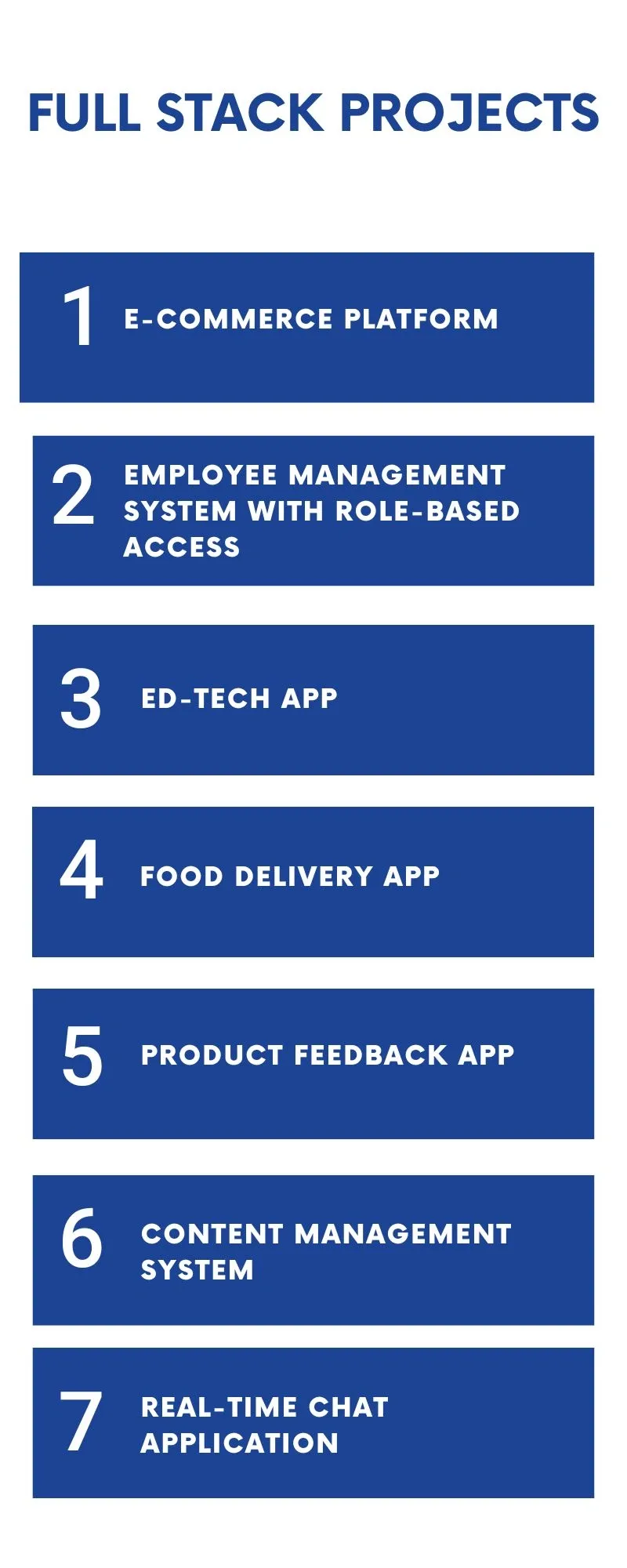
For a full stack developer, projects are proof that you can think, design, build, and scale an application end to end. A good project shows how you connect the frontend, backend, database, APIs, and security, just like you would in a real company.
1. E-Commerce Platform
An e-commerce application is an online platform that allows users to browse products, add them to a cart, make payments, and place orders. Examples include Amazon, Flipkart, and Myntra.
As a full stack project, it simulates how real businesses sell products digitally.
There are so many reasons why building this project can be beneficial for you:
- It acts as a problem solver: Businesses need a digital storefront to sell products, manage customers, process payments, and track orders securely.
- It works in a flow: Users browse products, add them to a cart, and check out. The system validates stock, processes payments, confirms orders, and updates inventory. Admins manage products and orders through a separate interface.
- Showcase your understanding power: You understand transaction management, security, scalability, and real business workflows.
Hence this is what you are going to build as a Full stack Developer:
- Frontend: Product pages, cart page, checkout UI
- Backend: APIs for products, orders, payments
- Database: Products, users, orders, and transactions
- Security: Authentication, secure payment handling
2. Employee Management System
it’s an internal application used by companies to store employee data, manage roles, track attendance, and approve leaves. This is common in HR and enterprise software.
How does it benefit you?
- The problem it solves: Companies need a secure system to manage employees, roles, attendance, and approvals.
- The working and what it will be covering: Users log in based on roles. Employees view profiles and apply for leave. Managers approve requests. HR manages records and reporting.
- Showcases your abilities: You can build enterprise-grade systems with security, access control, and data integrity.
3. Ed-Tech App
An ed-tech platform allows users to learn online through videos, quizzes, and tracked progress. Examples include Coursera, Udemy, and Byju’s.
How does it benefit you?
- The problem it solves: Online learners need structured content, progress tracking, and assessments.
- The process: Instructors upload courses. Students enroll, watch videos, take quizzes, and track progress. Admins manage content and users.
- Showcase your abilities: It shows, you can handle media-heavy applications, authentication systems, and complex user journeys.
How you will be applying your Technical skills:
- Frontend: React.js or Vue.js for interactive learning
- Backend: Node.js with Express for course management
- Database: PostgreSQL or MongoDB for user data
- Storage: Amazon S3 for videos, JWT for secure sessions
This project as a whole demonstrates video streaming integration, authentication systems, and building applications with real social impact.
4. Food Delivery App
It’s a platform that connects customers, restaurants, and delivery partners. Examples include Swiggy and Zomato.
How does it benefit you?
- The problem it solves: It connects customers, restaurants, and delivery partners in a single ecosystem.
- The process and working: Customers order food. Restaurants accept and prepare it. Delivery partners pick it up. Users track delivery in real time.
- Your abilities: You understand real-time systems, API orchestration, and multi-role application design.
Technical skills you will be using:
- Frontend: React Native or Flutter for mobile compatibility
- Backend: Node.js with Express for order processing
- Database: MongoDB or Firebase for user and restaurant data
- APIs: Google Maps for tracking, Stripe for payments
The impressive part? Managing different user types, customers, restaurants, delivery personnel, all within one system. This demonstrates cross-platform development and third-party service integration.
5. Product Feedback App
It’s a tool used by companies to collect user feedback, prioritize feature requests, and track progress. Common in SaaS products.
How does it benefit you?
- The problem it solves: Product teams need structured feedback to prioritize features based on user demand.
- The process and working: Users submit feedback. Others upvote ideas. Admins change feature statuses and communicate updates
- Your abilities: it shows that you have product thinking, not just coding skills.
Use React for the frontend, Node.js/Express for the backend, and MongoDB for the database. The value lies in creating intuitive interfaces for both users and administrators, plus implementing a voting system with dashboard analytics.
6. Content Management System
A CMS allows non-technical users to create, edit, and publish digital content like blogs and pages. Examples include WordPress and Medium.
How does it benefit you?
- The problem it solves: Non-technical users need an easy way to publish and manage digital content.
- The process and working: Editors create content. Admins review and publish it. Media is stored and reused across pages.
- Your abilities: You understand content workflows, UI design, and scalable backend systems.
Technical implementation of your skills:
- Frontend: React or Angular for responsive dashboards
- Backend: Node.js with Express or Django for content operations
- Database: MySQL or PostgreSQL for content storage, Redis for caching
- Additional: AWS S3 for media storage, rich text editing integration
This showcases rich text editing integration, UI component development, content storage strategies, and media management.
7. Real-time Chat Application
A real-time chat application is a system that allows users to send and receive messages instantly, without refreshing the page. Unlike email or comment systems, messages are delivered the moment they’re sent.
You use real-time chat every day, in apps like WhatsApp, Slack, Microsoft Teams, Discord, or Instagram DMs. Building a simplified version of this as a project proves you can work with live data and real-time systems, which are common in modern applications.
How does it benefit you?
- The problem it solves: Instant communication between users.
- The process and working: Messages are sent and received instantly using WebSockets, while data is stored for later retrieval.
- It proves your abilities: You can build high-performance, real-time applications.
Technical stack you will be making use of:
- WebSockets (Socket.IO) for real-time communication
- React or Vue.js for the frontend
- Node.js/Express for the backend
- MongoDB or PostgreSQL for message storage
Take it further with end-to-end encryption and voice/video calling capabilities. You'll demonstrate understanding of real-time protocols, state management, and handling concurrent connections, highly sought-after skills in today's market.
Also read: Essential Tools for Freshers in the java field
How to Make Your Projects Stand Out which can get you hired?
Building impressive projects is just the start. How you present them makes the difference between "nice work" and "when can you start?"
These strategies turn basic portfolio pieces into compelling showcases of your abilities.
1. Deploy Everything: A project that lives only on GitHub feels unfinished. A deployed project feels real. When someone opens your project link and can actually click around, create an account, or test a feature, it immediately builds confidence. It tells the reviewer: this person knows how to take something from idea to delivery.
Example:
A finance tracker hosted on Vercel with a live dashboard says far more than a local-only app, even if both have similar code.
2. Write Proper Documentation: Documentation is how your project communicates when you’re not in the room. Good documentation shows empathy: you’re thinking about the next person who reads your work. This could be a recruiter, a teammate, or even your future self-revisiting the project months later.
Example:
A README that explains how users register, how data flows through the backend, and what challenges you faced instantly makes your project feel intentional, not rushed.
3. Add These Technical Features: Real products handle real complexity, and your project should reflect that. Basic CRUD apps are a starting point. What stands out is when you show awareness of how software behaves in real environments, with real users making real mistakes.
Example:
An e-commerce app where admins manage products, users track orders, and errors are handled gracefully feels far closer to a real job scenario than a simple product list.
4. Show Your Process: How you think matters as much as what you build. Remember, No project is perfect, and that’s okay. What recruiters want to see is how you approach problems, learn from mistakes, and improve your solutions over time.
Example:
Explaining why you changed your database structure or optimized a slow API tells a story of growth and problem-solving, not just coding.
5. Make It Production-Ready: Production-ready projects feel reliable, thoughtful, and user-friendly.This is where many projects fall short. Small things, like handling errors properly or securing sensitive data, make a huge difference in perception.
Example:
A booking application that prevents double bookings and communicates clearly when something goes wrong feels trustworthy, just like real software should.
Also Read: Java Interview Questions Decoded: What Every Fresher Must Know
What you will learn while building strong full stack projects?
Strong full stack projects teach you how real applications are built, not just how code works in isolation.
You learn
- Core Java fundamentals,
- Backend logic,
- API design,
- Database handling, and
- How the front end connects seamlessly with everything behind the scenes.
Along the way, you can also pick up production-ready habits like debugging, version control, testing, and writing maintainable code. Structured learning paths, such as AI-integrated Full Stack Development course, can help in gaining a better understanding of how industry teams actually build and scale applications, providing freshers the right pathway to bridge the gap between coursework and real-world development.
Final Thoughts
Projects that get you hired don’t look flashy, they look thoughtful. When your work shows clear architecture, problem-solving, and end-to-end understanding, it speaks louder than any certificate ever could.
Also Read: The Essential Java Full Stack Developer Skills That Employers Want
Frequently Asked Questions
Q1. What types of full stack projects are most impressive to employers?
Projects that demonstrate complex business logic, data management, and challenging features are most impressive. Examples include e-commerce platforms, employee management systems, and real-time chat applications.
Q2. How can I make my full stack project stand out in my portfolio?
To make your project stand out, deploy it online, write clear documentation, implement robust security features, integrate real APIs, optimise for performance, and showcase your development process on GitHub.
Q3. Why are projects more important than certificates for job applications?
Projects demonstrate practical skills, problem-solving abilities, and real-world application of knowledge. They provide tangible evidence of your capabilities, which is more valuable to employers than theoretical knowledge alone.
Q4. What technologies should I use for a full stack project?
Popular technology stacks include React or Angular for the frontend, Node.js with Express for the backend, and databases like MongoDB or PostgreSQL. Additional technologies might include JWT for authentication and Docker for containerisation.
Q5. How detailed should my project documentation be?
Your documentation should include a concise project description, clear setup instructions, a list of technologies used, screenshots or GIFs demonstrating functionality, and API documentation for backend endpoints. Comprehensive documentation demonstrates your communication skills and attention to detail.
About the Author
TalentSprint
TalentSprint, Part of Accenture LearnVantage, is a global leader in building deep expertise across emerging technologies, leadership, and management areas. With over 15 years of education excellence, TalentSprint designs and delivers high-impact, outcome-driven learning solutions for individuals, institutions, and enterprises. TalentSprint partners with leading enterprises and top-tier academic institutions to co-create industry-relevant learning experiences that drive measurable learning outcomes at scale.
Advance your career with the right program