How AI is changing business careers?

TL;DR:AI is transforming business careers by shifting the focus from routine task execution to data-driven decision-making, technology adoption, and strategic thinking. As employers increasingly seek professionals who can work alongside AI, business education must combine management fundamentals with practical AI exposure, real-world projects, and industry-integrated learning to prepare students for future-ready careers.
A business career today looks very different from what it did even a few years ago. Tasks that once required hours of manual work such as analyzing customer trends, preparing reports, or forecasting sales are increasingly being supported by artificial intelligence (AI). But this shift is not only about automation. It is changing the kind of skills employers value.
According to a recent report by the World Economic Forum, organizations are not just adding AI tools to workplaces, they are redesigning how work gets done.
This means future business professionals may need more than theoretical management knowledge. They may also need to understand how to work with technology, interpret insights, and make smarter decisions in an AI driven workplace.
As business careers evolve, one question becomes increasingly important:, "How is AI changing the future of business jobs?"
Also Read: What is AI in Business?
From ‘doing the work’ to ‘understanding the work’
One of the biggest changes AI has brought is, “Work is no longer just about doing tasks
It is about understanding and directing systems”.
For example:
Instead of manually analysing data, professionals now interpret AI-generated insights
Instead of building campaigns from scratch, marketers refine AI-driven outputs
Instead of forecasting manually, finance professionals evaluate predictive models
The role has not disappeared, but the nature of contribution has evolved
Also Read: AI in the Workplace: From Task Execution to True Innovation
Business roles are becoming more tech-enabled
This shift is visible across industries:
Marketing: AI-based personalization and audience targeting
Finance: Predictive analytics and automated reporting
HR: AI-driven hiring and workforce analysis
Operations: Data-led decision-making and automation
Which means, Every business role today involves some level of technology interaction
What employers expect in this new reality?
This change in work has led to a clear shift in expectations.
Employers today are looking for candidates who:
can understand data, not just concepts
can work with tools, not just frameworks
can make decisions using insights, not assumptions
hence, It’s not just about what you know anymore and It’s about how you use that knowledge in real situations.
The gap students often discover late
Here’s where many students struggle.
They study:
business theories
marketing strategies
financial models
But when they enter interviews or internships, they are asked, “Have you worked on real business problems?” and “Do you know how AI is used in decision-making?”
And that’s when the gap becomes clear, which is the gap between learning and applying
Why business education needs to evolve?
If business roles have changed, learning can’t stay the same.
Today’s environment requires, Techno-Managerial Learning
This means students must:
understand business fundamentals
learn how those fundamentals work with AI and data
apply knowledge in real-world scenarios
Because business today is not separate from technology, it runs on it.
What preparing for AI-driven careers actually looks like?
So what does the right preparation look like?
It’s not just about adding AI as a subject.
It’s about:
learning concepts
applying them through projects
understanding tools used in real jobs
building confidence through exposure
This is where industry-integrated programs stand out
A new-age business degree built for an AI-driven world
One way this shift is being implemented is through programs designed with both academics and industry together.
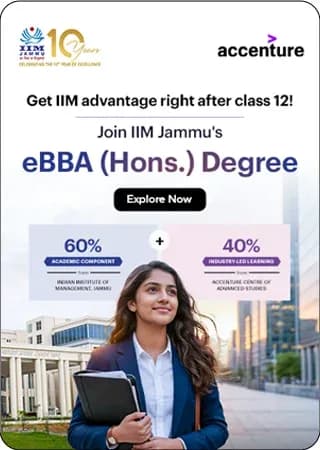
The online BBA by IIM Jammu, developed with the Accenture Centre of Advanced Studies, is designed to reflect exactly how business careers are evolving.
A smarter way to learn: balancing theory and practice
At the core of this approach is a structured model:
60% academic learning by IIM Jammu faculty through Live online classes
with distinguished faculty, Research based pedagogy, Future-focused
curriculum, Case study-based learning40% industry-led learning which includes Hands-on labs and simulations, Real world projects, Career readiness training through Accenture center of advanced studies.
This ensures students don’t just study business, they see how it works in real environments influenced by AI and data.
Where business meets AI and Data?
Since AI is central to modern careers, students are exposed to:
Cloud & AI
Data & AI
Digital infrastructure
AI-driven business applications
This helps them understand:
how decisions are made in real companies
how AI influences strategy and growth
how businesses operate digitally
Learning by doing, not just studying
Instead of waiting until after graduation:
students work on real-world projects
solve practical business problems
engage with industry experts
This builds confidence early
Preparation for real roles, not just exams
Career readiness is built throughout the journey:
professional skills training
resume and interview preparation
exposure to workplace expectations
So students don’t feel unprepared at the final stage
From learning to career opportunities
What strengthens this approach further is access to opportunity.
Students gain:
exposure to real business ecosystems
interaction with professionals
access to opportunities with 700+ global recruiters
This connects learning directly to careers, not just degrees.
What this means for students and parents?
For students: It means understanding how jobs actually work
It means being confident before entering the workforce
For parents: It means choosing education aligned with future careers
It means reducing uncertainty after graduation
Conclusion
AI is not eliminating business careers, It is redefining them. And that brings us back to the question, “How is AI changing business careers?”
It is changing, how work is done, what skills are required and how decisions are made, But more importantly, it is changing, “how students need to prepare for those careers”
Because in the end, “A degree helps you understand business, But the right learning experience helps you work in it”, and in an AI-driven world, that difference is what truly shapes your future.
Frequently Asked Questions
Q1. Will AI replace business jobs in the future?
AI is more likely to transform business roles than replace them entirely. Routine and repetitive tasks are increasingly automated, allowing professionals to focus on strategic thinking, problem solving, relationship building, and decision making. The most valuable employees will be those who can effectively work alongside AI tools.
Q2. What skills do business professionals need in an AI driven workplace?
Business professionals need a combination of AI literacy, data interpretation, critical thinking, communication, and leadership skills. Understanding how AI tools work and how to apply their insights can help professionals make better decisions and remain competitive in rapidly evolving industries.
Q3. Which business careers are being most influenced by AI?
AI is impacting careers across marketing, finance, human resources, operations, sales, and customer experience. Professionals in these fields are using AI to analyze data, improve efficiency, personalize customer interactions, forecast trends, and support faster, more informed business decisions.
About the Author
TalentSprint
TalentSprint, Part of Accenture LearnVantage, is a global leader in building deep expertise across emerging technologies, leadership, and management areas. With over 15 years of education excellence, TalentSprint designs and delivers high-impact, outcome-driven learning solutions for individuals, institutions, and enterprises. TalentSprint partners with leading enterprises and top-tier academic institutions to co-create industry-relevant learning experiences that drive measurable learning outcomes at scale.
Explore our Programme
Advance your career with the right program