
How can middle managers communicate with senior leadership with impact?

Middle managers operate at the critical intersection of strategy and execution. They turn leadership vision into everyday action, manage constant trade-offs, and keep teams delivering under pressure. Yet their influence often hinges not on the volume of their effort, but on how effectively that effort travels upward. Communicating with senior leadership is rarely straightforward competing priorities, limited time, and high stakes leave little room for misalignment.
Navigating these challenges can be tricky, but middle managers who stand out learn to communicate with intent: surfacing problems early, framing updates around leadership goals, and pushing back thoughtfully when it matters. When done well, upward communication becomes more than reporting it becomes a lever for influence, trust, and career growth.
This blog explores how middle managers can communicate with senior leadership with clarity, confidence, and impact.
What is middle management, why is it important?
Middle managers are the connective tissue that holds organisations together. They sit between strategy and execution, ensuring that big ideas don’t remain abstract but are translated into clear, achievable goals for teams. Their role goes far beyond managing tasks they shape alignment, momentum, and culture on the ground.
Translating strategy into action: Middle managers turn leadership strategy into clear, practical team objectives. This involves simplifying complex priorities, sequencing work effectively, and helping teams understand not just what to do, but why it matters.
Coaching and developing talent: Middle managers act as coaches by providing regular feedback, guidance, and support. They help employees grow while maintaining strong performance, which is especially important for younger professionals who value learning and career progression as much as results.
Allocating resources and setting priorities: They decide how time, talent, and attention are used across the team. By setting clear priorities, middle managers ensure teams aren’t overwhelmed, distracted, or working on the wrong things.
Bridging between levels: Middle managers serve as the bridge between senior leaders and frontline employees, bringing clarity and insight upward and downward context. Strong communication in this role builds credibility, influence, and long-term impact.
5 Challenges Middle Managers Commonly Face
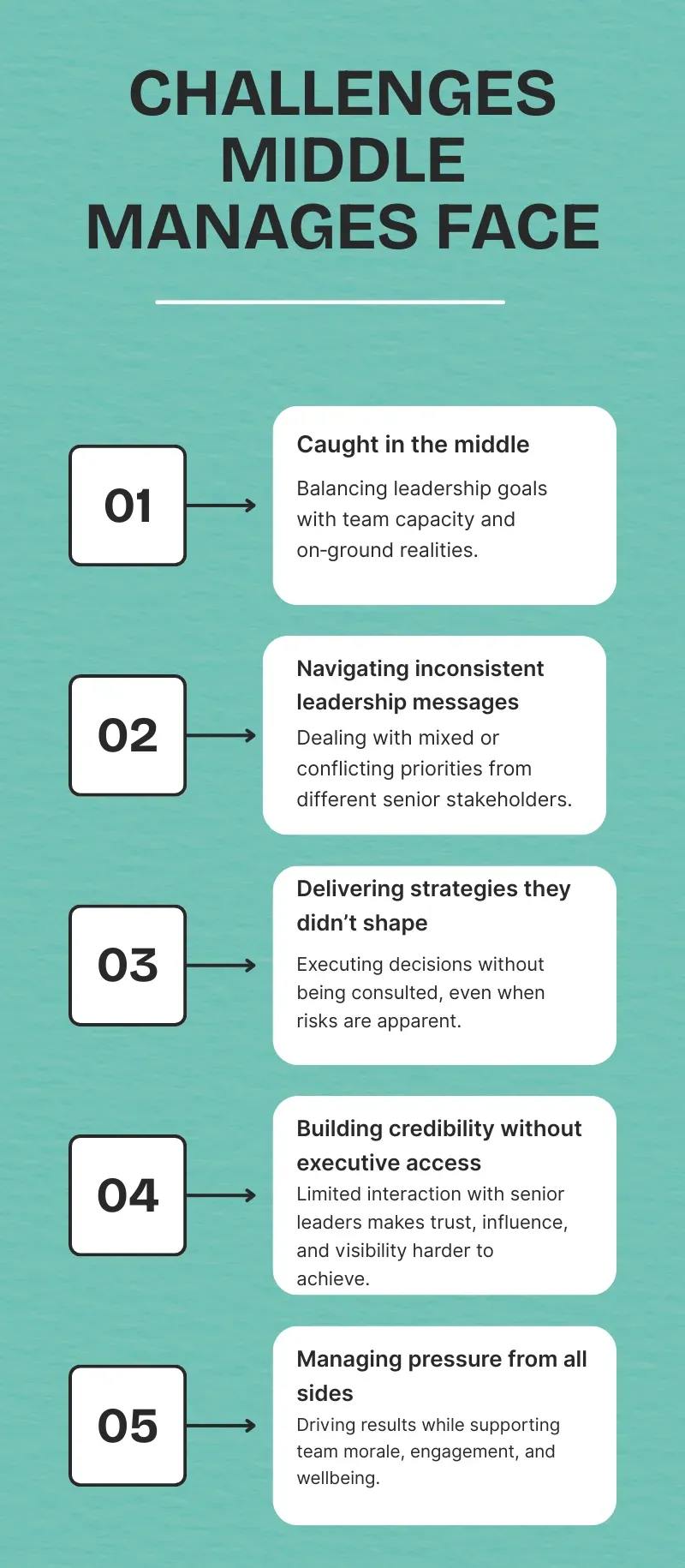
Middle managers operate in one of the most complex positions in an organisation. They are expected to deliver results while navigating competing expectations from above and below. Some of the most common challenges include:
1. Being caught in the middle
Middle managers often balance senior leadership’s growth targets with their team’s capacity and realities on the ground. When expectations are misaligned, they are left to absorb the tension and find compromises that satisfy both sides.
2. Managing conflicting directives
Messages from leadership are not always consistent. Different senior stakeholders may communicate varying priorities, leaving middle managers to reconcile contradictions and decide which direction to follow often without clarity or authority.
3. Limited visibility and trust with executives
Many middle managers have minimal direct interaction with senior leaders. This lack of exposure can make it difficult to build trust, gain influence, or ensure their perspectives are considered in decision-making.
4.Pressure to execute without input
Middle managers are frequently responsible for implementing strategies they had little role in shaping. Even when they see risks or flaws, they are expected to move forward and deliver results.
5. Emotional and mental strain
Alongside performance goals, middle managers must keep teams motivated, engaged, and supported. Balancing empathy with execution creates ongoing stress, especially when organisational demands conflict with employee needs.
These challenges make effective communication not just helpful, but essential for middle managers to succeed.
What Senior Leaders Actually Expect from Middle Managers?
Senior leaders expect middle managers to be more than operational executors they rely on them to create alignment, drive outcomes, and surface insight. The effectiveness of a middle manager is often measured by how reliably they translate strategy into action while keeping leadership informed.
- Clarity Over Detail: Senior leaders are focused on decisions and outcomes, not operational play-by-play. Middle managers create impact when they distil complexity into what has changed, why it matters, and what action is required.
- Strong execution of strategy: Senior leaders expect middle managers to translate strategy into clear priorities and ensure consistent, high‑quality execution across teams.
- Data-Backed Insights, Not Opinions: Personal opinions rarely influence leadership decisions. What earns credibility is data that highlights patterns, risks, or opportunities paired with a clear explanation of what those insights mean for the business.
- Solutions, Not Just Problems: Raising issues without recommendations signals limited ownership. Senior leaders value middle managers who surface challenges along with possible solutions, trade-offs, and a well-reasoned point of view.
- Alignment With Business Goals: Messages resonate most when they connect to organisational priorities like growth, customer impact, or risk. Framing team or process issues in business terms helps senior leaders quickly see relevance and value.
Strategies to communicate with impact
The most effective communication strategies for middle managers are rooted in empathy and clarity. By understanding leadership expectations and aligning messages with business objectives, middle managers can communicate with greater influence and credibility.
Below are some proven strategies that help middle managers strengthen upward communication and drive alignment.
Lead with key messages: Senior leaders have limited time. Start with the core insight, decision, or outcome, then provide supporting context only when necessary.
Use data to support your perspective: Ground your communication in relevant metrics and facts. Clear data builds credibility and helps leadership assess priorities quickly.
Align updates to leadership priorities: Frame your message around what matters most to senior leaders such as growth, risk mitigation, efficiency, or impact so your updates connect directly to business outcomes.
Raise issues early and objectively: Proactively surface risks or challenges before they escalate. Focus on facts, implications, and potential solutions rather than assigning blame.
Adapt to senior leadership communication styles: Observe how leaders prefer to receive information. Adjust your level of detail, tone, and format to ensure clarity and alignment.
Document decisions and next steps: Follow up key discussions with written confirmation outlining decisions, responsibilities, and timelines. This ensures shared understanding and accountability.
Seek feedback intentionally: Ask for targeted feedback to understand expectations and areas for improvement. This demonstrates ownership, professionalism, and commitment to growth.
Conclusion
Middle management is rarely about doing more it’s about communicating better. As the bridge between strategy and execution, middle managers carry the responsibility of translating vision into results while navigating pressure from both directions. What ultimately determines our influence is not effort alone, but how clearly we distill complexity, surface insight, and frame our work in ways senior leaders can act on.
By leading with clarity, grounding messages in data, flagging issues early, and aligning updates to business priorities, middle managers build credibility and confidence with senior leadership. Whether refined through experience or a comprehensive business management course, the ability to push back constructively, document decisions, and seek feedback remains a hallmark of professionalism and ownership.
In an environment where time is limited and stakes are high, communication becomes a strategic skill. When communication is intentional, empathetic, and business‑focused, it becomes one of the most powerful levers for impact, trust, and long‑term career growth
Also Read: A Strategic Shift From Mid-level Manager to Business Leader
About the Author
TalentSprint
TalentSprint, Part of Accenture LearnVantage, is a global leader in building deep expertise across emerging technologies, leadership, and management areas. With over 15 years of education excellence, TalentSprint designs and delivers high-impact, outcome-driven learning solutions for individuals, institutions, and enterprises. TalentSprint partners with leading enterprises and top-tier academic institutions to co-create industry-relevant learning experiences that drive measurable learning outcomes at scale.
Advance your career with the right program