How Mid-Career Professionals Can Build an AI-Ready Career Without Starting Over

TL;DR:AI isn't replacing experience, it's changing how experience creates value. Mid-career professionals can build AI-ready careers by combining domain expertise with practical AI skills. The key isn't starting over but evolving existing capabilities through structured learning, hands-on projects, and a clear understanding of how AI solves real business problems.
You have spent years understanding your industry, solving difficult problems, managing stakeholders, and earning professional credibility. Then AI enters the workplace and seems to change the rules almost overnight.
Suddenly, familiar workflows are being automated. Job descriptions mention machine learning and generative AI. Teams are exploring new ways to analyse information, serve customers, and make decisions.
It is understandable to wonder, Does everything I have learned still matter?
The short answer is yes.
Moving into AI mid-career does not necessarily mean leaving your experience behind or competing for an entry-level technology role. For many professionals, it means adding AI capabilities to the domain knowledge, business judgement, and leadership skills they already possess.
You are not starting over. You are learning how to apply your experience in a workplace increasingly shaped by AI.
What does an AI transition mean for a mid-career professional?
The phrase “transitioning into AI” can create the impression that professionals must leave their current fields and become data scientists or machine learning engineers.
That is only one possible path.
An operations manager could use AI to identify process inefficiencies. A marketer could apply it to customer insights and campaign analysis. A product leader could guide the development of AI-enabled features. A software professional could move deeper into machine learning and intelligent application development.
A mid-career AI transition can therefore involve:
- Applying AI within your existing role
- Moving into an AI-adjacent position
- Leading AI adoption or transformation projects
- Developing the technical skills needed to build AI solutions
The right path depends on your interests, current capabilities, technical foundation, and long-term career goals.
Also Read: AI Revolution in India: Opportunities for Professionals
Why your experience still matters in the AI era?
AI systems can process information, recognise patterns, and generate recommendations. However, they do not automatically understand the complete context surrounding a business problem.
An experienced professional brings:
- Knowledge of customers and markets
- Understanding of operational constraints
- Awareness of industry risks and regulations
- Judgement developed through previous decisions
- The ability to communicate with stakeholders
- Experience managing organizational change
- The confidence to question an unreliable output
Consider a finance professional reviewing an AI-generated forecast. The model may identify a pattern, but the professional must determine whether that pattern makes commercial sense.
Similarly, an experienced marketer may recognise that a technically accurate customer segment will not necessarily lead to a meaningful campaign strategy.
AI can strengthen analysis. Experienced professionals contribute context, judgement, and accountability.
Three ways to build an AI-ready career
Before selecting a course or learning a new tool, clarify what type of career movement you want to make.
1. Become AI-Enabled in Your Current Role
For many professionals, the simplest way to begin is by applying AI to work they already understand.
For example:
- A sales professional might use AI to analyse customer conversations.
- A supply-chain leader might explore demand forecasting.
- An HR professional could examine workforce data.
- A marketer might use AI to understand customer feedback.
- A software developer could integrate AI into applications.
This pathway allows you to build practical AI capabilities without immediately changing your role or industry.
2. Move Into an AI-Adjacent Role
AI-adjacent roles connect business needs with technological capabilities. They may not require the same technical depth as machine learning engineering, but they still demand a working understanding of AI and its limitations.
Depending on the organization, such roles may include:
- AI Product Manager
- AI Business Analyst
- AI Program Manager
- AI Transformation Consultant
- AI Strategy Lead
- Responsible AI Specialist
- AI Innovation Manager
These job titles and their requirements can differ between employers. Reviewing current job descriptions can help you understand which business, technical, and leadership abilities are expected in your target role.
3. Develop Deeper Technical Expertise
Professionals with coding experience may choose to move closer to designing and building AI solutions.
This path can involve:
- Machine learning
- Deep learning
- Computer vision
- Natural language processing
- Generative AI
- Agentic AI
- Model testing and evaluation
A technical transition requires more than familiarity with AI tools. It typically involves working with programming, data, algorithms, models, and evaluation methods.
It is achievable, but it requires consistent practice and a realistic understanding of the learning involved.
What skills should mid-career professionals build?
AI Fundamentals
Professionals should understand how major AI approaches work, what problems they can address, and where their limitations lie.
Important areas include:
- Machine learning fundamentals
- Regression and classification
- Neural networks and deep learning
- Natural language processing
- Computer vision
- Generative AI and large language models
- Agentic AI
- Model evaluation
- Responsible AI
The aim is not simply to memorise technical vocabulary. It is to become capable of discussing AI clearly, assessing whether it fits a problem, and making informed decisions about its use.
Technical Foundations
The required level of technical knowledge depends on your chosen pathway.
For technically focused AI careers, professionals may need to develop skills in:
- Python
- Data preparation and analysis
- Machine-learning algorithms
- Model training and testing
- Model-performance evaluation
- AI development tools and frameworks
Coding may initially feel like a barrier, especially if you are returning to technical learning after several years. Connecting it with practical problems from your industry can make the learning more meaningful.
Business Problem-Framing
Effective AI projects begin with a relevant problem, not with a fashionable tool.
Professionals should ask:
- What problem are we trying to solve?
- Is AI appropriate for this situation?
- What data is available?
- How will success be measured?
- What could go wrong?
- Who could be affected by the results?
- Where is human review necessary?
The ability to frame the right problem is one of the areas where professional experience becomes especially valuable.
Responsible AI Judgement
An AI output should not be trusted simply because it appears confident or precise.
Professionals must learn to consider:
- Bias in data and results
- Privacy and security
- Reliability of outputs
- Explainability
- Human oversight
- Effects on customers and employees
Responsible AI is not limited to technical teams. Anyone recommending, approving, deploying, or using AI has a role in ensuring it is applied thoughtfully.
Communication and Leadership
AI projects usually involve collaboration across technology, data, business, legal, security, and leadership teams.
Professionals who can explain technical possibilities in clear business language can help their organizations distinguish between what is technically possible, commercially useful, and responsible to implement.
Also Read: Developing AI Skills: From Basics to AI Mastery
A Practical roadmap for making the transition
Step 1: Begin with the industry you already Know
Identify where AI could improve work in your existing function.
Look for:
- Repetitive processes consuming significant time
- Decisions involving large amounts of information
- Customer issues that are difficult to categorise
- Forecasting or planning challenges
- Tasks where consistency is difficult to maintain
- Processes that require faster analysis
Starting within a familiar domain helps you evaluate whether an AI solution addresses a genuine need or merely demonstrates technical novelty.
Step 2: Define your destination
Avoid beginning with a broad goal such as “I want a career in AI.”
A more specific goal might be:
- I want to apply AI more effectively in product management.
- I want to lead AI transformation projects.
- I want to move from software development into machine learning.
- I want to build expertise in natural language processing.
- I want to manage AI products and cross-functional teams.
A clear destination makes it easier to select the appropriate level of technical depth.
Step 3: Assess your existing capabilities
Divide your skill gaps into three categories:
- Conceptual: Do you understand the major AI methods and their limitations?
- Technical: Can you work with code, data, algorithms, and models?
- Applied: Can you connect a business problem with an appropriate AI approach?
This assessment prevents learning from becoming too theoretical or too dependent on particular tools.
Step 4: Build a project connected to your Experience
Choose a problem from a field you already understand.
Possible projects include:
- A customer-feedback classification system
- A demand-forecasting model
- A recommendation engine
- An image-classification application
- An NLP-based document analysis solution
- A generative AI assistant for a defined workflow
Document the complete journey:
- What was the original problem?
- Why was AI considered?
- What data or inputs were used?
- Which approach was selected?
- How was the output evaluated?
- What were the limitations?
- How could the solution create practical value?
A credible project demonstrates not only that you can use an AI tool, but that you understand the decisions behind its application.
Step 5: Apply your learning at work
Look for opportunities to participate in:
- AI pilots
- Analytics initiatives
- Automation projects
- Innovation challenges
- Cross-functional technology discussions
- Internal learning communities
Even limited practical exposure can help you understand how an AI idea develops into an operational solution.
Step 6: Build a portfolio around outcomes
A strong AI portfolio should be more than a collection of screenshots and certificates.
For each project, describe:
- The business context
- Your individual contribution
- The technical approach
- The results
- The risks or limitations
- What you learned
For an experienced professional, a portfolio becomes more compelling when it shows how technical knowledge works alongside established domain expertise.
Why is self-learning not always enough?
Online tutorials, videos, and AI tools can offer a useful introduction. They can help you explore different concepts and determine whether the field interests you.
However, self-learning can become fragmented. A professional may learn prompt engineering without understanding machine learning, experiment with a model without knowing how to evaluate it, or collect certificates without building anything substantial.
Common challenges include:
- Not knowing what to learn next
- Moving between disconnected resources
- Receiving limited feedback on mistakes
- Getting insufficient coding or laboratory practice
- Struggling to select relevant projects
- Maintaining consistency alongside a full-time job
When the intended transition requires deeper technical knowledge, guided practice, and applied experience, a structured learning pathway may provide greater clarity.
When structured learning becomes the next logical step?
Self-learning can help professionals understand the possibilities of AI and identify areas that interest them. However, those pursuing technically oriented roles may eventually need a structured pathway that connects conceptual foundations, coding practice, guided laboratory work, and applied projects.
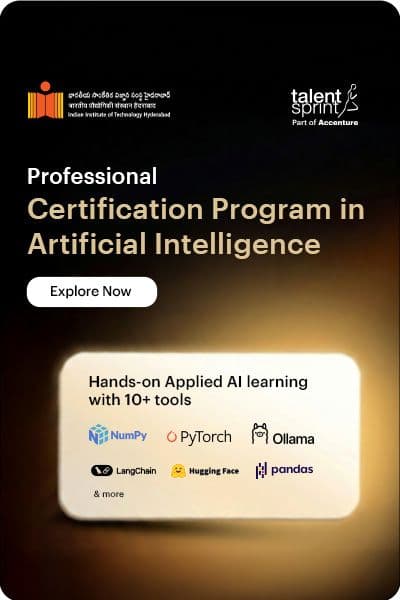
One example is the Artificial Intelligence course from IIT Hyderabad, delivered with TalentSprint. The official program page describes it as a six-month executive program for experienced professionals and states that basic coding experience is required. Its format includes live online classes and a two-day campus visit.
Its published learning experience includes:
- 200 hours of live interactive learning
- 60 hours of structured laboratory work
- Exposure to more than 10 AI tools
- Capstone projects
- Learning from Dr. Antony Franklin, Dr. Srijith P.K, other faculty members, and industry experts
The curriculum covers regression and classification, ensemble methods, clustering, dimensionality reduction, neural networks, deep learning, computer vision, speech, natural language processing, generative AI, and agentic AI. It also covers large language model training, fine-tuning, and prompt engineering.
The program page lists practical project areas such as:
- E-commerce recommendations
- Object recognition
- Image classification
- Text classification
- Spam filtering using natural language processing
- Fake-news detection
- Deep learning
- Generative AI
This type of pathway may be relevant for professionals who:
- Already have basic coding experience
- Want to develop technically grounded AI knowledge
- Prefer faculty-led learning
- Need structured laboratory and project exposure
- Want to learn several AI areas before specialising
- Can make a consistent learning commitment alongside work
A certification should not be viewed as a guaranteed route to a new job or promotion. Its practical value depends on your starting point, career objective, consistency, project quality, and ability to connect new technical capabilities with existing professional experience.
Common questions mid-career professionals ask
1. Am I too late to move into AI?
No. Your experience can help you recognise viable use cases, understand business constraints, and make contextual decisions. What matters is whether you are willing to learn consistently and choose a pathway suited to your starting point.
2. Do I need to leave my current job?
Not necessarily. Many professionals begin by applying AI within their current roles, joining internal projects, and developing new capabilities alongside full-time work. This makes the transition more manageable and creates opportunities to demonstrate practical application.
3. Can I transition without a computer science degree?
A computer science degree is not the only route. However, technically demanding AI roles require genuine ability in areas such as programming, data, algorithms, and model evaluation. These capabilities cannot be replaced by familiarity with AI tools alone.
4. Is learning generative AI enough?
Generative AI is important, but it represents only one part of the AI field. Professionals pursuing technically focused careers should also understand machine-learning fundamentals, data preparation, model evaluation, responsible AI, and other relevant applications.
5. Will completing a certification guarantee an AI role?
No certification can responsibly guarantee a career transition. Structured learning can provide knowledge, guidance, and opportunities to build projects, but hiring decisions may also depend on prior experience, demonstrated technical ability, problem-solving, and role fit.
The next chapter of your career starts now
AI is creating new opportunities for professionals who are willing to learn, adapt, and evolve. The advantage doesn't belong solely to AI specialists. It belongs to those who can combine technical understanding with years of practical experience.
The question isn't whether you should start over. It's how you can build on everything you've already achieved and prepare for what comes next.
After all, the most valuable professional in the AI era may not be the one with the newest skills, but the one who knows how to apply them with purpose.
Frequently Asked Questions
Q1. Will AI Replace My Job? What Mid-Career Professionals Need to Know
AI is more likely to change tasks than replace entire professions. While some routine activities may become automated, employers still need human judgement, leadership, problem-solving, and industry expertise. Professionals who learn how to use AI effectively are often better positioned to adapt and remain relevant as their roles evolve.
Q2. How to Learn AI Skills Without Starting Your Career Over
You don't need to leave your job or start from scratch. Begin by learning AI concepts relevant to your current role, identify practical use cases, and apply them through small projects. Structured learning programs and hands-on experience can help build AI capabilities while leveraging the expertise you've already developed.
Q3. Should I Switch Careers Because of AI? A Practical Decision Guide
A complete career switch isn't always necessary. First evaluate how AI is impacting your industry and role. Many professionals can unlock new opportunities by adding AI skills to their existing expertise. Consider a career pivot only if your long-term goals require deeper technical specialization or a new professional direction.
About the Author
TalentSprint
TalentSprint, Part of Accenture LearnVantage, is a global leader in building deep expertise across emerging technologies, leadership, and management areas. With over 15 years of education excellence, TalentSprint designs and delivers high-impact, outcome-driven learning solutions for individuals, institutions, and enterprises. TalentSprint partners with leading enterprises and top-tier academic institutions to co-create industry-relevant learning experiences that drive measurable learning outcomes at scale.
Explore Our Programme
Advance your career with the right program