Regular college vs career-ready learning

Two students can graduate with the same qualification and still feel completely different about their future.
One feels ready.
The other feels unsure.
Not because one worked harder, but because one spent more time applying concepts, working on projects, and understanding how work actually happens.
That is the growing conversation around regular college vs career-ready learning.
Why this conversation matters more than ever?
The way careers work today is changing quickly.
According to the World Economic Forum, nearly 39% of core job skills are expected to change by 2030, meaning students entering college today may graduate into a very different workplace.
So what does this actually mean for students?
A degree still matters.
But today, employers increasingly want more than academic knowledge. They want people who can apply concepts, solve problems, communicate clearly, and adapt to real work environments.
Understanding the difference: It’s not just about the degree
Before comparing the two, let’s keep one thing clear, this is not about saying traditional college is bad.
In fact, regular college still plays an important role in building academic foundations.
The real difference lies in how much practical exposure is built into the learning experience.
What matters | Regular college | Career-ready learning |
When application starts | Often later (final years) | From early semesters |
Industry exposure | Occasional / optional | Structured + continuous |
Curriculum relevance | Updates slower | Evolves with industry |
Career preparation | Often near placements | Throughout the degree |
Learning model | Classroom-first | Applied + experiential |
Also Read: Traditional BBA vs Industry-Integrated Online BBA: Learn the Difference
What does regular college learning usually look like?
Traditional college education still offers important benefits.
It can help students:
Build strong academic foundations
Learn discipline and consistency
Experience peer learning and campus life
Develop theoretical understanding
For many students, regular college becomes a strong starting point.
Especially when they combine academics with internships, certifications, or self-learning.
So, the conversation is not about “traditional vs modern.”
It is about whether students are getting enough opportunities to apply what they learn.
Where many students still feel unprepared?
Most students do not struggle because they are not capable.
They struggle because they have not had enough exposure.
Imagine two students applying for a marketing internship.
One says, “I studied marketing theory in college.”
The other says, “I worked on a social media campaign project and analysed audience engagement.”
Who sounds more prepared?
That difference often comes down to experience, not intelligence.
Common gaps students often face include:
Learning that stays heavily theory-focused
Limited exposure to workplace tools and workflows
Internships happening too late in the degree
Resume building and interview preparation starting only before placements
As a result, many students graduate with knowledge,
but not always the confidence to explain how they can contribute at work.
What does career-ready learning actually look like?
A career-ready degree is not defined by marketing claims, but by how consistently it combines learning with real-world application.
Some newer programs are being designed around this idea.Instead of separating academic learning and industry exposure, they bring both together from the start.
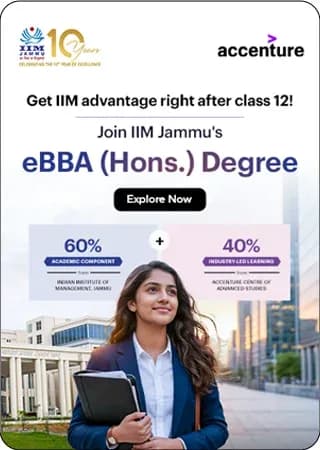
One example of this approach is the online BBA by IIM Jammu, a 4-year undergraduate program developed through an industry–academia partnership between IIM Jammu and the Accenture Centre of Advanced Studies (ACoAS).
Also Read: The Future of Business Careers in India: What’s changing for graduates?
Why this structure feels more career-ready?
1. Learning is application-led, not exam-led
Students do not just learn concepts in isolation.
They work on projects, simulations, and real-world assignments alongside academic learning, helping them apply ideas as they learn them.
2. Industry exposure is built into the degree
Instead of waiting for the final year, students are exposed to how businesses work through industry-led sessions, practical assignments, and real-world contexts throughout the program.
3. The curriculum reflects how modern business actually works
Business roles today are closely connected with technology.
So learning includes not just management fundamentals, but also exposure to areas like:
Data and analytics
AI and digital systems
Cloud and business applications
This helps students understand how decisions are made in modern organisations, not just how they are described.
4. Career preparation happens alongside learning
Instead of being a last-minute activity, professional readiness is built gradually.
Students work on:
Resume building
Communication and interview skills
Professional profile development
so they are not starting from scratch when opportunities come up.
How the learning structure brings this together?
What makes this model different is how these elements are structured:
60% academic learning focused on business fundamentals, case-based learning, and conceptual depth
40% industry exposure including projects, labs, simulations, and practitioner-led sessions
A blended format combining live learning with campus immersion experiences
A curriculum that connects business education with emerging domains shaping modern careers.
So… what should students really focus on?
If you step back, the comparison becomes much simpler.
It is not about choosing between
“regular college” and “career-ready learning.”
It is about asking:
Am I only learning concepts?
Or am I also learning how to use them?
Because the real difference is not the degree itself.
It is whether the learning experience helps you move from understanding something… to actually being able to do something with it.
Final thoughts
A degree will always matter.
But feeling ready at the end of it matters even more.
And that confidence usually comes from one thing:
not just learning, but applying.
Frequently Asked Questions
1. What is the difference between regular college education and career ready learning?
Regular college education primarily focuses on academic knowledge and subject understanding. Career ready learning combines academics with practical experiences such as industry projects, internships, workplace simulations, and professional skill development, helping students apply classroom concepts to real world business and workplace situations.
2. Why are employers increasingly looking for career ready graduates?
Employers value candidates who can contribute from the beginning of their careers. Career ready graduates often possess practical problem solving abilities, communication skills, industry exposure, and familiarity with workplace expectations, making it easier for organizations to onboard and integrate them into teams.
3. Can career ready learning improve a student's employability?
Yes. Career ready learning helps students develop skills that employers actively seek, including teamwork, critical thinking, digital proficiency, and professional communication. By gaining practical exposure alongside academic learning, students are often better prepared for interviews, internships, and early career opportunities.
About the Author
TalentSprint
TalentSprint, Part of Accenture LearnVantage, is a global leader in building deep expertise across emerging technologies, leadership, and management areas. With over 15 years of education excellence, TalentSprint designs and delivers high-impact, outcome-driven learning solutions for individuals, institutions, and enterprises. TalentSprint partners with leading enterprises and top-tier academic institutions to co-create industry-relevant learning experiences that drive measurable learning outcomes at scale.
Explore our Programme
Advance your career with the right program