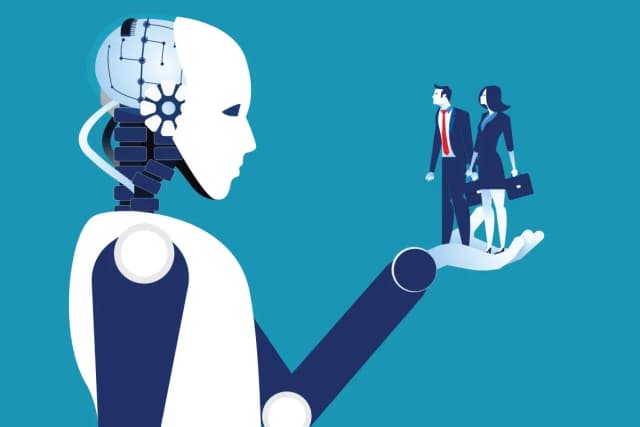
The rise of AI co-workers: how human-AI collaboration is evolving

TL;DR:AI is evolving from a tool into a workplace collaborator. As organizations adopt Generative AI and Agentic AI, professionals are increasingly working alongside AI systems that can analyze, create, and execute tasks. The future belongs to human-AI teams, making AI collaboration, workflow design, and AI literacy essential workplace skills.
A new kind of co-worker is entering the workplace, one that doesn't occupy a desk, attend meetings, or take coffee breaks.
AI is rapidly evolving from a productivity tool into a collaborative partner. It can analyze information, generate ideas, automate workflows, and assist with decision-making, helping professionals work faster and more effectively. Across industries, organizations are beginning to rethink how work gets done, not by replacing people with AI, but by enabling humans and AI to work together.
This shift is giving rise to the era of AI co-workers, where the future of work is increasingly defined by collaboration between human intelligence and artificial intelligence.
From automation to collaboration
The first wave of workplace technology was largely about efficiency. Software automated routine processes, digitized workflows, and reduced manual effort.
The current wave of AI is different.
Modern AI systems can understand natural language, interpret context, generate recommendations, and assist with tasks that once required significant human involvement. Rather than automating a single step in a process, AI is increasingly contributing across entire workflows.
A marketer can use AI to uncover customer insights and generate campaign concepts. A software developer can use AI to write and review code. A project manager can use AI to summarize meetings and organize action items. In each case, AI isn't replacing the professional. It's helping them work more effectively.
This marks a fundamental shift from automation to collaboration.
The workplace is already changing
The idea of AI co-workers may sound futuristic, but it is already becoming part of everyday work.
Organizations are embedding AI into operations across departments:
- Customer service teams use AI assistants to resolve routine queries.
- Sales teams use AI to research prospects and personalize outreach.
- Healthcare professionals use AI to support documentation and diagnostics.
- Financial institutions use AI to analyze risk and detect unusual patterns.
- Knowledge workers use AI to summarize information, generate insights, and accelerate decision-making.
As AI handles more repetitive and data-intensive tasks, employees can spend more time on work that requires judgment, creativity, communication, and strategic thinking.
The result is not necessarily fewer people at work. Instead, it is a different way of working where humans and AI increasingly collaborate.
What makes an AI co-worker?
An AI co-worker is more than a chatbot or content-generation tool.
It is an AI system that can assist throughout a workflow rather than supporting a single task. These systems can:
- Understand goals and instructions
- Analyze large volumes of information
- Generate recommendations and insights
- Support planning and execution
- Interact with different tools and platforms
- Improve outputs through feedback and iteration
In many ways, AI is becoming similar to a workplace assistant, supporting professionals throughout a process while humans remain responsible for oversight, decision-making, and outcomes.
The value lies not in replacing human expertise, but in enhancing it.
Why human-AI collaboration matters?
The rise of AI is reinforcing an important reality: humans and AI bring different strengths to the workplace.
Humans excel at creativity, strategic thinking, communication, leadership, and navigating complex decisions where context and judgment matter. AI excels at processing large volumes of information, identifying patterns, generating insights, and handling repetitive tasks with speed and consistency.
Take a product team, for example. AI can analyze customer feedback, surface trends, and summarize research in minutes. Humans then use those insights to make decisions, prioritize opportunities, and shape the broader strategy. The value comes not from either working alone, but from their ability to complement each other.
This is why organizations are increasingly shifting the conversation from "How can AI automate work?" to "How can AI help people do their best work?"
The most effective workplaces are not replacing human capabilities with AI. They are combining human creativity and judgment with AI's speed and analytical power to drive better outcomes. As AI becomes more integrated into everyday workflows, collaboration, not replacement, is emerging as the defining theme of the future of work.
From generative AI to agentic AI
As AI takes on a larger role in workplace tasks, the technology itself is evolving. The shift from Generative AI to Agentic AI is expanding what AI can contribute as a workplace collaborator.
Generative AI has already transformed how professionals create content, write code, conduct research, and solve problems. It excels at generating outputs based on prompts.
Agentic AI takes this a step further.
Agentic AI
Rather than simply responding to instructions, AI agents can:
- Understand objectives
- Break goals into smaller tasks
- Retrieve and analyze information
- Make context-aware decisions
- Interact with applications and systems
- Execute workflows with limited supervision
For example, an AI agent could monitor industry trends, gather information from multiple sources, summarize key developments, and provide recommendations, all while requiring minimal human intervention.
This evolution is bringing AI closer to functioning as a true collaborator rather than simply a tool.
Also Read: Agentic AI Era: Your Essential Guide to the Next Big Shift
What skills will matter in a human-AI workplace?
As collaboration between humans and AI increases, so does the need for new skills.
Knowing how to use AI tools is becoming a baseline expectation. Increasingly, professionals are being asked to understand how AI systems work, where they create value, and how they can be integrated into business processes.
Some of the capabilities gaining importance include:
- Prompt engineering
- Retrieval-Augmented Generation (RAG)
- Large Language Models (LLMs)
- AI workflow design
- Agentic AI systems
- Multi-agent orchestration
- Responsible AI practices
- Enterprise AI implementation
Importantly, these skills are no longer relevant only for AI specialists. Business leaders, consultants, marketers, analysts, product managers, and operations professionals are all beginning to work alongside AI-powered systems.
Also Read: What are the human skills beating AI and making you irreplaceable?
From AI users to AI collaborators
The conversation around AI is gradually shifting.
The question is no longer simply, "How do I use AI?" Instead, professionals are asking, "How do I work effectively with AI?"
This shift requires a deeper understanding of how AI systems are designed, managed, and integrated into workflows.
Organizations increasingly need people who can:
- Identify opportunities for AI adoption
- Design AI-enabled workflows
- Collaborate with AI agents
- Evaluate AI-generated outputs
- Ensure responsible and effective implementation
In other words, the future workplace is likely to reward those who can collaborate with AI, not just consume its outputs.
Learning to build and collaborate with AI systems
As organizations move beyond AI experimentation and toward real-world implementation, learning pathways are evolving to reflect this change.
Programs focused on Generative AI, Agentic AI, AI agents, Retrieval-Augmented Generation (RAG), and enterprise AI applications are becoming increasingly relevant because they mirror how businesses are adopting AI today.
For example, the Generative AI and Agentic AI course by TalentSprint part of Accenture explores concepts such as Generative AI, AI agents, multi-agent systems, RAG, and enterprise AI implementation. These areas reflect a broader industry trend toward building intelligent systems that can work alongside human teams.
The significance of such learning journeys extends beyond any single technology. They represent a growing recognition that understanding AI collaboration may become an essential professional capability across industries.
The future is human plus AI
The rise of AI co-workers is not simply a technology trend. It is a shift in how work is organized and how value is created.
While AI can automate tasks, process information, and operate at scale, human strengths such as creativity, judgment, empathy, and leadership remain essential. The most successful workplaces are unlikely to be powered by humans or AI alone, but by a combination of both.
As AI continues to evolve from Generative AI to more autonomous Agentic AI systems, the ability to collaborate effectively with intelligent technologies will become an increasingly valuable professional skill.
The future of work is not about competing with AI. It is about learning how to work alongside it. In that sense, the future belongs not to humans or AI, but to human-AI teams.
Frequently Asked Questions
Q1. What is an AI co-worker?
An AI co-worker is an intelligent system that assists professionals throughout a workflow by analyzing information, generating insights, completing tasks, and supporting decisions. Unlike traditional automation tools, AI co-workers collaborate with humans, helping improve productivity while allowing people to focus on creativity, judgment, and problem-solving.
Q2. Will AI co-workers replace human jobs?
AI is more likely to transform jobs than replace them entirely. While AI can automate repetitive and data-intensive tasks, humans remain essential for leadership, creativity, communication, ethical decision-making, and relationship-building. The most successful workplaces will combine human strengths with AI capabilities.
Q3. What is the difference between Generative AI and Agentic AI?
Generative AI creates outputs such as text, images, code, or summaries based on prompts. Agentic AI goes further by pursuing goals, making decisions, interacting with systems, and executing tasks with limited supervision. This makes Agentic AI more capable of supporting complex workplace workflows.
Q4. What skills are needed to work effectively with AI?
Professionals increasingly benefit from skills such as prompt engineering, AI-assisted problem-solving, Retrieval-Augmented Generation (RAG), understanding Large Language Models (LLMs), AI workflow design, and responsible AI practices. These capabilities help individuals collaborate more effectively with AI-powered tools and systems.
Q5. Why is human-AI collaboration becoming important?
Organizations are adopting AI to improve efficiency, accelerate decision-making, and unlock insights from large amounts of data. Human-AI collaboration combines AI's speed and analytical capabilities with human creativity, judgment, and empathy, creating stronger outcomes than either could achieve independently.
About the Author
TalentSprint
TalentSprint, Part of Accenture LearnVantage, is a global leader in building deep expertise across emerging technologies, leadership, and management areas. With over 15 years of education excellence, TalentSprint designs and delivers high-impact, outcome-driven learning solutions for individuals, institutions, and enterprises. TalentSprint partners with leading enterprises and top-tier academic institutions to co-create industry-relevant learning experiences that drive measurable learning outcomes at scale.
Explore Our Programme
Advance your career with the right program