
Statistical Thinking for Executives to Make Confident Decisions Under Uncertainty

TL;DR:Statistical thinking helps executives make high-stakes decisions with greater confidence by reducing reliance on intuition alone. It enables leaders to assess probabilities, interpret data objectively, understand risks, and evaluate uncertainty. By focusing on evidence rather than assumptions, executives can make more informed choices, allocate resources effectively, and navigate complex business situations with clarity and resilience.
Every executive today faces the same paradox: there has never been more data available, yet making the right decision has never felt more difficult. Dashboards are overflowing with metrics, AI tools are generating insights in seconds, and markets are changing faster than ever. But data alone does not create confidence. The real advantage lies in knowing how to interpret what the data is saying and, just as importantly, what it is not saying.
Consider a leader deciding whether to enter a new market, invest in AI, or launch a major transformation initiative. The challenge is rarely a lack of information. It is uncertainty. Statistical thinking provides a way to navigate that uncertainty by helping leaders assess probabilities, evaluate risks, and identify meaningful patterns amid the noise.
In an AI-driven business environment, statistical thinking is no longer a technical skill reserved for analysts. It is a leadership capability that enables executives to turn data into strategic decisions and uncertainty into opportunity.
Why is statistical thinking important for executives making high-stakes decisions?
The most consequential business decisions are rarely made with complete certainty. Whether evaluating a market expansion opportunity, investing in AI-led transformation, or responding to competitive disruption, leaders must often act before all the facts are known. Statistical thinking provides a structured approach to navigating this uncertainty. It helps executives move beyond intuition and make decisions grounded in evidence, probability, and measurable outcomes.
Statistical thinking enables executives to:
- Apply data-driven reasoning to business decisions rather than relying solely on experience or assumptions.
- Use probability to manage uncertainty, assess risks, and evaluate potential outcomes before making strategic investments.
- Draw meaningful insights through data sampling, allowing decisions to be made without waiting for perfect information.
- Understand relationships between business variables using regression analysis, helping identify the factors that influence performance, growth, and customer behavior.
- Build greater confidence in strategic decision-making by supporting recommendations with objective evidence and analytical rigor.
As organisations increasingly invest in analytics and AI, statistical thinking becomes more than an analytical skill. It evolves into a strategic leadership capability that enables executives to interpret data effectively, evaluate opportunities with clarity, and make high-impact decisions with greater confidence.
The New Leadership Reality: Data Is Everywhere, Insight Is Rare
Organisations today generate vast amounts of data from customers, operations, supply chains, financial systems, and digital interactions. Yet the real challenge is no longer collecting data. It is transforming that data into decisions that create business value.
AI can accelerate analysis, uncover patterns, and support forecasting, but technology alone cannot make business decisions. Leaders must understand how to interpret data, evaluate uncertainty, and determine which insights truly matter.
Also Read: Why is Strategic Thinking Essential for Every Leader?
Why data alone does not drive growth?
Leadership is the critical link between analytics and business impact. To unlock value from data, executives must:
- Ask the right questions before seeking answers from analytics or AI.
- Separate meaningful signals from noise rather than chasing every trend.
- Avoid misleading correlations and false patterns that can lead to poor strategic decisions.
- Translate analytical insights into business action that drives growth, innovation, and competitive advantage.
In the age of AI, the organisations that outperform are not those with the most data, but those with leaders capable of converting data into confident decisions.
Also Read: Why Leaders Need to Understand Artificial Intelligence?
Five ways statistical thinking improves executive decision-making
In today's data-rich business environment, the competitive advantage no longer comes from having access to information. It comes from knowing how to interpret it. Statistical thinking helps executives move beyond intuition, identify meaningful patterns, and make decisions with greater confidence, especially when uncertainty is high.
1. Make Objective, Evidence-Based Decisions
Statistical thinking encourages leaders to evaluate facts rather than rely solely on assumptions or personal experience. This creates a stronger foundation for strategic choices and reduces the influence of cognitive biases.
2. Assess Risk and Uncertainty More Effectively
Every major business decision involves uncertainty. By applying probability-based thinking, executives can evaluate potential outcomes, weigh trade-offs, and make informed decisions even when complete information is unavailable.
3. Identify Trends That Matter
Not every change in data signals a meaningful shift. Statistical analysis helps leaders separate genuine trends from random fluctuations, enabling them to focus on insights that can influence business performance.
4. Understand What Drives Business Results
Techniques such as correlation and regression analysis help uncover relationships between variables. Leaders can better understand which factors drive customer acquisition, revenue growth, operational efficiency, or employee performance, allowing resources to be allocated more effectively.
5. Turn Data into Strategic Action
Perhaps most importantly, statistical thinking bridges the gap between analytics and decision-making. It enables leaders to ask better questions, interpret analytical outputs correctly, and translate insights into actions that drive growth and competitive advantage.
As organisations increasingly leverage Analytics, AI, and machine learning, these capabilities are becoming essential leadership skills. The ability to think statistically is no longer reserved for analysts. It is a strategic competency for executives who want to lead with confidence in an increasingly uncertain world.
How is AI changing the way executives make decisions?
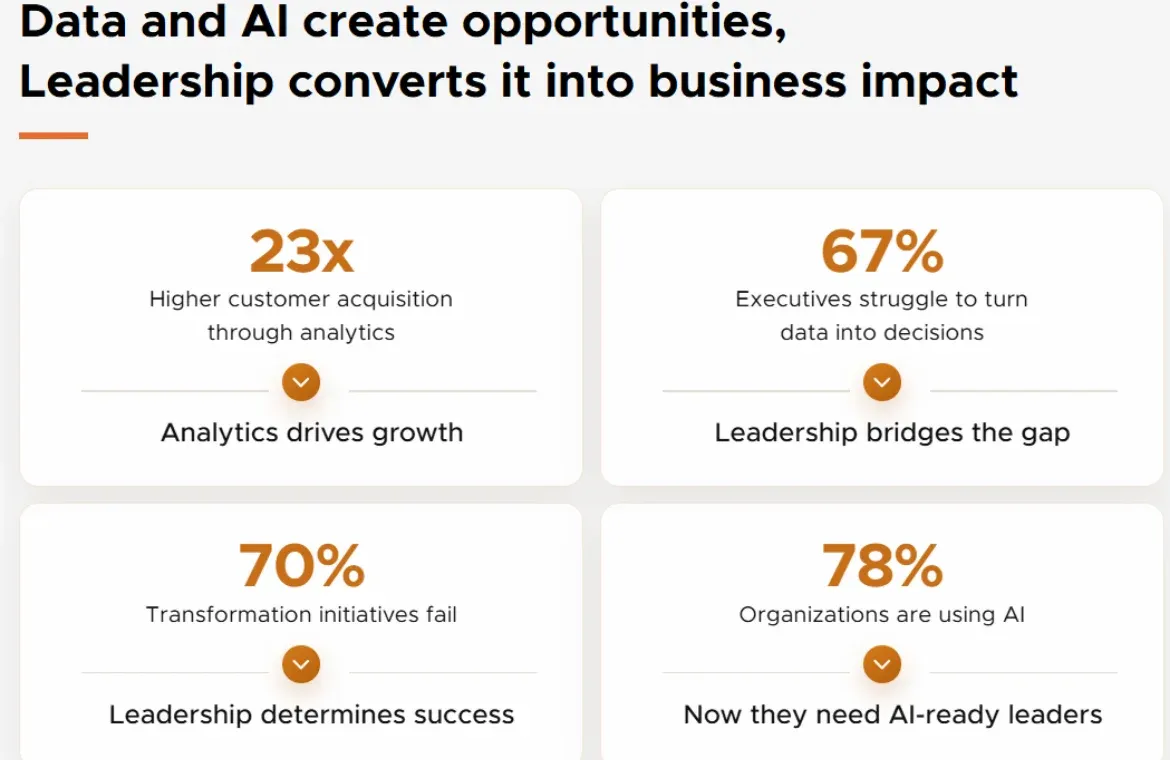
Executive decision-making is undergoing a fundamental shift. As organisations grapple with increasing data complexity, market uncertainty, and the need for faster responses, AI is emerging as a powerful decision-support tool. According to research, more than half of CXOs already use AI to support or inform strategic decision-making, and this adoption is expected to grow significantly in the coming years.
AI's greatest value lies in its ability to process vast amounts of information, identify patterns, model scenarios, and generate insights at a speed that would be impossible through manual analysis alone. It can help leaders:
- Analyse large volumes of data to uncover business opportunities and risks.
- Challenge assumptions and identify blind spots during strategic planning.
- Model and stress-test multiple scenarios before major investments or transformation initiatives.
- Monitor outcomes in real time and recommend course corrections when conditions change.
However, AI does not replace executive judgment. Research highlights that leaders expect AI to augment and strengthen strategic thinking rather than make autonomous decisions. The final responsibility for interpreting insights, evaluating trade-offs, and making high-stakes decisions remains firmly with business leaders.
This is why statistical thinking becomes even more important in the age of AI. Leaders who understand probability, risk, and analytical reasoning are better equipped to evaluate AI-generated recommendations, separate meaningful insights from automated noise, and convert data-driven intelligence into sustainable business value.
Statistical Thinking Across Business Functions
Statistical thinking is no longer confined to analytics teams. It is increasingly becoming a cross-functional leadership capability that helps executives make smarter decisions across the enterprise. The ability to interpret data, evaluate uncertainty, and identify patterns is now critical in multiple business functions.
Marketing and Customer Growth
- Use customer analytics to understand purchasing behavior and preferences.
- Power personalisation strategies that improve customer engagement and growth.
Finance and Risk Management
- Strengthen forecasting accuracy for revenue, budgeting, and investments.
- Optimise decisions by assessing risk and evaluating alternative scenarios.
Operations and Supply Chain
- Improve efficiency through data-driven process optimisation.
- Build resilient supply chains with predictive insights and better planning.
Workforce and Talent Decisions
- Leverage AI-powered people analytics for workforce planning.
- Make more informed decisions about talent, productivity, and organisational capability.
As Analytics and AI become embedded across business functions, leaders who think statistically are better positioned to translate insights into enterprise-wide impact.
Building statistical thinking as a strategic leadership skill
As data and AI become central to business strategy, executives need more than technical awareness. They need a decision-making mindset that enables them to interpret evidence, evaluate uncertainty, and translate insights into action. This requires a combination of capabilities, including:
- Statistical reasoning to assess probabilities and risks.
- Data interpretation to uncover meaningful insights.
- Decision science to make structured, evidence-based choices.
- Analytics strategy to align data initiatives with business goals.
- AI literacy to understand the opportunities and limitations of AI.
- Experimentation and causal thinking to test assumptions and identify what truly drives outcomes.
Why structured learning matters?
Developing these capabilities cannot happen through statistics alone. Modern leaders must understand how analytics, AI, and business strategy intersect to create competitive advantage. Equally important is practical exposure through real-world business applications, simulations, and transformation projects that mirror the complexity of executive decision-making.
This growing need is driving demand for executive programs that combine analytical rigor with strategic leadership development. The IIM Calcutta Strategic Leadership Programme in Analytics with AI is designed for this purpose, helping leaders build expertise in Analytics, AI, decision-making, and enterprise transformation.
Through a blend of foundational concepts and applied learning, the programme equips executives to move beyond understanding data and confidently lead data-driven business outcomes.
Conclusion
In the age of AI, the leaders who create the greatest impact will not be those with the most data, but those who can transform data into decisive action. Statistical thinking, analytics, and AI together provide a powerful framework for navigating uncertainty, anticipating risks, and making better strategic choices.
The real question is no longer whether AI will influence business decisions. It is whether leaders are prepared to use it effectively. As organizations increasingly rely on data-driven decision-making, executives who can combine analytical rigor with strategic judgment will be best positioned to drive growth and lead transformation.
For leaders looking to strengthen these capabilities, investing in structured learning can be the difference between simply consuming insights and confidently turning them into measurable business value.
Frequently Asked Questions
1. What is statistical thinking in business decision-making?
Statistical thinking is the ability to use data, probability, and evidence to evaluate situations, assess risks, and make informed decisions under uncertainty. It helps leaders move beyond intuition and base decisions on measurable insights.
2. How does AI support executive decision-making?
AI helps leaders process large volumes of data, identify patterns, model scenarios, and generate insights more quickly. However, executives still need analytical and statistical reasoning to interpret AI-generated recommendations effectively.
3. How is statistical thinking used across different business functions?
Statistical thinking supports customer analytics in marketing, forecasting and risk analysis in finance, operational optimization in supply chains, and workforce planning in human resources.
4. What skills do leaders need to make data-driven decisions?
Modern leaders need statistical reasoning, data interpretation, decision science, AI literacy, and the ability to translate analytical insights into business action.
About the Author
TalentSprint
TalentSprint, Part of Accenture LearnVantage, is a global leader in building deep expertise across emerging technologies, leadership, and management areas. With over 15 years of education excellence, TalentSprint designs and delivers high-impact, outcome-driven learning solutions for individuals, institutions, and enterprises. TalentSprint partners with leading enterprises and top-tier academic institutions to co-create industry-relevant learning experiences that drive measurable learning outcomes at scale.
Advance your career with the right program