
Top Skills Every Global Business Leader Needs in the Age of AI

TL;DR:In the age of AI, global business leadership requires far more than technical awareness. Leaders must combine strategic thinking, digital fluency, cross-cultural collaboration, change management, data-driven decision-making, and ethical judgment to navigate complexity, drive innovation, and lead organizations confidently through rapid technological and market transformation.
Artificial intelligence can now write, analyse, forecast, and build in seconds. It drafts the strategy memo, models the market, and surfaces the insight before the meeting even begins. Yet for all that speed, it still cannot set an ambition, win a room's trust, or make the call when the data runs out. That gap is exactly where leadership lives today.
The context around that leadership has shifted on two fronts at once. Business has never been more global, with almost no product or service left untouched by international markets, cultures, or supply chains. At the same time, AI is reshaping how work gets done, with the World Economic Forum estimating that around 1.1 billion jobs could be transformed by technology this decade and 86% of businesses expecting AI to reshape their operations by 2030.
For anyone leading across borders, this creates a new and unfamiliar test. Functional expertise is no longer enough. The professionals who will thrive are those who can pair digital fluency with a genuinely global perspective, using AI to think with them rather than for them, while still doing the deeply human work that no algorithm can. This blog maps the skills that now define that kind of leader.
Why is global business leadership being redefined right now?
Because the ground has shifted on two fronts at once. Business is now inseparably global, shaped as much by geopolitics and cross-border trade as by any single market. At the same time, AI has moved into the core of how decisions get made. Together, these forces are quietly rewriting what leadership demands.
The clearest sign is a shift from command to context. When people, agents, and machines increasingly work side by side, the leader is rarely the smartest voice in the room. Old command-and-control instincts fall flat. The new task is to set direction, define guardrails, and build trust so teams can navigate constant change. Little wonder the WEF expects 39% of core skills to change by 2030.
What does a global business leader actually mean today?
It is easy to picture a global leader as someone with a passport full of stamps. The reality is quieter and more demanding. Today's global leader spots opportunity across markets they may never physically visit, leads teams they meet only on a screen, and makes decisions while regulation, currencies, and geopolitics keep shifting beneath them.
What sets them apart is not depth in one function, but breadth of perspective. A brilliant finance or marketing specialist manages a part of the machine. A global leader understands how the whole thing fits together across borders and cultures, and where AI now sits inside it.
That is why the skills that matter are shifting. Let's look at them.
What are the top skills every global business leader need in the age of AI?
The short answer: a blend of human judgment and digital fluency, applied across borders. AI raises the value of these skills rather than replacing them. Here are the six that matter most.
1. Global strategic thinking: Strategy today is about anticipating how technology, trade, and geopolitics reshape the board, not just planning the next move on it. The best leaders sense shifts early and reframe rather than react. In a global context, that means reading market entry, ESG pressures, and competitive advantage through an AI lens.
2. AI and digital fluency: Fluency is not coding. It is knowing what machine learning and generative AI genuinely deliver, and where the hype ends. Harvard research is blunt: success in the AI era hinges far more on leadership than on the technology itself. The leaders pulling ahead do not build the models; they know enough to decide, govern, and scale them.
3. Data-driven decision-making: Good judgment now means treating data as a first-class input into strategy, not a rearview report. This matters more than any other technical skill: analytical thinking remains the single most sought-after capability among employers worldwide. The art lies in letting evidence sharpen instinct without replacing it.
4. Cross-cultural leadership: A global mandate means leading people you may never share a room with, across languages and norms. That takes real skill in navigating cultural difference and building collaboration at a distance. As automation rises, this human dimension only grows, with empathy becoming what one framework calls "the new currency" of leadership.
5. Change leadership and adaptability: When the ground keeps moving, rigid plans become a liability. Adaptive thinking and the courage to unlearn yesterday's expertise are now core to the job. The data backs it up: resilience, flexibility, and agility rank among the top skills employers are prioritising.
6. Ethical judgment and responsible AI governance: As AI moves into real decisions, someone must own the questions of risk, bias, and explainability. That responsibility sits with leadership, not the technology team. In a global setting it stretches further, into ESG, geopolitics, and the ethics of operating across different regulatory worlds.
Which of these skills can AI never replace?
For all its speed, AI runs to a hard limit: it cannot lead. It can draft the plan, but it cannot set the ambition behind it. It can model the options, but it cannot make the tough call when the data runs out or win the trust needed to see it through.
Four things stay stubbornly human. Setting aspirations, the act of pointing an organisation at something bigger than itself. Building trust, the quiet work of holding stakeholders together through uncertainty. Accountability, being the one who owns the outcome. And original thinking, the genuinely new idea that no pattern in the training data could predict.
This is the real reframe. The most effective leaders do not treat AI as a replacement for judgment. They treat it as something to think with, not for, freeing their attention for the parts of the job only a human can do. Seen this way, AI does not shrink the leader's role. It sharpens it.
How do you build these skills? Where structured learning fits in
Some of this comes with experience. A hard posting abroad, a failed market entry, a team that only worked once you learned to listen differently. But experience is a slow teacher, and it rarely arrives in the order you need it. A stack this broad, spanning global strategy, data fluency, cross-cultural leadership, and ethical judgment, is hard to assemble in fragments.
This is where structured, senior-level learning earns its place. Not the kind built around code, but the kind built around business context.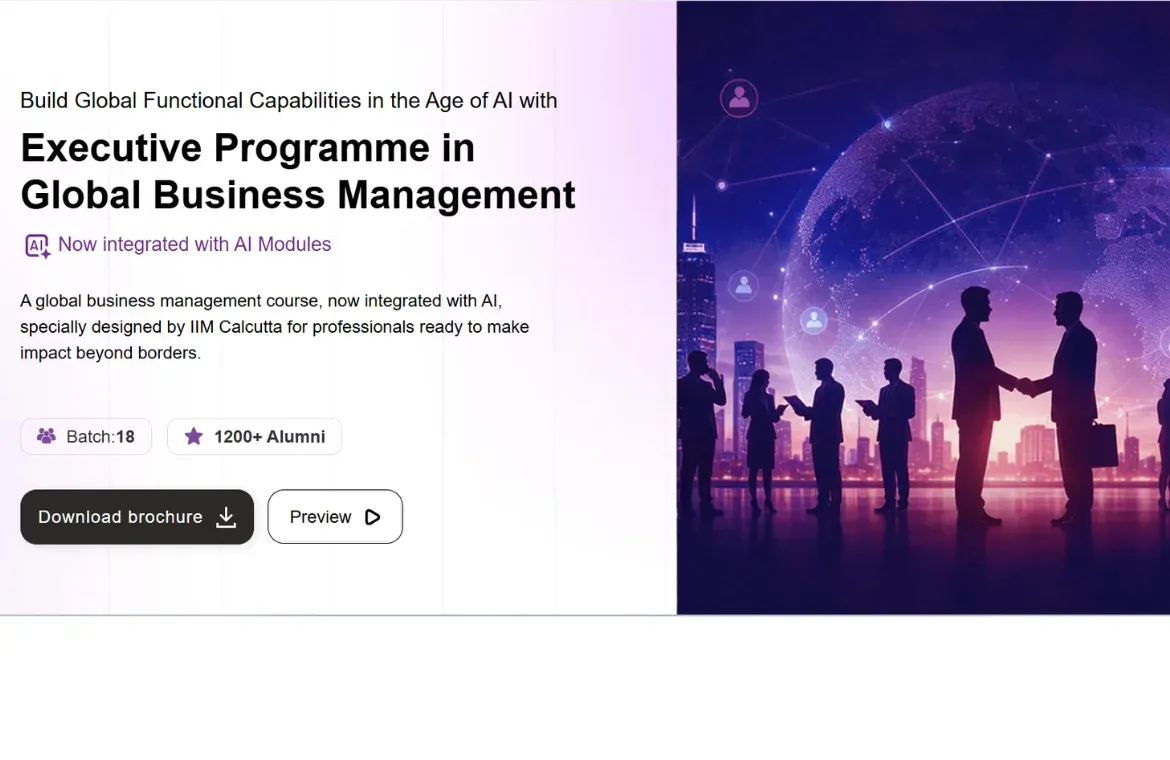
The Executive Programme in Global Business Management (EPGBM) from IIM Calcutta is one example of how these skills map onto a single curriculum. It is a 12-month live online programme, now integrated with AI across its strategy, analytics, finance, and leadership modules, so the technology sits inside the business rather than beside it.
Participants apply it through a business simulation and a capstone on real global problems, with two campus immersions and IIM Calcutta alumni status. The point is not the credential. It is that skills like these are built faster when practised together, in context.
Conclusion
Every wave of technology has promised to make leadership easier. AI does the opposite. By taking over the analysis, the forecasting, and the first draft, it strips leadership back to its hardest and most human core. The machine can tell you what the data says, but it cannot set the ambition, hold a team together through uncertainty, or make the call when the numbers run out.
That is the paradox of this decade: the more capable the technology, the more it exposes the quality of the person leading it. Strategy, data fluency, cultural intelligence, adaptability, and ethics are no longer separate skills to collect. Woven together, they are what it now means to lead across borders, and to lead well.
Frequently Asked Questions
1. What is the single most important skill for global leaders in the AI age?
There is no single winner, but analytical thinking comes closest. It remains the most sought-after skill among employers worldwide. In a global context, it pairs with cross-cultural leadership and ethical judgment. The real edge lies in combining these human strengths with digital fluency, not choosing one over another.
2. Do global business leaders need to know how to code or build AI models?
No. Fluency is not coding. Leaders need a working understanding of what machine learning and generative AI can and cannot do, enough to separate hype from opportunity. Research confirms success depends more on leadership and organisational change than on the technology itself. The job is to decide, govern, and scale.
3. How is leading a global team different in the age of AI?
You often lead people across borders, cultures, and time zones you may never share a room with. AI adds another shift: from command-and-control to setting context and guardrails as people and machines work side by side. Empathy and cross-cultural skill matter more, not less, as automation rises.
4. Can experience alone build these skills, or is formal learning needed?
Experience teaches, but slowly and unevenly, and rarely in the order you need. A capability stack spanning strategy, data, culture, and ethics is hard to assemble in fragments. Structured, senior-level learning built around business context accelerates it, letting you practise these skills together rather than picking them up piecemeal over years.
About the Author
TalentSprint
TalentSprint, Part of Accenture LearnVantage, is a global leader in building deep expertise across emerging technologies, leadership, and management areas. With over 15 years of education excellence, TalentSprint designs and delivers high-impact, outcome-driven learning solutions for individuals, institutions, and enterprises. TalentSprint partners with leading enterprises and top-tier academic institutions to co-create industry-relevant learning experiences that drive measurable learning outcomes at scale.
Explore Our Programme
Advance your career with the right program