Difference between traditional and industry-integrated degrees

TL;DR:Traditional degrees build strong academic foundations, while industry-integrated degrees combine classroom learning with practical experience, industry exposure, and career-focused skill development. As workplaces increasingly value applied skills alongside theoretical knowledge, industry-integrated learning helps students bridge the gap between education and employment by developing real-world experience, confidence, and job readiness throughout their academic journey.
Higher education today is no longer evaluated only by the degree a student earns, but by how well that degree prepares them for the professional world.
For decades, traditional degree programmes focused primarily on academic knowledge, classroom learning, and examinations. While this approach continues to provide strong conceptual foundations, changing industry expectations have created a growing demand for graduates who can also apply knowledge in real-world settings.
Employers increasingly value practical exposure, problem-solving ability, communication skills, and industry awareness alongside academic performance. As a result, many institutions are adopting industry-integrated learning models that combine academics with hands-on experience, industry interaction, and career-focused skill development.
This shift raises an important question, “What is the difference between traditional and industry-integrated degrees, and which approach better prepares students for today’s careers?”
The Gap between learning and working
This question often becomes clearer when students encounter real-world expectations.
While academic knowledge provides a strong base, workplaces demand:
the ability to apply concepts
familiarity with tools and platforms
confidence in decision-making
This is where many students experience a gap,
the gap between knowing something and using it effectively.
What traditional degrees continue to do well?
Traditional degree programs have long been the foundation of higher education.
They help students:
build conceptual clarity
understand theoretical frameworks
develop structured thinking
These are essential for developing a strong academic base and long-term understanding.
Where the limitation begins?
However, challenges arise when learning remains disconnected from real-world context.
In many cases:
exposure to industry is limited or delayed
application of concepts is not continuous
tools used in workplaces are rarely part of the learning process
As a result, students may graduate with knowledge, but without a clear sense of how that knowledge translates into real work.
What industry-integrated degrees do differently?
Industry-integrated degrees are designed to bridge this gap.
Instead of separating classroom learning and practical exposure, they bring both together.
These programs focus on:
application-led learning
industry interaction
exposure to real-world scenarios
continuous skill development
The shift is clear:
from learning about work to learning through work
Traditional vs industry-integrated degrees: A clear comparison
To understand this shift better, here’s a side-by-side comparison:
Feature | Traditional | Industry-Integrated |
Programme Approach | Theory-heavy learning with limited practical exposure | Application-led learning with real-world exposure from day one |
Industry Integration | Occasional guest lectures with limited interaction | Built-in industry integration through projects, labs, and internships |
Curriculum | Traditional curriculum with limited focus on emerging domains | Curriculum aligned with industry needs and evolving domains |
Learning Experience | Classroom-based lectures | Live sessions with faculty and industry experts |
Career Readiness | Career support limited to final stages | Structured career preparation throughout the program |
Industry Interaction | Occasional exposure | Continuous engagement with practitioners |
Learning Format | Fully campus-based | Flexible, blended learning with interactive sessions |
Tools Exposure | Limited or no tools exposure | Hands-on exposure through labs and simulations |
Skill Development | Academic knowledge focused | Job-ready skills and real-world application |
Outcome | Degree-focused learning | Degree + skills + experience aligned to careers |
The difference is not just in what students learn, but in how they experience learning.
Also Read: Traditional BBA vs Industry-Integrated Online BBA: Learn the Difference
How Business Education Is Evolving?
Business today operates in a very different environment.
Decisions are shaped by:
data
AI-driven insights
digital platforms
evolving technologies
Which means business professionals need more than theoretical understanding.
This has led to a new approach and that is techno-managerial learning
which means Business + Technology + Real-World Application
Students are expected to go beyond concepts and understand how businesses actually function in a technology-driven world.
So, what a future-ready business degree looks like?
To keep up with these changes, business education is evolving.
New-age programs are designed to:
combine academic learning with real-world exposure
integrate application from early stages
include emerging areas like AI, data, and digital systems
build career readiness alongside theoretical understanding
Also Read: The Future of Business Careers in India: What’s changing for graduates?
A New model in practice

To understand how this shift works in practice, it helps to look at how some modern programs are structured today.
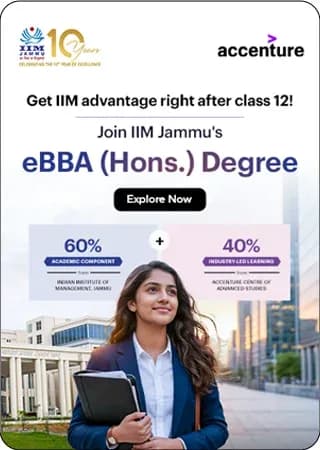
For example, the industry-integrated online BBA by IIM Jammu, developed in collaboration with the Accenture Centre of Advanced Studies, reflects this evolving model of business education.
1. A Structured academic + Industry learning model
At the core of this approach is a clearly defined 60-40 learning structure:
60% academic learning: delivered by IIM Jammu, focusing on core business fundamentals such as marketing, finance, and management
40% industry-led learning: delivered through projects, labs, and real-world exposure facilitated by Accenture center of advanced studies (ACoAS)
This balance is important.
It ensures that students don’t just understand concepts, they also learn how those concepts are applied in real business environments.
2. Business learning integrated with technology
Unlike traditional business programs, this model reflects how businesses operate today.
Students are exposed to:
AI and its applications in business
data analytics and decision-making
cloud and digital infrastructure
technology-driven business processes
This creates a techno-managerial foundation, where business understanding is supported by technological awareness.
3. Learning through real-world application
The structure focuses on learning through doing, not just studying.
Students engage with:
real-world projects and simulations
applied case-based learning
interaction with industry professionals
This helps bridge the gap between academic knowledge and real work scenarios as part of the learning process itself.
4. Career readiness built into the program
Instead of leaving career preparation to the end, it is integrated throughout the journey.
This includes:
structured professional skills development
resume building and interview preparation
exposure to workplace expectations
As a result, students build confidence gradually, not after graduation.
5. Connecting learning to career opportunities
One of the key outcomes of this model is access to a broader industry ecosystem.
Through structured collaboration and exposure, students benefit from:
interaction with industry practitioners
real-world project experience
Internship opportunities
access to 700+ recruiters across industries
This connects learning directly to potential career pathways, making the transition from education to employment more structured and predictable.
What this model changes?
Instead of: learning first and applying later
Students experience: learning and application happening together
And instead of asking: “What next?”
They are better prepared to say: “I understand how this works, and I’ve already applied it.”
Conclusion: The real difference lies in the learning experience
The difference between traditional and industry-integrated degrees is not about one being better than the other.
It is about how education is evolving to match the realities of the modern workplace.
Because in the end:
a degree helps you understand
but the learning experience determines how well you can apply it
And in a world where industries continue to evolve,
students who combine knowledge with real-world readiness are the ones who move forward with clarity, confidence, and purpose.
Frequently Asked Questions
Q1. What is the main difference between a traditional degree and an industry integrated degree?
A traditional degree mainly focuses on academic learning and theory through classroom education. An industry integrated degree combines academics with practical exposure, industry projects, internships, and skill based training to help students understand how workplaces function alongside their studies.
Q2. Are industry integrated degrees better for career readiness than traditional degrees?
Industry integrated degrees are often designed to improve career readiness because students gain practical exposure during the program. While traditional degrees build strong academic foundations, industry integrated learning helps students develop workplace skills, confidence, and professional understanding earlier.
Q3. Do employers value industry integrated degrees more than traditional degrees?
Many employers value candidates who combine academic knowledge with practical experience. Industry integrated degrees often help students demonstrate real world exposure, project work, and applied skills, while traditional degrees may require additional training after graduation for workplace readiness.
About the Author
TalentSprint
TalentSprint, Part of Accenture LearnVantage, is a global leader in building deep expertise across emerging technologies, leadership, and management areas. With over 15 years of education excellence, TalentSprint designs and delivers high-impact, outcome-driven learning solutions for individuals, institutions, and enterprises. TalentSprint partners with leading enterprises and top-tier academic institutions to co-create industry-relevant learning experiences that drive measurable learning outcomes at scale.
Explore our Programme
Advance your career with the right program