Everyone knows AI matters. So, why aren’t more people using It?

TL;DR:Although most people recognise AI’s importance, many struggle to move from awareness to consistent use. The biggest barrier isn’t access to tools but a lack of practical application and direction. Building AI confidence comes through regular practice, and structured, hands-on learning programmes like AI Infinity help learners develop real-world AI skills that prepare them for evolving workplace demands.
AI is no longer just a technology trend. It is becoming an increasingly important workplace skill.
According to LinkedIn's Work Change Report, 70% of the skills used in most jobs are expected to change by 2030. Employers are looking for people who can embrace new technologies, learn continuously, and combine technical capabilities with human skills such as communication, creativity, and critical thinking.
Yet despite growing awareness of AI's importance, many people still haven't made it part of how they learn, work, or solve problems.
So if everyone agrees AI matters, why are so many people still struggling to get started?
The Awareness- action gap
Most people are not ignoring AI.
They are simply not using it consistently.
A student may spend hours reading about AI tools, watching tutorials, and following discussions online. A working professional may attend webinars and explore the latest AI developments.
But when it comes to applying AI to real tasks, many stop before they begin.
This is the awareness–action gap.
People know AI matters.
They just haven't turned that awareness into a habit.
The Biggest myth about learning AI
One of the most common misconceptions about AI is that people need to understand everything before they start using it.
They tell themselves:
I'll learn more first.
I need to understand all the tools.
I'll start when I feel ready.
But confidence rarely comes before action.
It usually comes after it.
Think about learning to drive or using a new software platform. Reading and watching tutorials can help, but real confidence develops through practice.
AI works the same way.
The people benefiting most from AI today are not necessarily experts. They are often the people who started experimenting, applying, and learning through use.
Also Read: The Truth behind common AI Myths
The Real problem: exploration without practice
This is where many learners get stuck.
AI is being explored.
But it is not being practiced.
Trying ChatGPT once is not the same as making AI part of your workflow.
Watching videos about prompting is not the same as using AI to analyse information, brainstorm ideas, improve communication, or solve problems.
The difference between awareness and capability is repetition.
The more people use AI in meaningful situations, the more comfortable and confident they become.
Creating Opportunities through early adoption
AI is rapidly becoming part of everyday work across industries.
From marketing and finance to operations and customer service, organisations are exploring how AI can improve efficiency, decision-making, and productivity.
This does not mean everyone needs to become an AI specialist.
But it does mean that understanding how to work alongside AI is becoming increasingly valuable.
Those who start early gain something important:
Time to experiment
Time to learn
Time to build confidence
And confidence is often what separates people who adopt new technologies from those who struggle to keep up with them.
Also Read: Why AI adoption in enterprises falls short, and what it takes to scale?
The missing direction
Most people do not lack access to AI tools.
Nor do they lack access to information.
There are countless tutorials, courses, videos, and articles available online.
The challenge is knowing where to begin and what to focus on.
Without structure, learners often jump from one tool to another without building real capability.
As a result, curiosity fades before confidence develops.
What many people need is not more information.
They need direction.
From knowing AI matters to actually using It
This is where structured learning can make a difference.
Many learners understand the value of AI but struggle to move beyond occasional experimentation. They know the tools exist, but they are unsure how to apply them effectively in real-world situations.
AI Infinity is designed to address this challenge.
Rather than focusing solely on AI concepts, the programme is built around helping learners adopt AI confidently through practical application.
The emphasis is simple: move from awareness to action.
Learners gain hands-on exposure to widely used AI tools such as ChatGPT, Gemini, Copilot, and Perplexity while learning how these tools can support research, productivity, communication, creativity, and problem-solving.
Instead of treating AI as a subject to study, the programme encourages learners to use AI in ways that mirror real workplace and learning environments.
Learning paths built around different goals
Not everyone approaches AI with the same objective.
Some learners want to understand how AI can improve productivity and decision-making in their current roles. Others want deeper exposure to Generative AI and emerging areas such as Agentic AI.
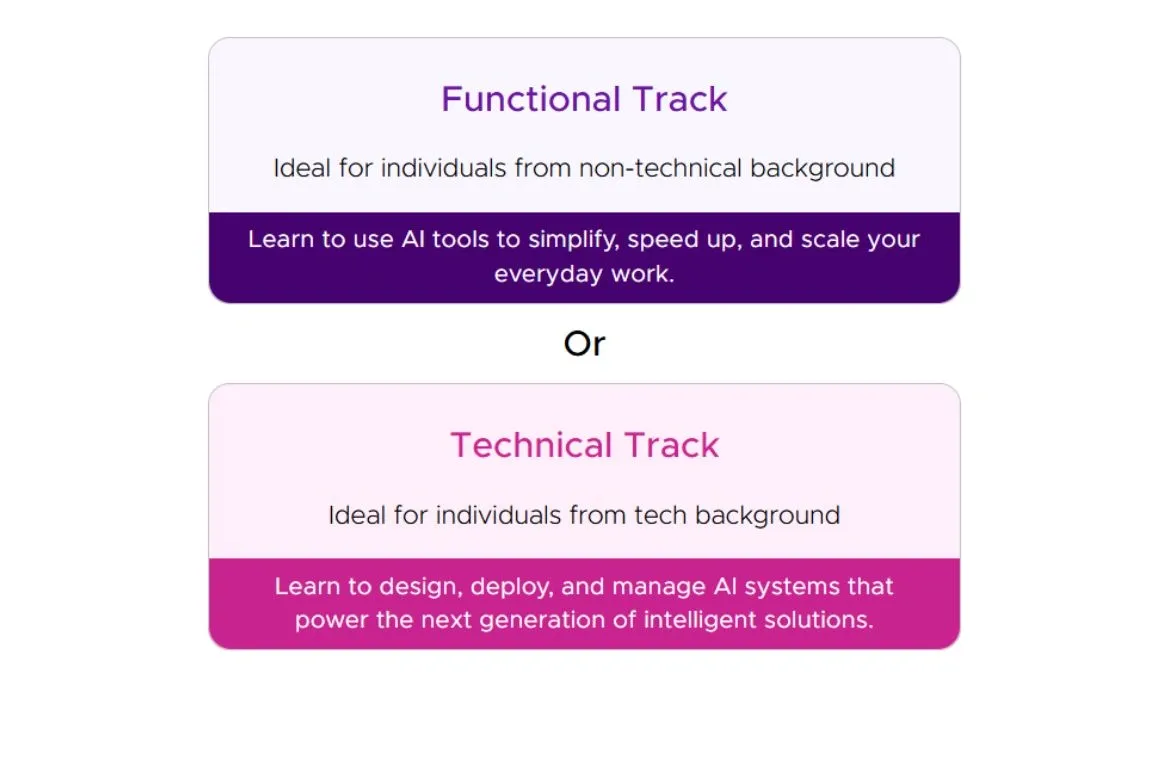
To support these different needs, AI Infinity offers two specialised pathways.
1. Functional Track
Designed for learners from non-technical backgrounds who want to build AI adoption skills and understand how AI can be used effectively in business and professional contexts.
2. Technical Track
Designed for learners with technical backgrounds who want applied exposure to Generative AI and Agentic AI concepts and applications.
This enables learners to pursue outcomes that align with their goals rather than follow a one-size-fits-all approach.
Why learning by doing matters
One reason many people struggle with AI adoption is that they spend more time consuming information than applying it.
Practical learning helps bridge that gap and AI Infinity is designed around the idea that confidence with AI develops through consistent use, not just theory.
The 40-hour learning experience combines live expert-led sessions, self-paced learning, assignments, and hands-on projects that allow learners to apply AI in real-world scenarios.
Participants gain exposure to more than 20 leading AI tools, including ChatGPT, Copilot, Gemini, and Perplexity, while learning how these technologies can be used across different professional and business contexts.
The programme also includes industry-relevant projects and skill-based assignments that encourage learners to move beyond experimentation and start solving practical problems using AI.
Rather than simply learning what AI can do, learners get opportunities to experience how AI can support decision-making, productivity, creativity, research, and automation.
Importantly, the learning journey does not end when the programme concludes. With continued access to updated content, tools, and resources for a year, learners can keep building their skills as AI technologies evolve.
The objective is simple: to help learners not just understand AI, but develop the confidence to adopt, apply, and build AI-driven solutions that are relevant to their work, studies, or future career goals.
A simpler way to start
If AI feels overwhelming, start smaller than you think.
Don't try to master every tool.
Instead, use AI to:
Summarise an article
Draft an email
Brainstorm ideas
Improve a presentation
Organise information
The specific task matters less than the habit.
Small, consistent use often teaches more than hours of passive learning.
Creating opportunities through early adoption
The biggest risk today is not getting AI wrong.
It is never getting started.
The people benefiting most from AI are not necessarily those who know the most about it.
They are often the people who chose to experiment, practice, and keep learning.
Because ultimately, AI adoption is less about mastering a technology and more about building a new habit.
And in a world where AI is becoming part of everyday work, the advantage will belong to those who are comfortable using it, not just talking about it.
Frequently Asked Questions
Q1. Why do many people know about AI but still not use it regularly?
Many people recognise AI’s value but struggle to make it part of their routine. They often spend time learning about AI instead of applying it. Real confidence develops through consistent practice, using AI to solve everyday tasks and gradually building practical experience.
Q2. Do I need technical knowledge to start using AI?
No. You do not need a technical background to begin using AI. Many AI tools are designed for everyday users and can assist with writing, research, brainstorming, productivity, and communication. Starting with simple tasks helps build confidence and practical skills over time.
Q3. How can structured learning improve AI adoption?
Structured learning provides a clear roadmap, practical exercises, and real-world projects that help learners apply AI consistently. Instead of jumping between tools, learners build confidence through guided practice, making it easier to develop lasting AI skills that support career growth.
About the Author
TalentSprint
TalentSprint, Part of Accenture LearnVantage, is a global leader in building deep expertise across emerging technologies, leadership, and management areas. With over 15 years of education excellence, TalentSprint designs and delivers high-impact, outcome-driven learning solutions for individuals, institutions, and enterprises. TalentSprint partners with leading enterprises and top-tier academic institutions to co-create industry-relevant learning experiences that drive measurable learning outcomes at scale.
Advance your career with the right program