
AI Readiness for Enterprises: A Complete Framework for Building an AI-Ready Organisation

TL;DR:Building an AI-ready enterprise starts with preparing people, not merely deploying tools. Organizations must assess current capabilities, establish foundational AI literacy, develop role-specific skills, equip leaders to guide change, and sustain learning. By measuring adoption and business outcomes, enterprises can turn AI ambition into responsible, scalable, and lasting value consistently.
Artificial intelligence is no longer a future capability. It is rapidly becoming a business necessity. Yet while organizations are investing heavily in AI technologies, many struggle to convert AI ambition into enterprise-wide impact. The challenge is not access to AI tools. It is workforce readiness.
The urgency is difficult to ignore. Industry estimates suggest that 61% of the workforce will require reskilling by 2027, while nearly 94% of employees will need at least foundational Generative AI skills to remain effective in an AI-driven workplace. At the same time, only a small proportion of organizations have successfully scaled AI upskilling across their workforce.
This gap highlights a critical reality: successful AI adoption depends as much on people as it does on technology. Organizations need employees who understand AI, leaders who can guide AI-driven transformation, and governance frameworks that promote responsible use. In other words, they need AI readiness.
Why has AI readiness become a leadership priority?
AI is no longer confined to pilot projects or innovation labs. It is reshaping how organizations operate, make decisions, and compete. However, while many enterprises are investing in AI tools, far fewer are seeing value at scale because workforce capabilities have not kept pace with technology adoption.
This is why AI readiness has become a leadership priority. Success with AI depends not only on technology, but also on employees who can use AI effectively, leaders who can guide AI-driven change, and governance frameworks that ensure responsible adoption.
For CHROs, CLOs, L&D leaders, and business executives, the focus is shifting from implementing AI to enabling the workforce to work alongside it. Organizations that invest in AI readiness create the foundation for enterprise-wide transformation, turning AI from an isolated innovation into a scalable business capability.
What does AI readiness really mean?
AI readiness is an organization's ability to equip its workforce, leaders, and business functions with the knowledge, skills, and governance needed to adopt AI effectively, responsibly, and at scale. It combines AI literacy, role-based capability building, leadership preparedness, a culture of continuous learning, and responsible AI practices to ensure AI investments translate into measurable business outcomes.
Rather than focusing solely on technology, AI readiness focuses on preparing people to confidently integrate AI into their everyday work and decision-making.
The Five Stages of Building an AI-Ready Organization
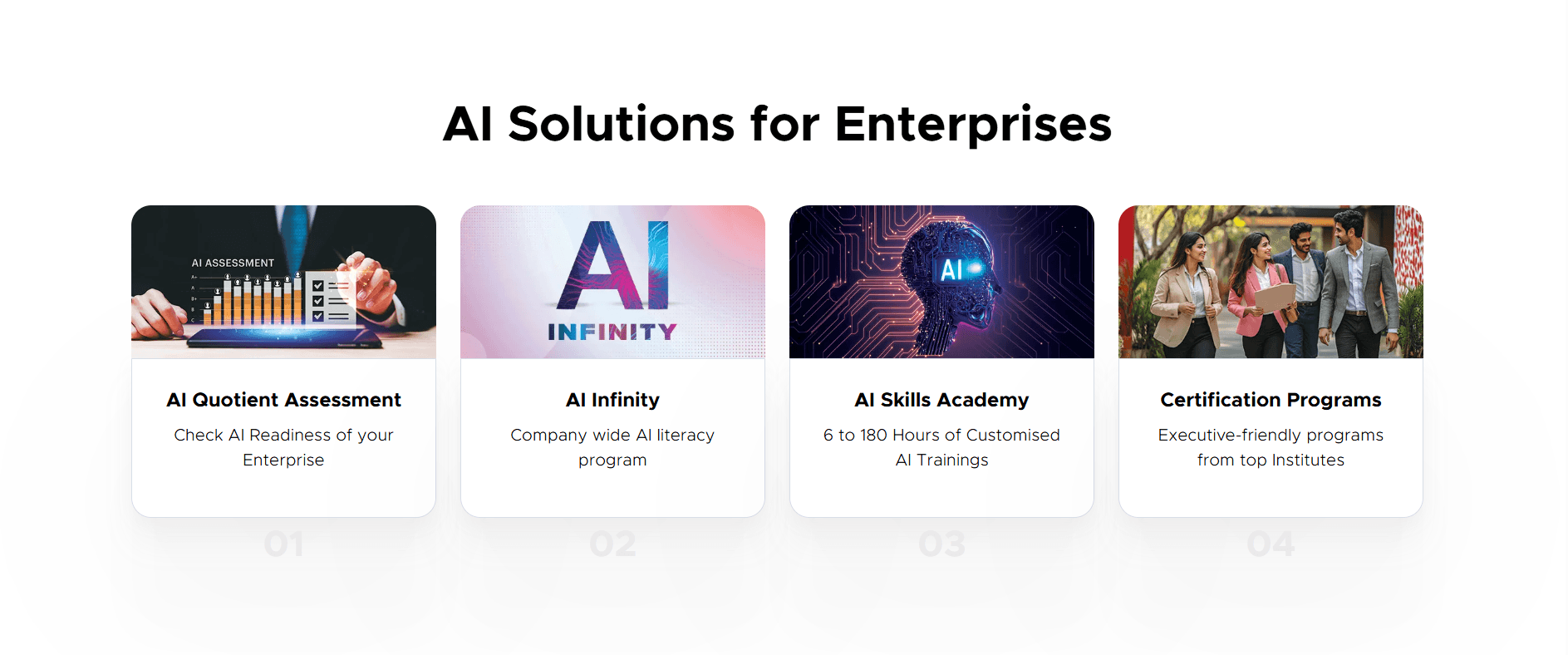
Building an AI-ready organization requires more than deploying new tools. It calls for a structured approach that develops AI capabilities across the workforce while aligning them with business goals. The journey typically unfolds in five stages.
1. Assess Current Readiness
Before designing learning interventions, organizations need a clear understanding of their starting point. This involves evaluating AI awareness, skill levels, adoption maturity, and leadership preparedness across functions and roles. A readiness assessment helps identify capability gaps and ensures training investments are targeted where they can deliver the greatest impact.
2. Build Enterprise-Wide AI Literacy
The next step is creating a common understanding of AI across the workforce. Employees need foundational knowledge of AI, Generative AI, Agentic AI, and responsible AI practices. A shared baseline helps reduce uncertainty, increase confidence, and foster broader adoption beyond technical teams.
3. Develop Role-Based AI Capabilities
Once foundational literacy is established, organizations must focus on practical application. Different functions interact with AI differently, so learning pathways should be tailored to specific roles and business contexts. This enables employees to apply AI directly to their daily work and generate measurable productivity gains.
4. Enable AI-Ready Leadership
Leaders play a critical role in scaling AI adoption. They need the ability to identify opportunities, manage change, govern AI responsibly, and align AI initiatives with strategic business priorities. Building leadership readiness ensures AI transformation is guided by informed decision-making rather than experimentation alone.
5. Sustain Learning and Adoption
AI technologies continue to evolve, making continuous learning essential. Ongoing assessments, hands-on projects, learning pathways, and regular capability updates help organizations keep pace with change and maintain an AI-ready workforce over the long term.
Together, these five stages provide a scalable framework for transforming AI readiness from a short-term initiative into a long-term organizational capability.
Develop AI-Ready Leaders Who Can Drive Transformation
Global AI spending will reach $2.5 trillion in 2026, yet many organizations are still asking how to translate that investment into durable business value. Technology may enable AI adoption, but leadership determines whether it delivers business value. As organizations move from AI experiments to enterprise-wide implementation, leaders must develop the skills to guide transformation, align AI initiatives with strategic priorities, and foster workforce adoption.
According to the World Economic Forum, the organizations that gain the greatest advantage from AI will be those that successfully embed it into everyday work, not simply deploy new technologies.
AI-ready leaders need more than awareness of emerging technologies. They must understand where AI can create business impact, how to redesign workflows around AI, and how to manage the organizational changes that accompany adoption. They also play a critical role in building trust by ensuring AI is deployed responsibly, ethically, and transparently. Deloitte research highlights that workforce trust and leadership buy-in are essential for successful AI adoption at scale.
This is why many organizations are investing in dedicated AI learning journeys for executives and senior managers. When leaders develop AI fluency alongside strategic and governance capabilities, they are better positioned to drive innovation, accelerate adoption, and create sustainable business value from AI.
Sustain Learning and Adoption
Building AI readiness is not a one-time training initiative. As AI technologies continue to evolve, organizations need a culture of continuous learning that helps employees keep pace with new tools, use cases, and ways of working.
To sustain AI adoption, organizations should focus on:
Continuous AI learning pathways that help employees progress from foundational AI literacy to advanced, role-specific capabilities.
Hands-on projects and real-world applications that allow employees to apply AI concepts in their daily work and build confidence through practice.
Regular skills assessments and benchmarking to measure progress, identify emerging capability gaps, and refine learning strategies.
Ongoing exposure to emerging AI trends, including developments in Generative AI, Agentic AI, and responsible AI, ensuring skills remain relevant as technology evolves.
Leadership support and organizational reinforcement that encourages experimentation, knowledge sharing, and responsible AI adoption across teams.
Organizations that treat AI readiness as an ongoing capability rather than a one-time program are better positioned to sustain adoption, maximize workforce productivity, and derive long-term value from their AI investments.
Measuring AI Readiness and Business Impact
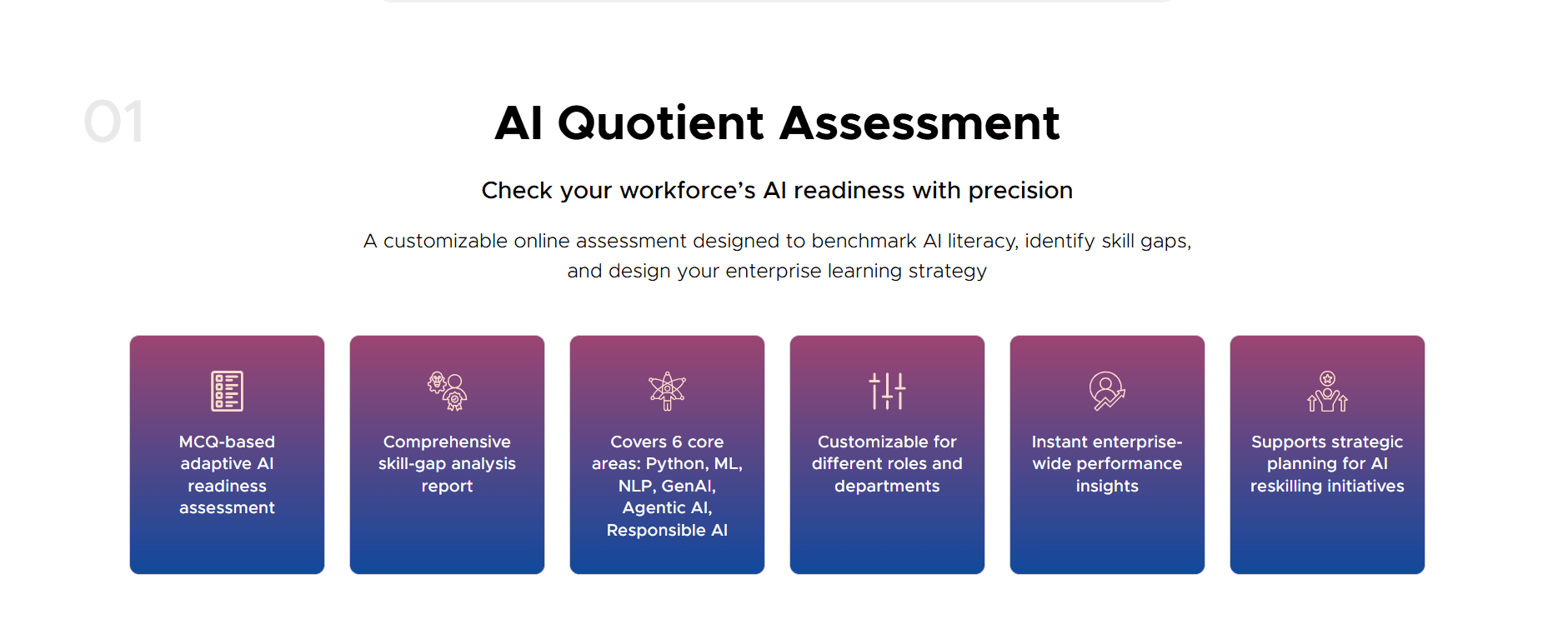
AI readiness initiatives deliver value only when their impact can be measured. For business leaders, the goal is not just to track training completion, but to understand whether learning is translating into workforce capability, AI adoption, and business outcomes.
Key metrics to monitor include:
- AI readiness scores to benchmark workforce knowledge and identify capability gaps across roles and functions.
- AI literacy and skill progression to measure how employees advance from foundational awareness to practical application.
- AI adoption indicators, such as usage of AI tools, participation in projects, and integration into everyday workflows.
- Business impact metrics, including productivity improvements, faster decision-making, process efficiencies, and innovation outcomes.
A structured AI readiness program combines assessment, learning, and ongoing measurement, enabling organizations to continuously track progress and align workforce capabilities with evolving business goals. This transforms AI readiness from a learning initiative into a measurable driver of enterprise performance.
Conclusion
AI readiness is the foundation of successful AI transformation. As organizations move beyond experimentation, the focus must shift from simply deploying AI tools to preparing people to use them effectively, responsibly, and at scale. By combining AI literacy, role-based capability building, leadership development, and continuous learning, enterprises can create a workforce that is equipped to unlock real business value from AI.
For CHROs, CLOs, and business leaders, the opportunity lies in taking a structured, enterprise-wide approach to readiness. Solutions such as TalentSprint's AI Readiness for Enterprises provide a practical framework to assess workforce capabilities, build AI fluency across teams, and develop the leadership needed to drive AI-powered transformation. Organizations that invest in AI readiness today will be better positioned to accelerate adoption, improve productivity, and build a lasting competitive advantage in an AI-driven future.
About the Author
TalentSprint
TalentSprint, Part of Accenture LearnVantage, is a global leader in building deep expertise across emerging technologies, leadership, and management areas. With over 15 years of education excellence, TalentSprint designs and delivers high-impact, outcome-driven learning solutions for individuals, institutions, and enterprises. TalentSprint partners with leading enterprises and top-tier academic institutions to co-create industry-relevant learning experiences that drive measurable learning outcomes at scale.
Explore Our Programme
Advance your career with the right program