How HR Leaders Can Align People Decisions With Business Outcomes?

TL;DR:As HR becomes a strategic driver of growth, leaders must connect people decisions to measurable business outcomes. This requires stronger business acumen, data literacy, and technology fluency. HR professionals who align talent strategy with organizational goals will be better positioned to drive performance, innovation, and long-term enterprise value.
Something meaningful is happening inside the HR function. Rapid technological change, evolving workforce expectations, new regulations, and entirely new models of work are redefining what the role demands. The organisations moving fastest are the ones that stopped treating people decisions as a downstream consequence of strategy and started treating them as a driver of it.
Business leaders increasingly recognize HR as a key driver of sustainable growth and a critical force in fostering a culture that supports innovation and transformation. That is an extraordinary mandate. The opportunity now belongs to HR professionals who can meet it with the strategic and analytical capability it requires.
Why has alignment become the defining HR capability?
HR and business goals drift apart easily. One function is measured on people outcomes, the other on performance and margin, and without deliberate connection the two run on parallel tracks. The result is familiar: strong hires who don't have the skills the business actually needs next, training programmes nobody asked for, and critical roles that stay open while budgets go elsewhere.
Alignment closes that gap. It turns recruitment into capability building, training spend into competitive advantage, and HR reporting into business evidence. More importantly, it changes where HR sits in the conversation. Strategic HR teams understand how the company makes money, anticipate workforce needs before they surface, and help leaders execute strategy through their people rather than simply implementing decisions made elsewhere.
This is the distinction worth internalising: HR that executes strategy is valuable, but HR that shapes it is indispensable.
Start with business fluency, not HR plans
The most consistent lesson across organisations that have made this transition is that alignment begins outside HR. Before designing a single programme, effective HR leaders develop a deep understanding of the organisation's mission, long-term objectives, and immediate commercial priorities.
That means asking different questions:
- How does the business actually create value? Margin expansion, market entry, and rapid scaling each demand entirely different workforce strategies.
- What are leadership's real current priorities? Not the mission statement the live agenda for the next four to six quarters.
- What capabilities will the business need before it needs them? Strategic HR works in multi-quarter planning cycles, integrated with annual business planning.
Once those answers are clear, HR design becomes straightforward. If innovation is the priority, the work is building an environment that rewards creativity, collaboration, and continuous learning. If speed is the priority, the work is organisational design. The people strategy follows the business logic, not the other way around.
Four levers that connect people decisions to outcomes
Alignment is not a single initiative. It operates through four levers, each of which translates a business priority into a people decision with a measurable result.
| Lever | What alignment looks like in practice |
| Talent strategy | Capability forecasting replaces headcount planning. Hiring targets the skills the business will need next, with cultural fit treated as a performance variable, not a soft preference |
| Performance and rewards | Clear goal setting, continuous feedback, and performance-linked reward systems that tie individual contribution directly to organisational objectives |
| Organisational design | Structure, engagement, and employee experience designed around strategic priorities including hybrid and agile models, and inclusive decision-making |
| Change leadership | HR as the catalyst of cultural change and transformation, guiding the organisation through new workforce models rather than reacting to them |
What makes these levers powerful is their interdependence. A compensation redesign without organisational clarity produces confusion. A transformation agenda without talent capability produces stalled execution. HR leaders who can operate all four simultaneously are the ones whose decisions show up in business results.
People analytics: Turning HR decisions into business evidence
If business fluency earns HR a hearing, analytics earns it a seat. Roughly 71% of HR leaders now consider people analytics essential to business growth, and that consensus is reshaping how the function is evaluated.
The shift is from activity to outcome. Traditional HR reporting counts what happened hires made, sessions delivered, surveys completed. Analytics-led HR explains what it meant: which hiring channels produce the strongest performers, where attrition threatens revenue-critical capability, which interventions moved productivity. Real patterns in turnover, engagement, and internal mobility data replace assumption with evidence.
This matters because business leaders make decisions in the language of forecasts and trade-offs. Data analytics for decision making, human resource planning and deployment, and AI-enabled process automation give HR leaders exactly that vocabulary. When workforce data can predict rather than report, HR moves into the planning room.
AI and digital transformation: The new alignment frontier
The next frontier is already visible.
C-suite leaders expect AI to significantly change roles within their organisations, which places HR at the centre of one of the most consequential transitions businesses will manage this decade.
This is genuinely good news for the function. AI is creating HR work that did not exist before designing pro-worker AI applications, applying AI across recruitment, learning, performance management, and career planning, and establishing responsible AI governance for people decisions. Alongside this sits the practical work of leading digital transformation across platforms such as Workday, CRM, and ERP systems, and addressing ESG considerations in workforce strategy.
HR leaders who build fluency here do not just adopt tools. They shape how technology and human capability combine which is, increasingly, the core question of business strategy itself.
Building the capability set with IIM Mumbai
Here is the honest constraint: strategic thinking, financial fluency, analytics, and digital transformation capability are difficult to build simultaneously while running a full HR function. On-the-job learning tends to develop piecemeal, in whatever order circumstances allow.
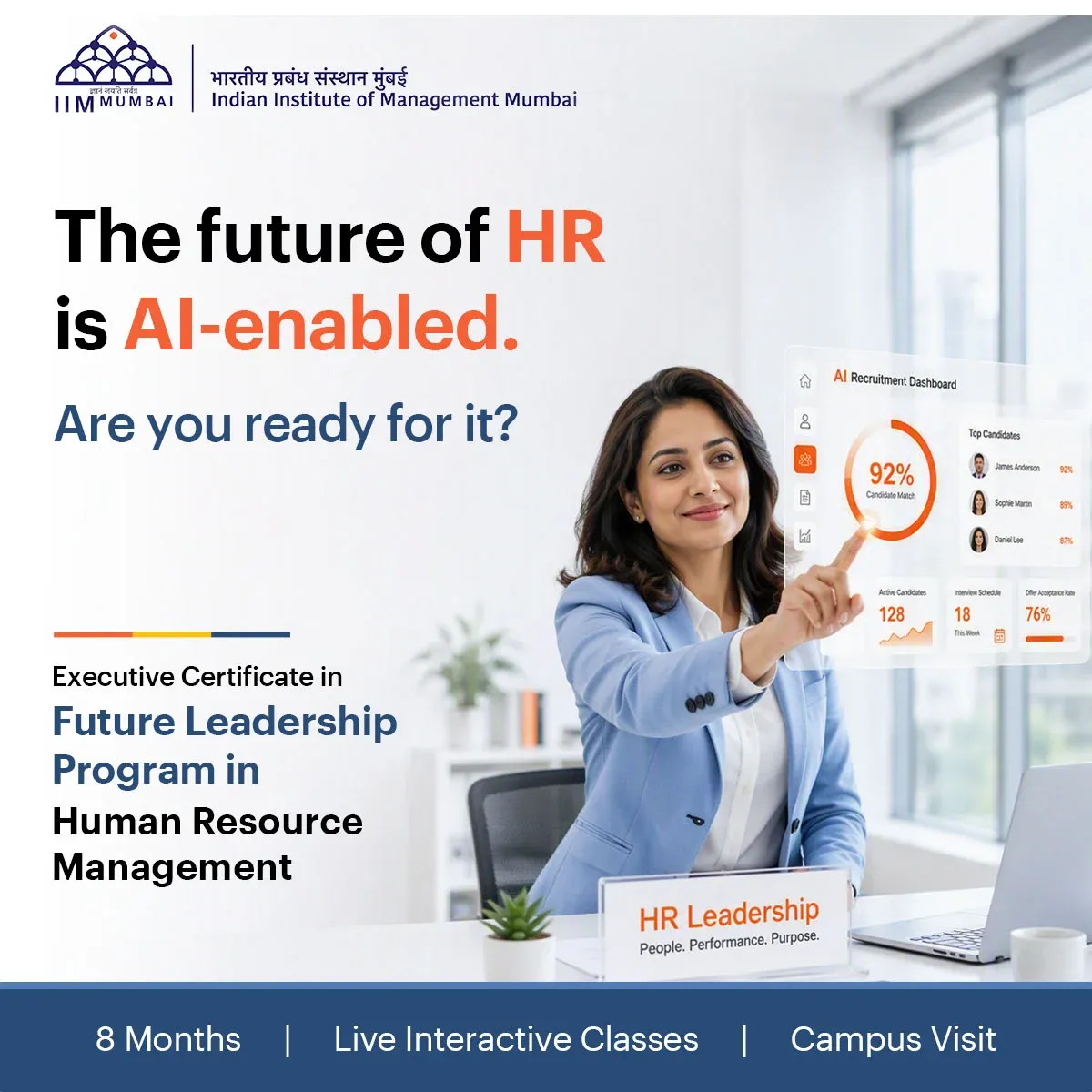
IIM Mumbai's Executive Certificate in Future Leadership Program in Human Resource Management is designed to close that gap systematically. Delivered over eight months through live, interactive online classes, the curriculum follows the complete employee lifecycle HR leadership and personal effectiveness, talent acquisition and retention, compensation and benefits, international HRM, digital transformation and Human-AI, organisational design, change leadership, and strategic leadership with functional integration.
Designed for immediate workplace impact, the programme combines academic rigor with practical application. Participants address real business problems through a capstone project, engage with a diverse cohort of professionals, and benefit from faculty guidance in leadership, human capital strategy, and organizational development.
Who this path is for?
The programme is built for mid-career HR and management professionals with at least three years of experience who are ready to move beyond HR operations into roles that shape business direction. If you are already influencing talent, culture, or transformation decisions and want the strategic, analytical, and technological depth to do it at scale, this is the capability set that supports that transition.
The next decade of HR leadership
Alignment is not an innate quality that some HR leaders possess and others don't. It is a learnable capability a combination of business understanding, analytical rigour, technological fluency, and the confidence to translate all three into decisions that move the organisation forward.
The mandate is already there. Executives are asking HR to own growth, culture, and the human side of technological change. The HR leaders who build these capabilities now won't be waiting for a seat at the table they'll be helping decide what's on it.
Way Forward
The mandate for HR has fundamentally changed. According to Accenture, 89% of CEOs expect CHROs to play a central role in driving long-term profitable growth, while 88% believe they should foster a culture of innovation across the enterprise. As organizations combine data, technology, and talent to accelerate growth and resilience, HR leaders are increasingly expected to shape business outcomes, not just workforce outcomes.
The future will belong to those who can translate people strategy into measurable value, use evidence to inform decisions, and lead workforce transformation with confidence. For today's HR professionals, the opportunity is clear: build the capabilities to influence the business agenda and help define the future of work.
Frequently Asked Questions
1. How can HR leaders align people decisions with business outcomes?
By first understanding how the business creates value and what leadership's priorities are, then designing talent, rewards, and structural decisions to serve those priorities and measuring the result in business terms.
2. What is strategic HR, and how is it different from traditional HR?
Strategic HR aligns people, structure, and culture with long-term business goals in multi-quarter planning cycles. Traditional HR is more reactive and operational.
3. Why is people analytics important for business growth?
People analytics is important for business growth. Analytics turns workforce data into evidence showing where attrition, hiring, or productivity gaps affect the business so HR can forecast, not just report.
4. How is AI changing the role of HR leaders?
C-suite leaders expect AI to significantly change roles. HR is now applying AI in recruitment, learning, and performance management, and leading digital transformation across systems like Workday and ERP.
5. What skills do mid-career HR professionals need for strategic leadership roles?
Business fluency, people analytics, digital/AI capability, and change leadership. IIM Mumbai's Executive Certificate in Future Leadership Program in Human Resource Management builds these over 8 months, with a capstone project on real business challenges.
About the Author
TalentSprint
TalentSprint, Part of Accenture LearnVantage, is a global leader in building deep expertise across emerging technologies, leadership, and management areas. With over 15 years of education excellence, TalentSprint designs and delivers high-impact, outcome-driven learning solutions for individuals, institutions, and enterprises. TalentSprint partners with leading enterprises and top-tier academic institutions to co-create industry-relevant learning experiences that drive measurable learning outcomes at scale.
Explore Our Programme
Advance your career with the right program