
Can AI Replace Designers? The Truth Behind AI-Generated Visuals
Last Updated:
February 12, 2026
Published On:
February 12, 2026

Think about a game studio generating concept art for a new level. Earlier the Designers used to spend days creating iterations but now tools like, MidJourney can produce dozens of variations in hours, giving the team a faster starting point.
This is just one,there are so many examples that shows how AI is reshaping workflows.
According to a report, Nearly 9 in 10 designers say AI helps them work faster, by cutting repetitive tasks, creating copy, or shaping prototypes. For many, it’s no longer just interesting; it’s essential.
But does speed really mean replacement? AI can generate visuals at lightning speed, producing polished outputs in seconds.
Yet, behind that impressive efficiency lies a limitation, it lacks the human intuition, emotional depth, cultural awareness, and nuanced brand sensibility that define truly powerful design.
And so, the debate continues. Can AI replace designers, or is it simply going to reshape the way they work? Let’s explore this question and uncover.
Also Read: What is Visual Design? The Silent Engine of User Experience
What is AI in Design?
AI in design refers to the use of artificial intelligence tools and systems to assist, enhance, or automate parts of the design process.
Instead of manually creating everything from scratch, designers can now use AI to generate ideas, create visuals, suggest layouts, refine content, or even prototype designs faster.
Also Read: AI Graphic Design in 2026
Understanding AI Generated Visuals
AI-generated visuals are images, graphics, videos, or 3D designs created by artificial intelligence instead of being manually designed from scratch by a human.
For example: You can ask Canva AI to create Instagram post variations and it will design multiple layouts in seconds.
Under the hood, these tools are trained on massive datasets of images and visual patterns. They learn styles, compositions, colors, and structures, and then generate new visuals based on patterns they’ve absorbed.
But here’s the important thing, AI generates based on patterns and probability and It doesn’t truly “understand” culture, emotions, or brand identity the way human designers do.
That’s why AI-generated visuals are powerful for speed and experimentation, but they still depend on human creativity, direction, and judgment to make them meaningful.
What AI Can Do for Designers?
There are so many things that AI can do for the designers, AI works for designers by acting as an intelligent assistant, one that can generate ideas, automate repetitive tasks, analyze data, and even suggest creative directions. It doesn’t replace the designer; it enhances what the designer can do.
1. Idea Generation: AI can generate mood boards, style variations, logos, and visual concepts from simple prompts.
2. Image & Graphic Creation: Tools like Midjourney, DALL·E, and Adobe Firefly create illustrations, backgrounds, and branded visuals.
3. Layout & UI Suggestions: Platforms like Figma AI and Canva suggest layouts, color palettes, spacing, and typography combinations.
4. Automation of Repetitive Tasks: Background removal, resizing for multiple platforms, color correction, and formatting can be automated.
5. Personalization at Scale: AI helps brands create multiple ad creatives or website variations tailored to different audiences.
Also Read: The Surprising Facts: Will AI Replace Human Jobs or Make New Ones?
Why Human Designers Are still essential?
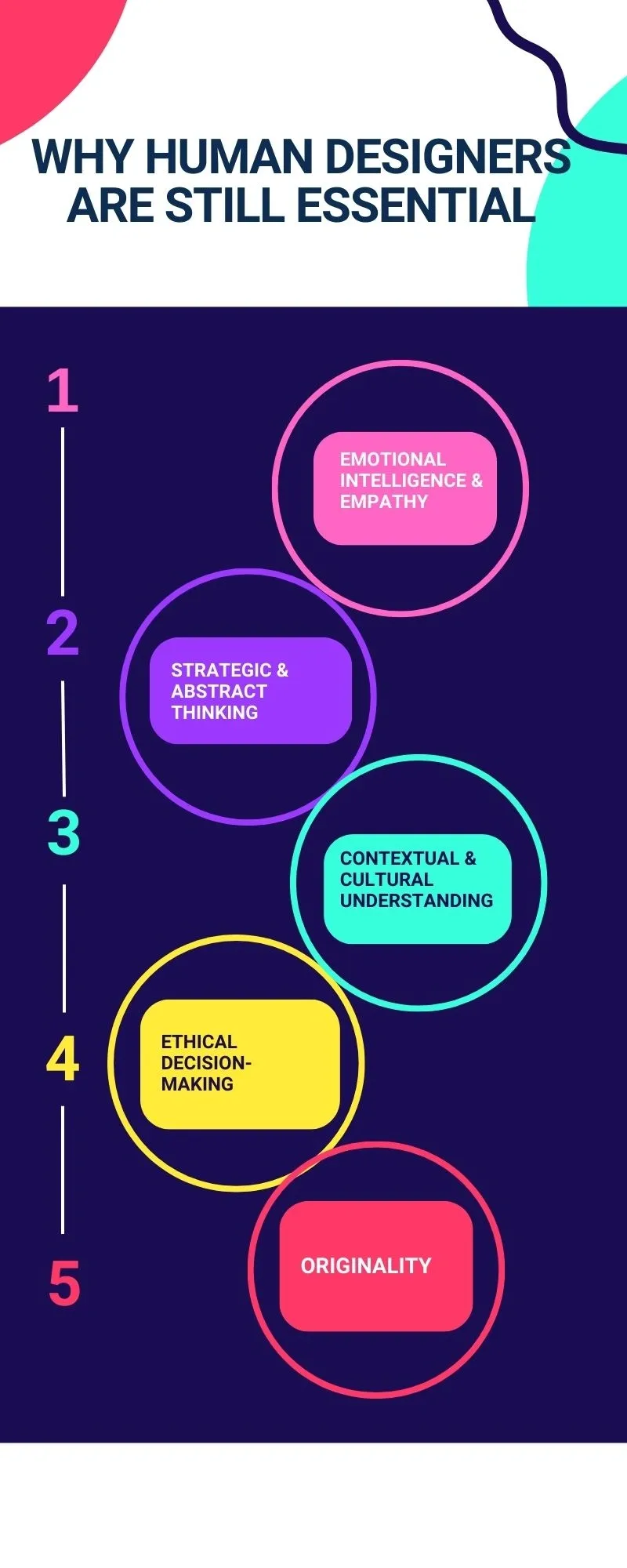
1. Emotional Intelligence & Empathy
Good design isn’t just about how something looks. It’s about how it makes someone feel.
When a designer works on a healthcare app, they think about nervous patients. When they design a finance tool, they think about stressed users trying not to make mistakes. That awareness shapes color choices, layout, tone of voice, everything.
AI can recognize emotional patterns in data. But it doesn’t actually understand fear, excitement, frustration, or hope. Designers do. They’ve experienced those emotions themselves. That lived experience shows up in their work.
2. Strategic & Abstract Thinking
Sometimes clients don’t say, “We need a new logo.”
They say, “Something feels off.”
That’s abstract. And it’s the designer’s job to figure out why.
Maybe the brand no longer matches its audience. Maybe the visuals don’t support business goals. Maybe competitors have evolved.
Designers connect the dots between business strategy and visual execution. They turn fuzzy ideas like “premium,” “bold,” or “trustworthy” into real, consistent systems.
3. Contextual & Cultural Understanding
Design doesn’t happen in a vacuum. It lives inside culture.
Colors, symbols, images, they all mean different things depending on where and when they’re used. What feels playful in one culture might feel disrespectful in another. What feels fresh today might feel outdated next year.
Designers pick up on these subtleties because they’re part of the world. They notice shifts in trends, conversations, and social climate.
4. Ethical Decision-Making
Design has power. It can persuade, influence, and shape behavior.
That means designers constantly make choices like:
- Is this checkout flow honest?
- Is this ad stereotyping anyone?
- Are we respecting user privacy?
AI can optimize for clicks or conversions. But it doesn’t pause and ask, “Is this the right thing to do?”
Ethics require responsibility, and responsibility is human.
5. Originality
AI is trained on what already exists.
Designers imagine what doesn’t.
The difference often lies in small details, adjusting spacing, softening typography, holding back when everyone else is going loud.
Let’s Reveal the Truth: Can AI replace designers?
AI is not going to replace designers rather it is going to replace some design tasks by reducing the time turning the work to be more efficient and easier for them.
We already know, AI is excellent at generating visuals quickly. It can create logos, social media posts, UI mockups, mood boards, and even brand concepts in minutes. For repetitive, production-heavy work, AI can absolutely take over.
But design isn’t just about making things look good.
We need the designers for the designs to outshine, customize and give the personal touch to it, which can only be provided, when human emotion and brain is involved.
AI works from patterns in data. Designers work from experience, judgment, and intent.
Remember:
- AI Can Produce but Designers Decide.
- Design Is About Meaning, Not Just Aesthetics.
- Emotional Intelligence Is Still Human.
- Context Matters, And Context Is Messy.
- Creativity Is More Than Prediction
- Accountability Still Belongs to Humans
The real shift isn’t “AI vs designers.”
It’s designers who use AI becoming faster, more experimental, and more efficient.
How can we move beyond this shift by learning design the right way?
As AI reshapes the design landscape, the real question isn’t whether designers will survive, it’s whether they’ll evolve. And evolution requires learning with intention.
A structured design course helps you understand what’s truly changing. It moves you beyond tools and trends and focuses on the foundations: design thinking, user research, interaction principles, visual storytelling, and strategic problem-solving. These are the skills AI cannot replicate, but can amplify when used wisely.
Through hands-on projects and real-world case studies, you begin to see how AI fits into the workflow.
Programs like IIT Hyderabad Visual Design course reflect this shift. With a focus on user-centric design, practical exposure, portfolio-building, and emerging interface experiences, such programs prepare designers to think critically and create responsibly in an AI-assisted world.
Because in this new era, design education isn’t just about mastering software, it’s about mastering perspective.
Conclusion
AI can generate visuals in seconds, But designs has never been about outputs. What’s changing isn’t the need for designers, it’s the nature of their role.
Because, In the end, AI doesn’t replace designers. It replaces routine and The future belongs to designers who can think beyond the screen, and use technology not as a crutch, but as a catalyst.
Frequently Asked Questions
Q1. Can AI completely replace professional designers?
No, AI cannot fully replace designers. It can automate repetitive tasks and generate visuals quickly, but it lacks emotional intelligence, strategic thinking, and contextual judgment, qualities essential for meaningful, brand-aligned design.
Q2. What can AI-generated design tools actually do?
AI tools can create logos, social media graphics, website layouts, mood boards, and even UI prototypes in seconds. They speed up ideation and production but still require human guidance for refinement and strategic alignment.
Q3. Why are human designers still important in the AI era?
Human designers bring empathy, creativity, cultural awareness, and ethical judgment. They interpret business goals, define brand identity, and ensure originality — areas where AI operates only through pattern recognition, not lived experience.
Q4. Will AI change the role of designers in the future?
Yes, but it won’t eliminate it. Designers are shifting from execution-heavy roles to strategic and creative direction roles, using AI as a collaborative tool rather than competing against it.
Q5. Should designers learn to use AI tools?
Absolutely. Designers who embrace AI can work faster, experiment more freely, and deliver greater value. The advantage lies not in resisting AI, but in learning how to guide and refine it effectively.
About the Author
TalentSprint
TalentSprint, Part of Accenture LearnVantage, is a global leader in building deep expertise across emerging technologies, leadership, and management areas. With over 15 years of education excellence, TalentSprint designs and delivers high-impact, outcome-driven learning solutions for individuals, institutions, and enterprises. TalentSprint partners with leading enterprises and top-tier academic institutions to co-create industry-relevant learning experiences that drive measurable learning outcomes at scale.
Advance your career with the right program
