Driving Digital Transformation: 7 Steps Senior Leaders Follow to Get It Right

TL;DR:Digital transformation succeeds when leaders drive it deliberately. This blog outlines seven steps senior leaders follow, from setting a clear vision and aligning teams to building AI-ready capabilities and sustaining momentum, so technology investments translate into measurable business outcomes rather than stalled initiatives.
Every enterprise today has a digital agenda. Far fewer have leaders equipped to carry one through. Gartner finds that only 48% of enterprise-wide digital initiatives achieve their intended outcomes a gap that rarely comes down to technology. It comes down to leadership. Just 20% of organisations report high confidence in their leadership strength, even as 70% of leaders expect generative AI to fundamentally reshape how business works.
That gap is also the opportunity. Leaders who can connect strategy, technology and people are the ones turning disruption into durable advantage. What separates them is not instinct, but method. These seven steps describe how they consistently get transformation right.
What digital transformation actually means in the AI era?
Ask ten leaders to define digital transformation and you will likely get ten answers which is precisely why so many programmes lose direction early. McKinsey offers the clearest framing: transformation is the fundamental rewiring of how an organisation operates to meet evolving business needs and scale for the future. Note the emphasis. Not adding tools. Rewiring.
What has changed is the engine driving that rewiring. Cloud migration and process automation defined the last decade. This one belongs to AI decision intelligence, agentic systems and autonomous workflows that reshape how choices get made across finance, operations, customer and talent.
That shift moves transformation out of the technology function and onto the general management agenda. It is no longer a systems upgrade to be delegated. It is a business-model question senior leaders are expected to answer themselves.
The 7-Step roadmap senior leaders follow
Transformation rarely fails for lack of ambition. It fails for lack of sequence. These seven steps describe the order in which experienced leaders actually work.
Step 1: Define What Transformation Means for Your Business
Digital transformation looks different in every organisation it may mean applying AI for sharper insight, or replacing systems that no longer scale. Ambiguity here quietly derails everything downstream. Effective leaders open by answering the 'what' and the 'why' in business language: the disruption being faced, the customer expectation outpacing capability, the outcome being pursued.
Leader's move: Write the outcome before naming the technology.
Step 2: Assess Readiness Before Committing Capital
Vision without an honest baseline produces expensive surprises. Readiness spans four dimensions: the state of legacy systems, the quality and accessibility of data, the depth of talent, and the organisation's genuine appetite for change. Senior leaders treat this as a diagnostic exercise, not a formality because in an AI-led agenda, data maturity and AI literacy determine what is realistically achievable.
Leader's move: Audit capability honestly, then scope ambition to match.
Step 3: Formulate Strategy and Sequence the Portfolio
Strategy converts intent into a prioritised set of moves. Rather than pursuing every opportunity simultaneously, leaders identify a small number of high-value use cases, sequence them by feasibility and impact, and assign each a business owner accountable for the P&L outcome. Sequencing matters as much as selection early wins fund credibility for the harder work that follows.
Leader's move: Fewer initiatives, each with a named owner.
Step 4: Build a Digital-First Culture
Transformation is not just a technology shift; it is a fundamental shift in culture, strategy and operations. Tools arrive faster than behaviours change, and that gap is where adoption stalls. Leaders close it deliberately communicating the rationale, equipping teams with AI fluency, making experimentation safe, and modelling the behaviour themselves before expecting it of others.
Leader's move: Lead adoption visibly; do not delegate it.
Step 5: Deploy Technology With Intent
Technology should serve the strategy, never dictate it. The question is no longer which platform to buy, but which decisions should be augmented, automated or redesigned entirely. That points leaders toward decision intelligence, agentic AI and autonomous workflows applied across customer, finance, operations and talent the functions where enterprise value actually moves.
Leader's move: Start from the decision, then choose the tool.
Step 6: Track Success and Govern Risk
What gets measured gets sustained. Leaders define success metrics upfront adoption, cycle time, cost-to-serve, revenue impact and review them on a fixed rhythm rather than at programme close. Alongside performance sits governance: responsible AI practices, model oversight, data privacy and clear accountability, which increasingly determine whether an AI initiative survives scrutiny at board level.
Leader's move: Set KPIs and guardrails before go-live, not after.
Step 7: Institutionalise Continuous Innovation
Digital transformation is constant, demanding businesses to adapt to rapid technological change. There is no completion date. The organisations that compound advantage build reinvention into their operating rhythm reviewing the portfolio regularly, retiring what no longer works, and scaling what does.
Leader's move: Treat transformation as an operating cadence, not a programme.
The Capability Shift: From Functional Expert to Enterprise-Wide Leader
Read the seven steps again and a pattern emerges. Not one of them belongs to a single function. Sequencing a portfolio requires financial judgement. Scaling adoption requires talent insight. Governing AI requires fluency in both risk and technology. The roadmap assumes a leader who can move across the enterprise, not one who optimises a corner of it.
That is the real shift underway. Functional depth built most senior careers and it remains valuable but it is no longer sufficient on its own. Organisations now need leaders who read a P&L, a supply chain and a model output with comparable confidence, and who can connect all three to a strategic decision.
This breadth is learnable, but rarely by accident. It comes from structured exposure to every function, applied to real business problems which is precisely what executive education is designed to deliver.
Also Read: Is functional expertise secretly holding back your career growth?
How the IIM Mumbai AI-Enabled Senior Management Programme builds this?
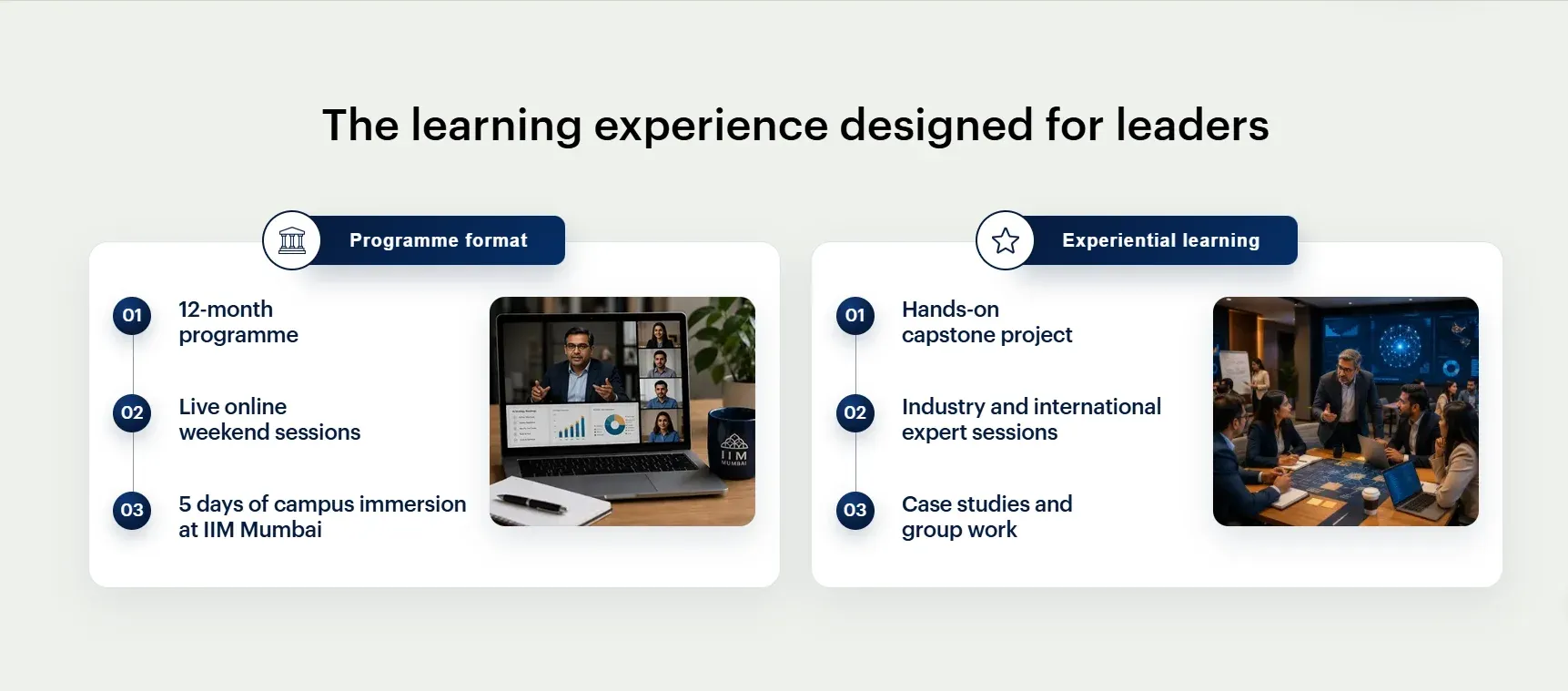
The Executive Certificate in AI-Enabled Senior Management Programme is built around exactly this shift integrating AI across business functions to prepare leaders for enterprise-wide impact. Its 13-module curriculum tracks the roadmap closely:
- Steps 1–2 | AI-Driven Leadership Foundations: Leading in the Age of AI, Strategic Thinking with AI, and Analytics and AI Foundations for Business Decision-Making build the vision and diagnostic lens
- Steps 3–5 | AI Across Business Functions: Customer and market leadership, financial leadership, operations and supply chains, and talent leadership, so strategy and deployment are understood function by function
- Steps 6–7 | Enterprise Transformation & Innovation: AI business models, AI-native organisations, leading change and adoption, Responsible AI and governance, and boardroom leadership
Designed for working leaders, it runs 12 months live-online with weekend classes, hands-on sessions on Claude, ChatGPT, Copilot and Gemini, a capstone on a real business challenge, a five-day IIM Mumbai campus immersion, and IIM Mumbai Executive alumni status.
Who Should Follow This Roadmap?
This roadmap is built for senior professionals who carry accountability for outcomes beyond their own function senior managers, business leaders, functional heads, entrepreneurs, and experienced professionals stepping into wider leadership mandates.
If your remit now includes any of the following, the seven steps apply directly to your work:
- Leading digital transformation across the enterprise rather than within one team
- Bringing an AI-informed strategic perspective to planning and investment decisions
- Influencing boardroom decisions with sharper judgement
- Shaping change through responsible AI adoption
- Turning complex, cross-functional challenges into measurable enterprise value
Conclusion
The seven steps are repeatable. What varies is the leader running them how clearly the vision is framed, how honestly readiness is assessed, how deliberately adoption is led.
That capability is the differentiator worth investing in. Structured programmes such as the Executive Certificate in AI-Enabled Senior Management Programme from IIM Mumbai are designed to build it equipping leaders to lead with an AI-informed strategic perspective, drive transformation across the enterprise, and turn complex challenges into enterprise value.
Transformation rewards the prepared.
Frequently Asked Questions
1. What are the 7 steps of digital transformation for senior leaders?
Covers the core roadmap define transformation, assess readiness, formulate and sequence strategy, build a digital-first culture, deploy technology with intent, track success and govern risk, and institutionalise continuous innovation. Strong featured-snippet candidate.
2. Why do most digital transformation initiatives fail to deliver results?
Anchors to the Gartner finding that only 48% of enterprise-wide digital initiatives achieve their intended outcomes, and attributes the gap to leadership, sequencing and adoption rather than technology.
3. How is AI changing the role of senior management in digital transformation?
Reinforces the blog's central claim that transformation has moved from the technology function to the general management agenda, with AI acting as a strategic business enabler.
4. Which programme helps senior professionals lead enterprise-wide AI transformation?
Conversion-oriented question answering with the IIM Mumbai AI-Enabled Senior Management Programme 12 months, live-online weekend classes, capstone project, five-day campus immersion and IIM Mumbai Executive alumni status.
About the Author
TalentSprint
TalentSprint, Part of Accenture LearnVantage, is a global leader in building deep expertise across emerging technologies, leadership, and management areas. With over 15 years of education excellence, TalentSprint designs and delivers high-impact, outcome-driven learning solutions for individuals, institutions, and enterprises. TalentSprint partners with leading enterprises and top-tier academic institutions to co-create industry-relevant learning experiences that drive measurable learning outcomes at scale.
Explore Our Programme
Advance your career with the right program