Seven Capabilities That Distinguish Enterprise Leaders from Functional Managers

TL;DR:Enterprise leadership requires a fundamental shift from functional excellence to organisation-wide impact. Senior leaders must develop systems thinking, create stakeholder value, exercise strategic judgement, prioritise decisively, lead through disruption, influence beyond authority, and execute through people and purpose. These capabilities enable leaders to navigate complexity and shape enterprise outcomes.
Running a function well has long been the proving ground for senior leadership. Yet the qualities that make someone an exceptional functional head do not automatically carry them to the top of the enterprise. The real shift lies in moving from optimising one part of the business to shaping the whole.
Recent leadership research suggests this transition has become more demanding than ever. Generative AI, geopolitical volatility and flatter organisations with fewer stepping-stone roles are redefining what enterprise leadership requires, while leaving less time to prepare for it.
So, what truly separates enterprise leaders from functional managers? This blog explores seven capabilities that define the difference and how experienced leaders can build them with intent.
Functional Manager vs. Enterprise Leader
A functional manager succeeds by optimising their unit: meeting targets, deepening expertise and leading a capable team. An enterprise leader succeeds by optimising the whole organisation, often making trade-offs that may not favour the function they once led.
| Dimension | Functional Manager | Enterprise Leader |
| Scope | One function or business unit | The enterprise as a complete ecosystem |
| Decisions | Expertise-led and operational | Judgement-led, with cross-functional trade-offs |
| Success metrics | Functional KPIs | Value for customers, employees, shareholders and partners |
| Time horizon | Quarterly delivery | Long-term direction |
| Source of influence | Positional authority | Influence across and beyond the organisation |
| Core focus | Solving problems | Setting the agenda |
The difference, then, isn't seniority or years of experience. It is perspective and judgement: the ability to turn deep functional expertise into impact across the enterprise.
Also Read: Leadership vs Management: Understanding the Critical Differences
Why is the path to enterprise leadership evolving?
The move from functional to enterprise leadership still follows familiar steps. What has changed is the context around it. Three forces are reshaping the transition, and each one opens new opportunities for leaders who are ready to grow.
- Generative AI: Leaders are moving from producing insight themselves to governing how people and AI make decisions together. This opens new possibilities for speed, scale and sharper judgement.
- Geopolitical and regulatory shifts: External complexity is now a central leadership concern. This rewards leaders who can read the wider environment and turn uncertainty into advantage.
- Flatter organisations: With fewer intermediate roles, high-potential leaders have the chance to step into enterprise responsibilities earlier in their careers.
Together, these forces show that experience alone is no longer the full measure of readiness. Leaders who deliberately build enterprise-wide perspective, adaptive strategy and AI-informed judgement will be best placed to shape what comes next.
Also Read: A Strategic Shift From Mid-level Manager to Business Leader
Seven capabilities that distinguish enterprise leader from functional managers
The first step towards enterprise leadership is a wider lens. Before leaders can shape the whole organisation, they must learn to see it clearly.
1. Enterprise-Wide Systems Thinking
Experienced functional heads bring deep expertise. Enterprise leaders add breadth, seeing the organisation as a complete ecosystem in which finance, marketing, operations and people constantly shape one another. Part of this is financial fluency: the ability to read the numbers behind every decision and put resources where they create the greatest return. A choice in one function inevitably ripples across others. Seeing those connections early is what turns expertise into enterprise judgement.
2. Value Creation Across Stakeholders
Functional success is often measured by functional KPIs. Enterprise success is measured by the value created for customers, employees, shareholders and partners alike. Leaders who balance these interests build trust, sustain growth and set the organisation up for long-term success.
3. Strategic Judgement Under Complexity
Enterprise decisions rarely come with complete information or one right answer. They call for higher-order thinking: the ability to interpret complexity, weigh competing priorities and make consequential choices with confidence. Just as important is treating strategy as a living discipline. Instead of relying on fixed annual plans, enterprise leaders keep sensing market shifts, testing assumptions and adjusting course as conditions change.
4. Focused Prioritisation: From Problem Solver to Agenda Setter
Functional managers excel at solving problems, while enterprise leaders set the agenda. With so many demands competing for attention, their real advantage lies in cutting through the noise and committing to a few critical priorities, ideally no more than three. This focus aligns teams, directs resources wisely and turns strategic intent into measurable progress.
5. Leading Through Disruption and AI-Augmented Decisions
As AI becomes part of how organisations operate, the leader's role is changing. It is less about generating every insight personally and more about governing how people and intelligent systems decide together. That means setting guardrails, questioning outputs and keeping accountability firmly with people. Leaders who guide digital transformation clearly turn technology into lasting competitive advantage rather than short-lived experiments.
6. Influence Beyond Authority: From Warrior to Diplomat
Within a function, authority often comes with the role. At the enterprise level, much of what matters lies beyond direct control, from regulators and partners to investors and communities. Enterprise leaders shape outcomes through influence. They build coalitions, earn trust across boundaries and give people a purpose worth following. In an increasingly interconnected world, aligning diverse stakeholders may well be the defining leadership advantage
7. Execution Through People and Purpose
Enterprise leaders know that execution is how a vision becomes reality. They don't manage every detail themselves. Instead, they create the conditions for others to deliver by removing obstacles, allocating resources wisely and giving clear direction. They also build flexible teams that come together around priorities rather than fixed reporting lines.
More and more, this means designing operating models where people and AI work side by side. Purpose matters just as much. When people understand why their work matters, commitment follows naturally. Ultimately, enterprise leadership is measured not by what a leader plans, but by what the organisation achieves together.
How Can Senior Leaders Build These Capabilities?
Enterprise capabilities rarely develop by chance. They grow through deliberate exposure, honest reflection and learning that goes beyond familiar ground.
- Step beyond your function: Seek out cross-functional assignments and roles that involve external partnerships. Working with unfamiliar stakeholders builds the breadth and diplomacy that enterprise roles demand.
- Get close to AI-led decisions: Gain hands-on experience governing AI-enabled processes. Learn where algorithms add value and where human judgement must prevail.
- Examine your blind spots: Regularly ask where your functional lens might be narrowing your view of the wider enterprise, and invite candid feedback.
- Learn from those who have made the leap: Engage with experienced CEOs and peers from other industries. Their reflections offer a perspective that no playbook can replicate.
The leaders who grow fastest treat development as an ongoing discipline, not an occasional event.
How does the LEAD programme by IIM Calcutta prepare enterprise leaders?
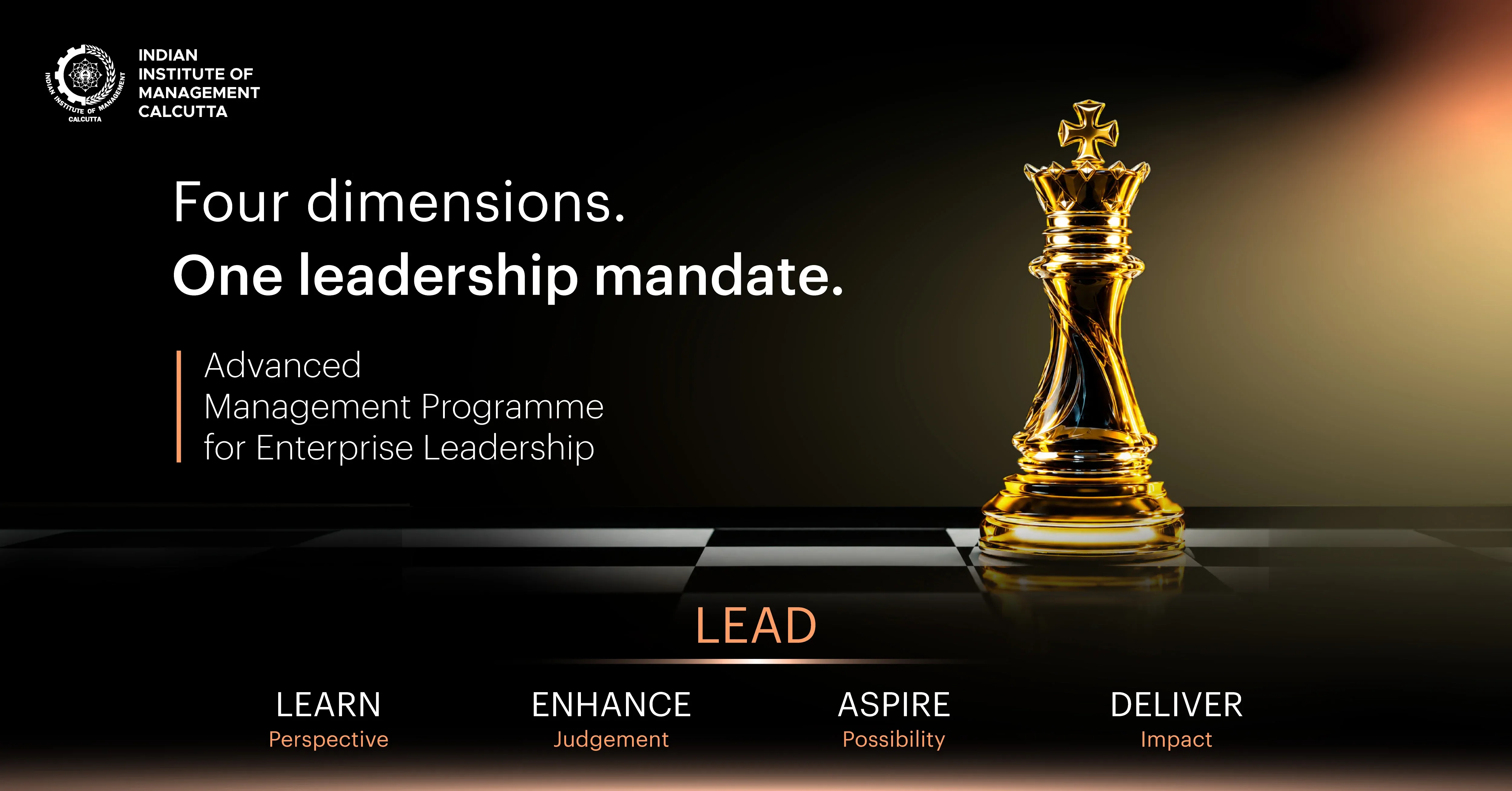
The seven capabilities are not learnt in isolation. The Advanced Management Programme for Enterprise Leadership (LEAD) by IIM Calcutta builds them through four connected dimensions:
- LEARN builds systems thinking and value creation, helping leaders see the enterprise as a complete ecosystem.
- ENHANCE strengthens strategic judgement and focused prioritisation for decisions of greater consequence.
- ASPIRE prepares leaders to navigate disruption and lead with influence as new shifts redefine the enterprise.
- DELIVER turns leadership intent into execution, with people and purpose at its core.
Delivered across four campus residencies at IIM Calcutta, LEAD brings together faculty, experienced industry leaders and a cross-industry peer circle. The Learning Diary, Organisational Manifesto and The CEO Looks Back help leaders apply every insight to their own enterprise.
For leaders ready to shape what comes next, LEAD offers the perspective to see further and the judgement to lead with confidence.
Way Forward
The next generation of enterprise leaders will be defined less by the functions they have mastered and more by the futures they can imagine and build. Seeing the whole system, judging with clarity, anticipating change, influencing beyond authority and delivering through people purpose and are fast becoming the foundations of leadership at the top.
As AI, global complexity and flatter organisations open new paths to senior roles, leaders who invest in these capabilities now will be ready to step forward and shape what comes next. For experienced leaders ready to take that step, LEAD by IIM Calcutta offers a natural next move: a place to broaden perspective, sharpen judgement and lead the enterprise into its next chapter with confidence.
Frequently Asked Questions
1. What is the difference between a functional manager and an enterprise leader?
A functional manager focuses on making one unit perform well, through functional KPIs, expertise and team delivery. An enterprise leader focuses on the whole organisation. They make cross-functional trade-offs, balance value for different stakeholders and set long-term direction, even when those choices don't favour their former function.
2. What are the seven capabilities that distinguish enterprise leaders?
The seven capabilities are:
- Enterprise-wide systems thinking
- Value creation across stakeholders
- Strategic judgement under complexity
- Focused prioritisation
- Leading through disruption and AI-augmented decisions
- Influence beyond authority
- Execution through people and purpose
Together, they help leaders move from functional excellence to impact across the whole enterprise.
3. Why is the move to enterprise leadership more demanding today?
Three forces are reshaping the transition: generative AI, geopolitical and regulatory volatility, and flatter organisations with fewer stepping-stone roles. Leaders now need to govern how people and AI make decisions together, treat strategy as something that keeps adapting, and step into enterprise responsibilities with less time to prepare.
4. How can senior leaders build enterprise leadership capabilities?
Senior leaders can build these capabilities in four ways:
- Take on cross-functional and external-facing roles.
- Get hands-on experience governing AI-led processes.
- Reflect on their blind spots.
- Learn from experienced CEOs and peers from other industries.
Structured executive programmes can speed this up by combining real-world perspectives with practical application.
About the Author
TalentSprint
TalentSprint, Part of Accenture LearnVantage, is a global leader in building deep expertise across emerging technologies, leadership, and management areas. With over 15 years of education excellence, TalentSprint designs and delivers high-impact, outcome-driven learning solutions for individuals, institutions, and enterprises. TalentSprint partners with leading enterprises and top-tier academic institutions to co-create industry-relevant learning experiences that drive measurable learning outcomes at scale.
Explore Our Programme
Advance your career with the right program