What Will Define Enterprise Leadership in the Next Decade?

TL;DR:Enterprise leadership in the next decade will be defined by the ability to navigate complexity, lead through uncertainty, make enterprise-wide decisions, embrace technological change, and drive sustainable impact. Leaders who combine strategic judgement with adaptability and cross-functional influence will be best positioned to create long-term value.
The move from leading a function to leading an enterprise has always been the most demanding step in a career. What is different now is that the destination keeps moving. Three forces are reshaping this transition at once: artificial intelligence, geopolitical complexity, and leadership pipelines that are shorter than they have ever been.
That changes what the role asks of you. Enterprise leaders make trade-offs that may not favour the team they came from, and they hold a holistic view of what the whole business needs to win.
So what will genuinely define enterprise leadership over the next ten years? The answer is already taking shape.
What does Enterprise Leadership Mean?
Enterprise leadership is the capacity to think, act, and lead for the good of the whole organisation rather than a single team or function. It is a shift in vantage point, not just a wider remit.
In practice, it shows up as three observable behaviours:
- Seeing connections across functions, markets, and people
- Deciding for the long term, in service of the entire organisation
- Mobilising others around shared purpose and enterprise-wide goals
Organisations that build this capability gain agility, coherence, and the ability to integrate across silos.
It sounds self-evident. Which is precisely why so few organisations manage to practise it consistently.
Why is Enterprise Thinking So Hard to Practise?
If enterprise leadership is this valuable, why does it remain so rare? The obstacles are structural and cognitive, not a question of intent.
- Narrow identities: Leaders instinctively define themselves by "my team, my function, my region," which builds belonging but also in-group bias.
- Narrow goals: When success is measured locally, people act rationally for their own scorecard and irrationally for the enterprise.
- Systems thinking: Reading the whole as an interconnected system is a higher-order capability, not an innate trait.
- Organisational design: Most structures are built for accountability rather than integration.
These are exactly the capabilities LEAD is designed to strengthen, helping leaders view the enterprise as a complete ecosystem and interpret complexity with sharper judgement.
Five Forces That Will Define the Next Decade
The capabilities that carried leaders to the top will not be the ones that keep them there. Five forces are actively redrawing the enterprise leadership agenda.
| Force | What shifts for leaders |
| AI fluency | Virtually every leader now works with AI personally while leading organisations deploying increasingly agentic systems. Fluency has moved from advantage to baseline. |
| Operating leverage | Scale was once defined by capital, then by code. In the AI era it is defined by how work flows through the enterprise rather than how many people it employs. |
| Judgement under abundance | Answers are no longer scarce. The genuinely scarce skill is deciding which questions deserve attention, and which initiatives do not make the agenda at all. |
| Geopolitical complexity | Commercial choices now carry political, regulatory, and supply-chain weight, making the operating context far harder to read. |
| Compressed pipelines | Leaders are reaching enterprise roles with less runway to develop enterprise-wide perspective before it is required of them. |
Each force pulls in the same direction. Technical depth and functional excellence remain necessary, but the differentiator is the ability to hold the whole enterprise in view while making consequential decisions at pace.
This is precisely the ground LEAD by IIM Calcutta is built on. Its four dimensions map closely to what these forces demand:
Learn expands executive perspective across the enterprise as a complete ecosystem,
Enhance strengthens the higher-order cognitive capabilities needed to interpret complexity and make consequential choices,
Aspire engages leaders with the shifts, disruptions, and possibilities redefining contemporary enterprise leadership,
Deliver turns leadership intent into distinctive execution, informed by experienced practitioners. An accomplished cross-industry leadership circle adds the outside-in pattern recognition that compressed pipelines rarely allow leaders to build on the job.
From Productivity Thinking to Enterprise Orchestration
For decades, growth followed a predictable formula. More customers meant more employees, more products meant larger teams, and greater complexity meant additional management layers. Scale was tightly correlated with headcount.
AI breaks that equation. The defining question is no longer "how many people do we need," but "how should work flow through the enterprise."
That reframes the leadership task as orchestration across three interconnected systems: human expertise, digital platforms, and autonomous intelligence.
Crucially, it clarifies where human capital remains irreplaceable: judgement, creativity, strategic thinking, relationship management, ethical decision-making, and deep domain expertise.
The leaders who will define the next decade are not those who deploy the most tools. They are the ones who redesign how value moves through the organisation, and know exactly which decisions must stay human.
What this asks of leaders personally?
Orchestrating an enterprise begins with how a leader thinks, not with what the organisation installs.
- Widen the frame. Seeing the enterprise as a complete ecosystem, rather than a collection of well-run functions, is the first shift.
- Strengthen judgement. Higher-order cognitive capability is what allows leaders to interpret complexity and make consequential choices with conviction.
- Make reflection deliberate. Experience accumulates naturally, but perspective only compounds when that experience is examined.
- Lead through influence. At enterprise level, outcomes depend on mobilising people across boundaries you do not control. The key to leadership here is influence, not authority.
None of this arrives with seniority. It is built through exposure to decisions larger than your remit and to peers solving different versions of the same problem.
Where Structured Learning Fits?
Experience is an excellent teacher of depth. It is a far less reliable teacher of breadth.
Two decades inside one industry builds sharp instincts for that industry's patterns. What it rarely provides is the outside-in view that reveals how the same challenge is being solved elsewhere, or the space to examine your own decisions with any distance.
That gap has widened as leadership pipelines compress and leaders arrive in enterprise roles with less runway to build enterprise-wide perspective on the job.
Structured learning closes it deliberately. Time away from immediate priorities, exposure to consequential decisions beyond your remit, and dialogue with peers across industries turn accumulated experience into transferable judgement.
The question is what that environment needs to look like for leaders already operating at the top.
LEAD by IIM Calcutta: A Considered Pathway
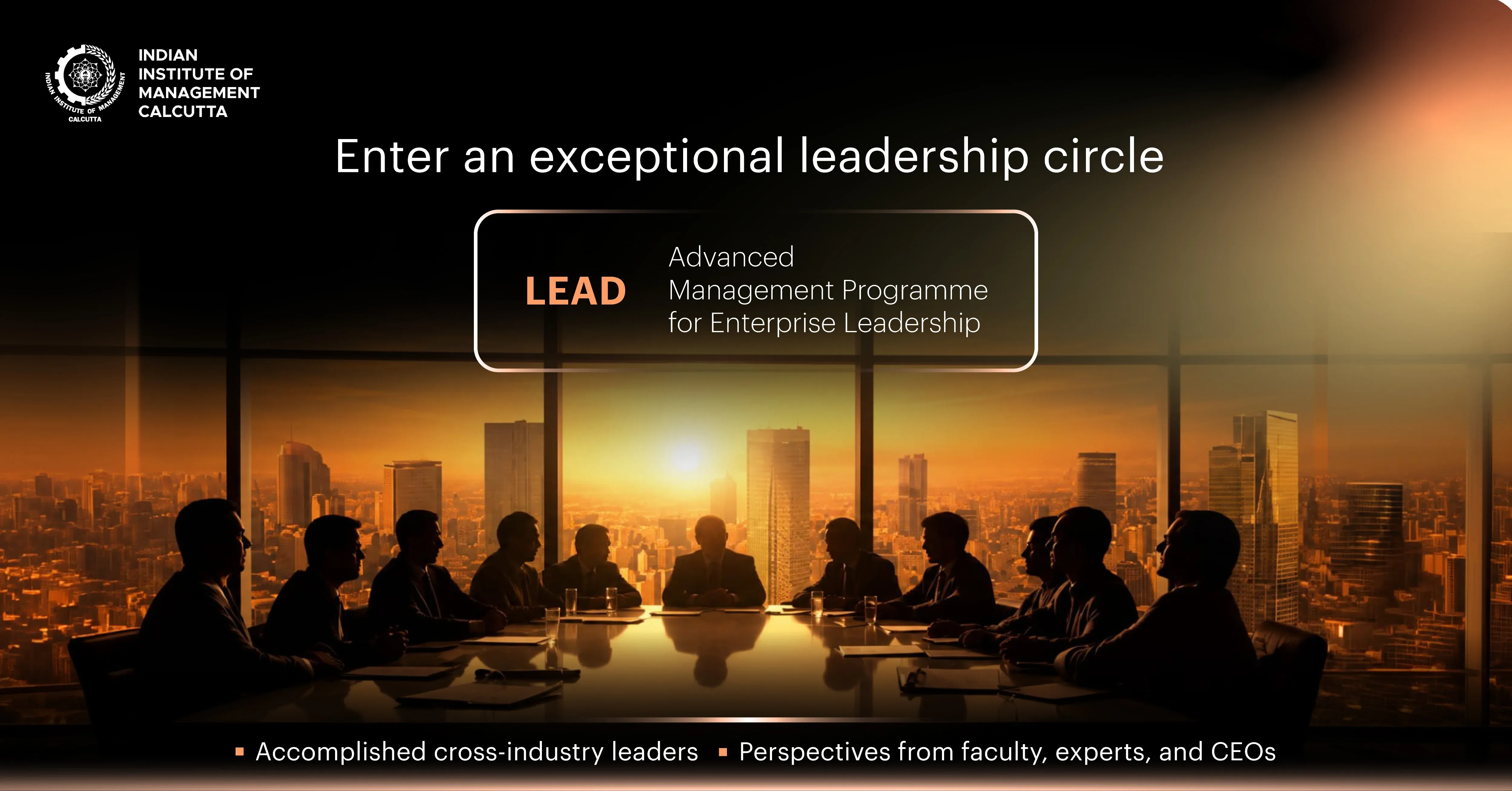
LEAD, the Advanced Management Programme for Enterprise Leadership from IIM Calcutta, is designed for exactly this. Built around four dimensions of enterprise leadership:
- Learn: Expand executive perspective across enterprise fundamentals
- Enhance: Strengthen the higher-order capabilities needed to navigate complexity
- Aspire: Engage with the shifts and possibilities redefining contemporary leadership
- Deliver: Translate leadership intent into distinctive enterprise impact
The programme is delivered entirely in person across four campus residencies at IIM Calcutta.
Three distinctive elements deepen the experience: the Learning Diary, the Organizational Manifesto, and The CEO Looks Back, connecting personal reflection and enterprise application with perspectives from current and former CEOs.
Who LEAD is created for?
LEAD is an invitation-only experience for leaders chosen to shape what comes next. Eligibility reflects that: 15+ years of professional experience in reputed enterprises, and a position no more than two levels away from an India-level CEO.
It is created for experienced leaders looking to:
- Sharpen judgement for decisions of greater consequence
- Navigate emerging shifts and complex business contexts
- Translate leadership intent into distinctive enterprise impact
- Engage with an accomplished, cross-industry leadership circle
If that describes the decade ahead of you, LEAD is built for it.
Conclusion: The Decade Rewards the Prepared
The next decade will not ask leaders to work harder within their function. It will ask them to see further across the enterprise, decide with sharper judgement, and translate intent into impact at a pace the last decade never demanded.
That is an opening, not a burden. Enterprise perspective is a capability, and capabilities can be built deliberately.
LEAD offers accomplished leaders the environment to do exactly that: distinguished faculty, current and former CEOs, and a cross-industry leadership circle, all on the IIM Calcutta campus.
The leaders who will define what comes next are already preparing for it. Express your interest in LEAD.
Frequently Asked Questions
1. What is enterprise leadership and how is it different from functional leadership?
Enterprise leadership is the capacity to think, act, and lead for the good of the whole organisation rather than a single team or function. Functional leaders optimise their own remit. Enterprise leaders make trade-offs that may not favour their own team, in service of what the entire business needs.
2. What capabilities will enterprise leaders need most over the next decade?
AI fluency, as leaders increasingly work with agentic systems personally and organisationally. Alongside it: judgement in conditions of information abundance, the ability to design how work flows through the enterprise rather than scaling headcount, and confidence navigating geopolitical complexity.
3. Why is enterprise thinking so difficult to practise?
Four obstacles recur: narrow identities built around "my team, my function," goals measured locally rather than enterprise-wide, the cognitive demand of systems thinking, and organisational structures designed for accountability instead of integration.
4. How is LEAD different from a general executive leadership programme?
LEAD is built around four dimensions Learn, Enhance, Aspire, Deliver and enriched by three distinctive elements: the Learning Diary, the Organizational Manifesto, and The CEO Looks Back, which connect personal reflection and enterprise application with perspectives from current and former CEOs.
About the Author
TalentSprint
TalentSprint, Part of Accenture LearnVantage, is a global leader in building deep expertise across emerging technologies, leadership, and management areas. With over 15 years of education excellence, TalentSprint designs and delivers high-impact, outcome-driven learning solutions for individuals, institutions, and enterprises. TalentSprint partners with leading enterprises and top-tier academic institutions to co-create industry-relevant learning experiences that drive measurable learning outcomes at scale.
Advance your career with the right program