Is an Executive HR Leadership Programme Worth It? Benefits, ROI and Career Growth

TL;DR:Executive HR leadership programmes can be valuable for experienced HR professionals seeking strategic roles. They build capabilities in business strategy, people analytics, AI and change leadership, strengthening career readiness and organisational impact. The right programme can deliver ROI through stronger decision-making, leadership credibility, professional networks and progression toward senior HR roles.
For most of the last 20 years, HR was judged on how well it ran its processes: hiring on time, payroll with no errors, policies followed. That standard no longer covers what the business expects. Today HR leaders are asked to shape culture, redesign work for AI, plan the future workforce and back their decisions with data.
This shift raises a practical question for mid-career and senior HR professionals. Is an executive HR leadership programme a real career move, or just another certificate? The answer depends on what the programme builds and how well it matches where HR is going.
Why is HR leadership being redefined?
The CHRO's agenda has grown quickly, and research shows it.
- Leadership is still the top priority. Gartner's survey of more than 1,400 HR leaders ranked leader and manager development as the No. 1 HR priority for 2025, for the third year running. SHRM found the same pattern: 51% of CHROs named it a top priority.
- Managers are under strain. 75% of HR leaders say managers are overwhelmed by their growing responsibilities, and 69% say leaders aren't equipped to lead change.
- AI has moved to the top of the agenda. In Gartner's 2025 CHRO survey, using AI to transform HR became the No. 1 priority, up from fifth place the year before. Yet only 8% of HR leaders believe their managers have the skills to use AI well.
- Skills are changing fast. LinkedIn expects about 70% of the skills used in most jobs to change by 2030, with AI driving much of that change.
- HR and business planning are often disconnected. Only 28% of HR leaders say HR strategic planning is fully integrated with business planning.
The trend is similar in India. ETHRWorld's CHRO Study 2025 describes CHROs becoming strategic architects of enterprise transformation. It finds that modern CHROs need business acumen, digital fluency and AI knowledge to gain influence in the boardroom. One in four CHROs aspire to CEO or board roles, but a lack of P&L ownership is a common barrier.
The takeaway is that HR expertise alone no longer gets you to the top table. You also need business, technology and change leadership skills.
What executive HR leadership programme should deliver?
A programme worth your time and money should offer:
- A curriculum tied to business strategy, not only HR operations
- Practical skill in people analytics and AI for workforce decisions
- Application through real problems, such as case studies and projects, rather than lectures alone
- A format that suits working professionals, so learning happens alongside work
- Institutional credibility and a peer network that stay valuable after the programme ends
Format matters. Gartner's research found that traditional leadership development, such as seminars and lectures, can actually have a negative effect on development. Repeated peer connection works better.
The key benefits for experienced HR professionals
1. Speaking the language of the business
The biggest change is moving from "HR said" to "the business needs." Learning to connect talent strategy with growth, cost and performance helps HR leaders shape decisions instead of only carrying them out.
2. Using people analytics and AI with confidence
Workforce data and AI tools are becoming central to hiring, retention, workforce planning and performance management. HR leaders who can read the data, question it and act on it bring more credibility to leadership discussions.
3. Leading change, not just managing it
Restructuring, AI adoption and culture shifts all need someone who can lead people through uncertainty. Change leadership is now a core HR capability, not a side skill.
4. Learning by applying
Case studies and project work let you test frameworks against the kinds of problems your organisation actually faces. This shortens the gap between learning something and getting results from it.
5. Credibility and a peer network
An institutional credential signals commitment to growth. A cohort of HR peers from different industries also becomes a lasting source of ideas, benchmarks and opportunities.
Measuring the ROI
The return on an executive HR programme shows up in two places:
| ROI dimension | What it looks like |
| Personal ROI | Readiness for bigger roles, a stronger leadership profile, more confidence with analytics and AI, a wider professional network |
| Organisational ROI | Better workforce decisions, stronger manager capability, smoother change initiatives, HR strategy that fits business priorities |
| Career-stage ROI | Moving from HR specialist or HRBP roles towards HR head and CHRO-track positions |
Organisations also see a link between learning and results. LinkedIn's 2025 Workplace Learning Report found that companies with strong career development programmes are 42% more likely to be frontrunners in generative AI adoption. Leadership training is also the most common career development strategy, used by 71% of organisations. HR leaders who build these capabilities themselves are better placed to build them in others.
Career Growth Pathways After the Programme
An executive HR leadership programme can support moves such as:
- HR Business Partner → Senior HRBP / HR Head
- Talent or L&D Manager → Head of Talent / Capability
- HR Generalist → People Analytics or HR Transformation Lead
- HR Head → CHRO-track roles with more say in strategy
A programme doesn't guarantee a promotion. What it builds is readiness, so that when a bigger role opens up, you can show the capabilities it needs.
How the IIM Mumbai Future Leadership Program in HRM Fits?
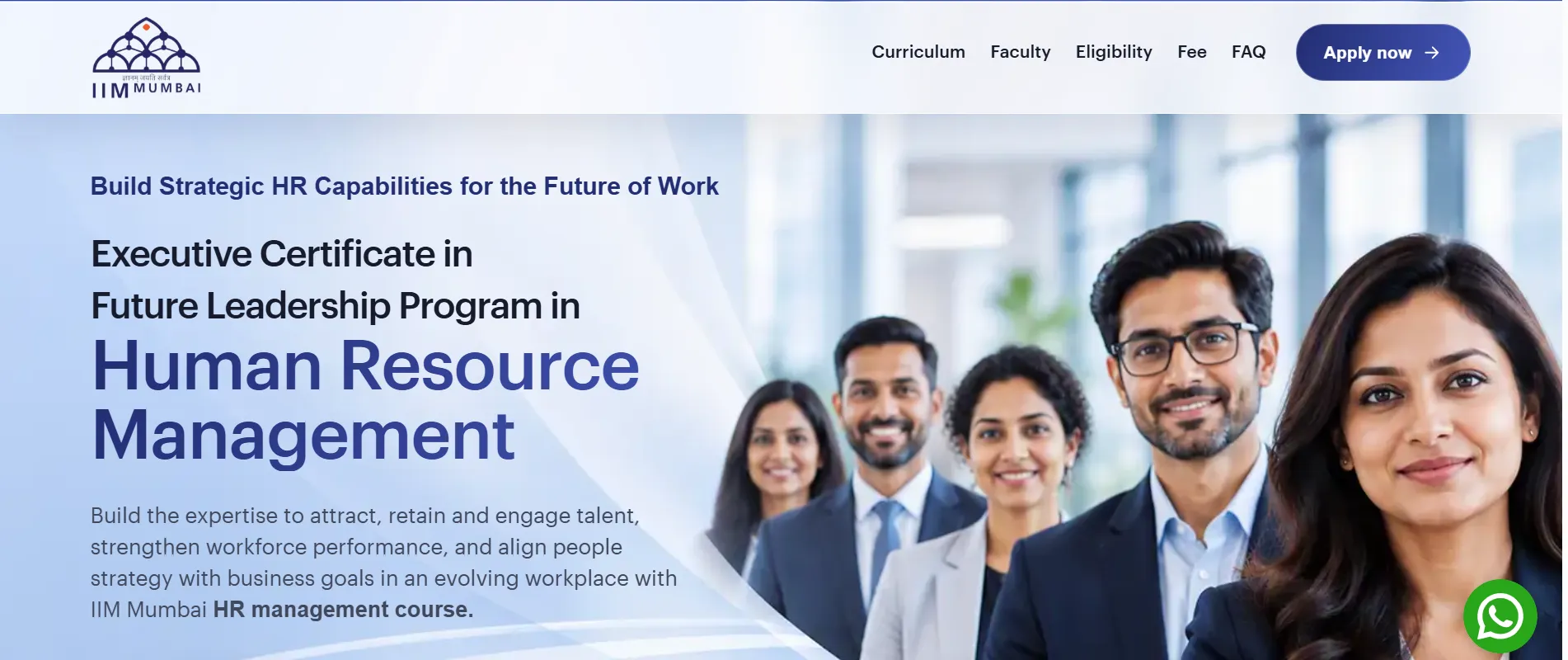
The Executive Certificate in Future Leadership Program in Human Resource Management from IIM Mumbai, is designed around the shifts described above. Several features stand out:
- A curriculum built for changing HR roles. It covers strategic HR, talent management, people analytics, AI and change leadership across the whole employee lifecycle, from talent strategy and organisational design to human–AI collaboration, global HR and business transformation.
- People analytics and AI for decision-making. Data analytics, workforce planning and AI are taught as tools for HR decisions, not as abstract theory.
- Business-aligned learning outcomes. Modules focus on aligning HR strategy with business strategy and on using strategic HRM and negotiation skills to influence organisational outcomes.
- Applied learning. Case studies, assignments and a faculty-guided capstone project help you work through real HR challenges.
- A weekend schedule. Live, interactive online classes run on Sundays from 10 AM to 1 PM over 8 months, taught by faculty and industry practitioners.
- Time on campus. A 2-day visit to IIM Mumbai adds face-to-face peer connection to the online learning.
- Lasting credentials. Participants receive an IIM Mumbai certification and Executive Alumni Status.
The institution behind the programme also matters. IIM Mumbai, formerly NITIE, was established in 1963. It is ranked 6th among management institutes in India by NIRF 2025 and partners with universities in the USA, Spain and Belgium for research.
Together, these features cover all three capabilities HR leaders now need (business strategy, technology and change leadership) in a format that fits around a demanding job.
Is It Right for You? A Quick Self-Check
An executive HR leadership programme is likely to be worth it if you:
- Have several years of HR experience and want to move into strategic or leadership roles
- Are expected to bring data and AI into people decisions but don't yet feel confident doing so
- Want more influence in business conversations beyond HR operations
- Prefer structured, applied learning you can fit around work
If you're early in your career or looking for basic HR training, a foundational course may be a better place to start.
Conclusion
The question is no longer whether HR needs to evolve, because it already has. The real question is whether your capabilities are keeping up. For HR professionals who want to lead the change, an executive programme that combines business strategy, people analytics, AI and change leadership is a good investment, and its value grows with each role you take on. Before choosing, look closely at how well a programme connects learning to the work HR leaders will need to do next.
Frequently Asked Questions
1. Who should consider an executive HR leadership programme?
Mid-career and senior HR professionals, such as HRBPs, HR managers, talent and L&D leaders, and HR heads, who want to move into strategic roles.
2. How is it different from an HR certification course?
It focuses on leadership, business alignment and transformation, not just functional HR processes.
3. Can I study while working full time?
Yes. The IIM Mumbai programme runs live online classes on Sundays, along with a 2-day campus visit.
4. Do I need a technical background for people analytics and AI modules?
These modules focus on using data and AI to make HR decisions, not on technical development.
About the Author
TalentSprint
TalentSprint, Part of Accenture LearnVantage, is a global leader in building deep expertise across emerging technologies, leadership, and management areas. With over 15 years of education excellence, TalentSprint designs and delivers high-impact, outcome-driven learning solutions for individuals, institutions, and enterprises. TalentSprint partners with leading enterprises and top-tier academic institutions to co-create industry-relevant learning experiences that drive measurable learning outcomes at scale.
Explore Our Programme
Advance your career with the right program