Why choosing a future-focused curriculum matters more than college rankings?

TL;DR:Generating response Copilot said: Choosing a college is only part of the decision. Students should also consider whether a programme builds the skills, experiences, and industry exposure needed for future careers. Reflecting NEP 2020's vision, modern business education increasingly combines academic learning with practical, real-world experiences to help students become career-ready from the start.
India's higher education landscape is undergoing a transformation.
With the National Education Policy (NEP) 2020 aiming to increase the Gross Enrolment Ratio (GER) in higher education from 26.3% to 50% by 2035, the focus is no longer only on making education accessible but also on making it more relevant, flexible, multidisciplinary, and aligned with the future of work.
As students and parents explore college options, rankings often become an important reference point. They can offer insights into an institution's reputation, legacy, and academic standing.
But as industries evolve and careers become increasingly dynamic, another question is gaining importance, “Will the curriculum prepare students for the opportunities of tomorrow?”
After all, a college experience is shaped not only by where students study but also by what they learn, the skills they develop, the industry exposure they gain, and their ability to adapt to a changing world.
Why college rankings continue to influence student decisions?
For generations, college rankings have played a significant role in higher education choices.
Students often look at rankings as indicators of academic quality, institutional reputation, faculty expertise, and overall student experience. It is no surprise that questions such as:
- Does college ranking really matter for getting a job?
- Will my child's future depend on which college they choose?
remain common among students and parents.
The reality is that rankings can provide useful information. They help students evaluate institutions and compare different options.
However, rankings do not always reveal what students will experience inside the classroom, how relevant the curriculum is to emerging industries, or how effectively a programme prepares graduates for evolving career opportunities.
As industries continue to change, students increasingly need to look at both the institution and the learning model that supports their long-term growth.
What employers look for beyond academic credentials
While academic credentials certainly matter, employers often evaluate candidates on a broader set of attributes.
They look for graduates who can:
- Solve problems and think critically
- Communicate effectively
- Collaborate with diverse teams
- Adapt to changing technologies
- Apply knowledge in practical situations
- Demonstrate initiative through projects and experiences
This shift explains why many students today also ask:
- Can I get a good job with a degree from a non-ranked university?
- What do tech companies actually look for in new hires?
- What matters more: school prestige or what you actually learn?
For most employers, the strongest candidates are often those who combine academic knowledge with real-world exposure and practical skills.
This makes the learning experience itself an increasingly important part of the college decision.
Why future-ready learning is becoming a priority?
One of the most significant ideas behind NEP 2020 is that higher education should help students prepare not only for their first job but also for lifelong learning and career growth.
The policy encourages:
- Multidisciplinary education
- Industry collaboration
- Experiential learning
- Skill development
- Flexible degree pathways
- Technology-enabled learning
This reflects the reality of today's workplace.
Modern professionals are expected to understand business fundamentals while also being comfortable with technology, data, innovation, and continuous learning.
As a result, students are increasingly asking,"What should I actually learn during college to stay relevant in the future?"
The answer often lies in choosing a curriculum that blends academic rigor with industry relevance
What should students look for in a future-focused curriculum?
A future-focused curriculum does more than teach subjects.
It creates opportunities for students to understand how knowledge is applied in real-world settings and prepares them to thrive in changing environments.
When evaluating a degree programme, students can look for:
- Strong business and analytical foundations
- Industry exposure integrated into learning
- Practical projects and internships
- Exposure to emerging technologies
- Leadership and communication development
- Career readiness support
- Learning that connects theory with application
- Opportunities to interact with industry professionals
These elements align closely with the broader goals of NEP 2020, which seeks to make higher education more flexible, multidisciplinary, and industry-oriented
Also Read: How Industry-integrated degrees are helping students build careers earlier?
What does a future-focused business degree look like in practice?
As students begin evaluating degree programmes through this lens, they may notice a growing shift toward industry-academia collaboration.
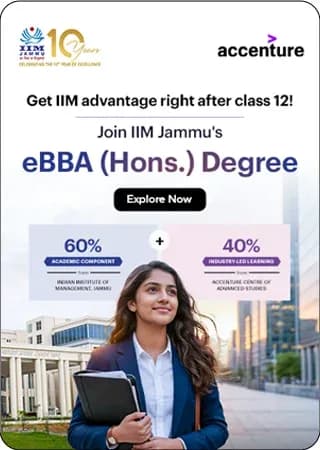
A strong example is the Industry-Integrated eBBA (Hons.) from IIM Jammu, a four-year undergraduate business degree developed through a collaboration between IIM Jammu and the Accenture Centre of Advanced Studies.
The programme combines the strengths of academic learning and industry exposure within a single learning framework.
1.The distinctive 60:40 industry-academia learning model

At the heart of the programme is its unique learning structure:
- 60% academic learning through IIM Jammu
- 40% industry-integrated learning through the Accenture Centre of Advanced Studies
This balance enables students to build a strong foundation in management while also gaining meaningful exposure to how businesses operate in practice.
Instead of treating industry exposure as an add-on, the programme embeds it throughout the learning journey, helping students connect classroom concepts with real business contexts.
2. Designed for the future of business
In line with the increasing emphasis on future-ready learning, the programme provides exposure to areas that are reshaping modern organizations, including:
- AI Business Applications
- Data-driven decision-making
- Cloud technologies
- Digital infrastructure
- Technology-enabled business transformation
As businesses continue to become more technology-driven, exposure to these areas can help students develop a broader understanding of today's business landscape.
3. Learning through experience
NEP 2020 places considerable emphasis on experiential learning. The programme reflects this through opportunities such as:
- Industry projects
- Internships
- Practitioner-led sessions
- Hands-on labs
- Business simulations
These experiences help students move beyond theoretical understanding and learn through application.
4. Flexible learning for modern learners
The policy also encourages technology-enabled access to higher education.
The Industry-Integrated online BBA by IIM Jammu, adopts a digital-first learning model while also providing annual campus immersion opportunities at IIM Jammu, creating a blend of flexibility and engagement.
Career Development Begins Early
Career readiness is another important aspect of future-focused education.
Rather than concentrating career preparation only in the final year, the programme incorporates:
- Professional skills development
- Aptitude training
- Resume-building support
- Interview preparation
- Placement-focused guidance
Students also benefit from access to the IIM Jammu alumni ecosystem and professional networking opportunities.
The better question to ask before choosing a degree
When comparing colleges, many students naturally ask, "How highly ranked is this institution?"
Though, It is an important question.
But in an era shaped by technological change, evolving careers, and lifelong learning, there may be another question worth asking, "How future-ready is the curriculum?"
A strong degree today is not defined solely by reputation. It is also defined by its ability to help students develop relevant skills, gain practical exposure, understand emerging trends, and build confidence for the future.
Also Read: Questions every parent should ask before choosing a college after 12th
Conclusion
Hence, Rankings will continue to play an important role in helping students evaluate institutions. However, long-term success is also shaped by the quality of learning experiences students encounter during their academic journey.
As students and parents evaluate their options, it may be worthwhile to look beyond reputation alone and consider how effectively a curriculum prepares learners for the world they will enter after graduation.
Because ultimately, the best degree is not only one that reflects where a student studied, but one that equips them with the knowledge, experiences, adaptability, and confidence to thrive wherever their future takes them.
Frequently Asked Questions
Q1. Does college ranking still matter when choosing a degree?
Yes, college rankings can provide insights into an institution's reputation, academic environment, and credibility. However, students should also assess the curriculum, industry exposure, learning opportunities, and skill development offered by the programme, as these factors contribute significantly to long-term career readiness and growth.
Q2. What makes a curriculum future-focused?
A future-focused curriculum combines strong academic foundations with practical learning experiences. It typically includes industry interaction, internships, projects, emerging technology exposure, communication skills, and career readiness support, helping students develop the adaptability and capabilities needed in an evolving professional landscape.
Q3. How does the IIM Jammu Industry-Integrated eBBA (Hons.) align with NEP 2020?
The programme reflects several NEP 2020 priorities, including flexible and technology-enabled learning, industry collaboration, experiential education, and skill development. Its distinctive 60:40 model combines academic learning from IIM Jammu with industry-integrated learning through the Accenture Centre of Advanced Studies, creating a balanced and future-oriented educational experience
About the Author
TalentSprint
TalentSprint, Part of Accenture LearnVantage, is a global leader in building deep expertise across emerging technologies, leadership, and management areas. With over 15 years of education excellence, TalentSprint designs and delivers high-impact, outcome-driven learning solutions for individuals, institutions, and enterprises. TalentSprint partners with leading enterprises and top-tier academic institutions to co-create industry-relevant learning experiences that drive measurable learning outcomes at scale.
Explore Our Programme
Advance your career with the right program