
A Practical Checklist for Building High-Performing Teams

Think about the teams that consistently deliver exceptional results. Decisions are clear. Communication flows effortlessly. Trust isn’t negotiated, it’s built into how the team operates. These teams don’t just meet expectations, they redefine them.
In today’s fast‑paced business environment, team cohesion and effectiveness matter more than ever. Teams are the engine that drives performance, innovation, and growth. When they function at their best, the impact is far‑reaching higher productivity, sharper decision‑making, stronger engagement, and the ability to adapt quickly to changing market demands. High‑performing teams create momentum that sustains success, even under pressure.
But these teams don’t come together by chance. They are intentionally designed. Building high‑performing teams requires clarity of purpose, aligned objectives, and a deep understanding of the foundational elements that underpin excellence.
What is a high-performing team?
A high‑performing team is a unified group of individuals with diverse yet complementary skills, aligned around a clear purpose and shared goals. Built on trust, open communication, and mutual accountability, these teams collaborate effectively and resolve conflict constructively. They continuously learn, adapt, and improve their ways of working. By prioritising collective success over individual wins, high‑performing teams consistently deliver strong results and sustain excellence over time.
Characteristics of high-performing team
Building effective teams must be a continuous priority in today’s dynamic business environment. High‑performing teams drive sustained growth and competitive advantage by combining diverse skills, adapting to change, and consistently delivering strong results.
By understanding their mindsets, behaviors, and ways of working, organisations can replicate what makes these teams successful at scale.
- Psychological Safety & Trust: Team members feel safe taking risks, admitting mistakes, and sharing ideas without fear of judgment or retribution laying the foundation for open dialogue and innovation.
- Open Communication & Two-Way Feedback: Honest, transparent communication flows freely. Feedback is seen as a developmental tool, not criticism, helping teammates continuously improve together.
- Strong Relationships & Empathy: Deep understanding and empathy strengthen bonds within the team, creating a supportive environment where people connect, collaborate, and align towards shared goals.
- Shared Purpose & Clear Goals: High-performing teams unite around a common mission, with every member understanding the direction and contribution expected from them.
- Defined Roles & Complementary Skills: Roles and responsibilities are clear, and team members’ unique strengths complement one another, enabling more effective performance and collaboration.
- Sense of Belonging & Identity: Being part of the team isn’t just functional members feel a strong psychological connection and pride in who they are together.
- Culture of Curiosity & Innovation: Trust and belonging fuel curiosity, creativity, and experimentation, empowering teams to explore new ideas and push beyond conventional boundaries.
- Continuous Learning Mindset: High-performing teams treat every experience including setbacks as an opportunity to learn, adapt, and improve collectively.
- Self-Awareness & Contextual Insight: Both leaders and team members understand their strengths and impact and remain aware of the broader organisational landscape while executing tasks.
Steps to Build a High-Performing Team
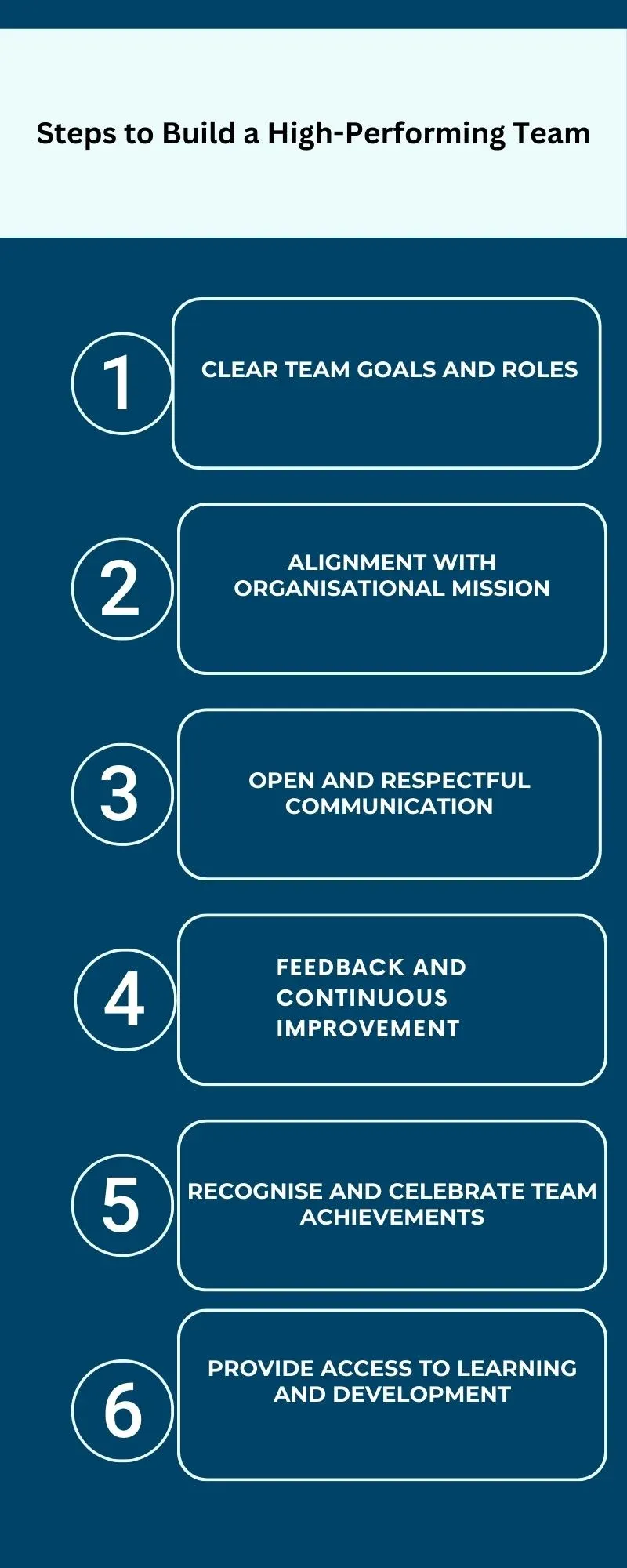
1. Define clear team goals and roles
Role clarity is the quiet force behind high‑performing teams. When people know exactly what they own and how their work contributes to the bigger picture, execution becomes faster, cleaner, and more confident. Clear roles don’t just boost efficiency; they prevent overlap, reduce friction, and stop small misunderstandings from turning into team‑wide roadblocks.
But role clarity goes beyond job titles. It’s about understanding how responsibilities connect across the team and how individual efforts drive shared goals. This shared awareness strengthens accountability, sharpens collaboration, and removes the drag that slows even the most capable teams.
2. Ensure alignment with organisational mission
Teams that understand their purpose outperform those that don't. When individual goals align with organisational objectives, engagement increases significantly. This alignment provides the context that makes daily work meaningful and helps team members understand how their contributions support larger goals.
Leaders must clearly communicate not just what the team should accomplish, but why it matters to the organisation's mission. This connection creates a shared vision that drives collective commitment and helps teams prioritise their efforts effectively.
3. Promote open and respectful communication
Communication failures are among the most common reasons teams underperform. High-performing teams establish clear channels for information sharing regular meetings, one-on-one sessions, and digital platforms that keep everyone informed and aligned. But effective communication goes beyond logistics.
Teams thrive when members feel safe expressing ideas, concerns, and feedback without fear of judgment. Leaders who model transparency about business performance and encourage open dialogue create psychological safety that enables teams to tackle difficult problems together.
4. Encourage feedback and continuous improvement
Feedback drives performance improvement when it flows freely in both directions. Teams that foster cultures of constructive feedback consistently outperform those that don't. Regular feedback sessions identify growth opportunities, while anonymous surveys can capture honest opinions from team members who might otherwise stay silent.
The key is acting on feedback. Teams pay attention when they see their input creating tangible changes. This responsiveness demonstrates that contributions matter and encourages continued engagement in the improvement process.
5. Recognise and celebrate team achievements
Recognition reinforces the behaviours and results you want to see repeated. Acknowledging both individual contributions and collective achievements strengthens team cohesion and motivation. Research indicates employees who receive recognition are more likely to bring new ideas forward.
Effective recognition is timely, specific, and aligned with team values. Whether through public acknowledgment or personal appreciation, celebrating successes shows team members that their efforts create meaningful impact.
6. Provide access to learning and development
Teams that stop learning stop improving. Investment in skill development enhances team adaptability and demonstrates organisational commitment to long-term growth. The impact on retention is significant of employees cite lack of advancement opportunities as their reason for leaving.
Effective development includes formal training, mentoring relationships, and opportunities for team members to share expertise with colleagues. This investment addresses immediate skill gaps while building the capabilities teams need to tackle future challenges.
How to Sustain High Performing Teams?‑Performing Teams?
Excellence in team performance isn't a destination it's an ongoing process that demands sustained attention long after initial team formation. The gap between achieving high performance and maintaining it often catches organisations off guard, as the practices that build great teams aren't always the same ones that keep them performing at their peak.
- Treat performance as an ongoing discipline
High performance isn’t a one‑time achievement. It requires continuous attention, reinforcement, and adaptation as teams and conditions evolve. - Build and protect trust and accountability
Create transparency around goals, challenges, and outcomes. Foster psychological safety so team members feel confident taking ownership, learning from mistakes, and speaking up. - Enable cross‑functional collaboration
Break down silos by encouraging collaboration across teams. Invest in shared tools, clear communication channels, and structures that make knowledge‑sharing easy and frictionless. - Balance short‑term results with long‑term growth
Deliver quick wins without sacrificing future capability. Use metrics that support both immediate performance and sustainable progress. - Connect daily work to long‑term goals
Regularly reinforce how short‑term efforts contribute to broader organizational ambitions, ensuring momentum aligns with long‑term success.
Also Read: Cross-Cultural Management: Driving Global Team Success Through Empathy
Conclusion
High-performing teams are built through intention, not chance. When trust, clarity, and open communication are embedded into how teams work, performance becomes consistent and resilient. As explored in this blog, strong teams are shaped by clear roles, alignment with organisational goals, continuous feedback, and ongoing learning not just individual talent.
Yet achieving high performance is only the starting point. Sustaining it requires leaders to treat performance as continuous discipline, protect psychological safety, and balance immediate results with long-term growth. When teams clearly see how their daily efforts connect to the bigger mission, they stay engaged, adaptable, and focused.
Organisations that invest in sustaining high-performing teams don’t just deliver better outcomes they build the capability to thrive in constant change.
Frequently Asked Questions
Q1. What are the key elements of a high-performing team?
High-performing teams typically have clear goals, well-defined roles, strong alignment with organisational objectives, open communication, and a culture of continuous improvement. They also benefit from regular recognition of achievements and access to learning opportunities.
Q2. How can managers promote effective communication within their teams?
Managers can foster effective communication by establishing clear channels for information sharing, such as regular team meetings and one-on-one sessions. They should also model transparency, encourage open dialogue, and create an environment where team members feel safe to express their thoughts without fear of judgement.
Q3. Why is it important to have diverse personalities and work styles in a team?
Diverse personalities and work styles contribute to a team's overall effectiveness by providing complementary strengths and perspectives. This diversity allows team members to compensate for each other's weaknesses and approach problems from different angles, leading to more innovative solutions and improved performance.
Q4. How can organisations sustain long-term team performance?
To sustain long-term team performance, organisations should focus on creating a culture of trust and accountability, supporting cross-functional collaboration, and balancing short-term wins with long-term growth. Regular feedback, continuous learning, and aligning daily work with larger objectives are also crucial for maintaining high performance.
Q5. What role does recognition play in building high-performing teams?
Recognition plays a significant role in motivating and engaging team members. Acknowledging both individual and collective achievements reinforces commitment and enthusiasm. Timely and sincere recognition, aligned with workplace values, demonstrates appreciation for team members' contributions and encourages them to continue performing at a high level.
About the Author
TalentSprint
TalentSprint, Part of Accenture LearnVantage, is a global leader in building deep expertise across emerging technologies, leadership, and management areas. With over 15 years of education excellence, TalentSprint designs and delivers high-impact, outcome-driven learning solutions for individuals, institutions, and enterprises. TalentSprint partners with leading enterprises and top-tier academic institutions to co-create industry-relevant learning experiences that drive measurable learning outcomes at scale.
Advance your career with the right program