Top 10 HR Leadership Skills Every Professional Needs in 2026

TL;DR:Future-ready HR leadership combines strategic business thinking with workforce planning, analytics, AI fluency and strong people leadership. By connecting these capabilities, HR professionals can influence enterprise decisions, strengthen talent strategies, lead organisational change and ensure technology adoption remains responsible, human-centred and aligned with business priorities.
The HR leader of 2026 will not simply manage the workforce. They will help design its future. From preparing organisations for human-AI collaboration to translating workforce data into business decisions, HR is becoming central to how companies navigate growth and transformation.
Gartner’s survey of 426 CHROs found that the leading priorities for 2026 include AI-driven HR transformation, workforce redesign, leadership readiness and embedding culture into everyday work. Its research also indicates that making change a routine part of work can make organisations three times more likely to achieve healthy change adoption.
This shift requires professionals to build a broader leadership toolkit, combining strategic thinking, digital fluency and analytical rigour with communication, judgement and empathy. The following ten skills represent the capabilities HR professionals need to lead with greater influence in 2026.
What is changing about HR leadership in 2026?
HR leadership is shifting from supporting business strategy to actively shaping it. Rather than simply administering people programmes, HR leaders are expected to anticipate workforce needs, connect talent priorities with enterprise goals and influence how organisations grow and adapt.
Decision making is also becoming more forward-looking. Traditional reports that explain past outcomes give way to people analytics that identify patterns, forecast capability gaps and guide evidence-based workforce decisions.
At the same time, digital leadership now extends beyond implementing technology. As AI takes on more transactional work, HR leaders must design responsible human-AI collaboration while applying sound judgement to decisions involving employees. This calls for stronger communication, foresight, systems thinking, business fluency, and change leadership. Forbes Human Resources Council also highlights these capabilities as increasingly important for future ready HR leaders.
Technology and human leadership are therefore not competing priorities. Greater automation makes trust, empathy, cultural stewardship, and contextual judgement even more valuable.
Top 10 HR Leadership Skills for 2026
Future-ready HR professionals need a balanced mix of strategic, analytical, digital and people leadership capabilities. The following skills reflect the changing HR mandate and align with the strategic HR, Human-AI, organisational design and transformation areas covered in IIM Mumbai’s Executive Certificate in Future Leadership Program in Human Resource Management.
1. Strategic Business Acumen
HR leaders must understand how the organisation creates value and connect people priorities with business goals. This means looking beyond operational measures and assessing how talent, leadership and culture influence growth, productivity and innovation. Business acumen enables HR professionals to contribute to enterprise decisions while working effectively with finance, operations, marketing and digital teams.
2. Strategic Workforce Planning
Effective workforce planning involves anticipating the roles and capabilities the organisation will need next. HR leaders must identify skill gaps and determine the right combination of recruitment, reskilling, internal mobility and automation. This helps the organisation build a future-ready workforce rather than react to talent shortages after they emerge.
3. People Analytics
People analytics helps HR leaders turn workforce data into better decisions. Instead of only reporting past outcomes, professionals must use data to identify patterns, anticipate talent needs and strengthen recruitment, retention and workforce deployment. The goal is not simply to create dashboards, but to translate evidence into clear business recommendations.
4. AI and Digital HR Fluency
HR leaders must understand how AI and digital platforms can improve recruitment, learning, performance management and career planning. They do not need to become technology specialists, but they should be able to evaluate use cases, ask informed questions and lead digital adoption. This capability helps HR improve processes without losing sight of employee needs.
5. Responsible AI Leadership
Using AI in people decisions requires fairness, transparency and human oversight. HR leaders must recognise risks related to bias, privacy and data quality, particularly in recruitment, performance and career decisions. Responsible AI leadership helps organisations use emerging technology productively while protecting employee trust and maintaining accountability.
6. Change Leadership
HR leaders play a central role in helping employees and managers navigate transformation. They must communicate the purpose of change, address resistance and reinforce new behaviours through workplace systems and routines. Strong change leadership turns transformation from a one-time initiative into an organisational capability.
7. Organisational Design
Organisational design connects structure, roles, decision rights and workflows with business priorities. HR leaders must understand how changes in one area can affect collaboration, culture and performance elsewhere. This systems perspective is particularly valuable when developing agile, hybrid or AI-enabled workplace models.
8. Talent Development and Retention
HR leaders must build talent systems that support continuous learning, career growth and leadership development. This involves connecting recruitment, performance management, reskilling, internal mobility and succession planning. A strong talent strategy enables organisations to retain critical capabilities while preparing employees for emerging roles.
9. Human-Centred Leadership
As workplaces become more technology-enabled, trust, inclusion and employee well-being become even more important. HR leaders must balance organisational performance with a genuine understanding of employee needs. Human-centred leadership helps translate company values into everyday behaviours and creates an environment where people can contribute, develop and adapt.
10. Executive Communication and Influence
HR leaders must communicate workforce insights in language that senior decision-makers understand. This includes presenting evidence clearly, explaining business implications and building support across functions. Strong communication, negotiation and storytelling skills enable HR professionals to turn people insights into action and influence enterprise-level decisions.
Together, these capabilities reflect the programme’s focus on strategic HR leadership, talent management, people analytics, Human-AI integration, organisational design and transformation.
How do these HR leadership skills work together?
Future-ready HR leadership is not about mastering isolated skills. It is about applying them together across three connected areas:
- See the business clearly: Strategic business acumen, workforce planning and people analytics help HR leaders understand priorities and identify capability gaps.
- Design the future of work: AI fluency, responsible AI and organisational design help create effective, ethical and adaptable ways of working.
- Bring people through transformation: Change leadership, talent development, human-centred leadership and executive communication turn strategy into action.
For example, people analytics may reveal a capability gap. Workforce planning identifies how to close it, organisational design determines where the capability should sit, and change leadership supports adoption. Together, these skills enable HR professionals to connect workforce decisions with meaningful business outcomes.
How can HR professionals build these leadership skills?
For mid-career HR and management professionals, leadership development should combine practical experience with focused learning. Key steps include:
- Gain cross-functional exposure: Participate in projects involving finance, operations or technology to understand how people decisions influence business outcomes.
- Use evidence to guide decisions: Replace activity-based HR reports with analysis that connects talent, engagement and workforce trends to organisational priorities.
- Build AI fluency: Experiment with approved AI tools on low-risk HR tasks while developing an understanding of responsible use.
- Lead transformation: Seek assignments involving organisational change, digital adoption or workforce redesign.
- Strengthen executive influence: Develop commercial awareness, data storytelling and communication skills to present workforce insights clearly.
- Create a learning plan: Build capabilities across strategic HR, people analytics, AI and leadership.
Workplace experience can develop these skills unevenly. Structured learning can connect them more systematically. IIM Mumbai’s Executive Certificate in Future Leadership Program in Human Resource Management brings these areas together through strategic HR, Human-AI integration, organisational design, change leadership, case-based assignments and a faculty-guided capstone project.
How IIM Mumbai’s Future Leadership Programme Builds Future-Ready HR Leaders?
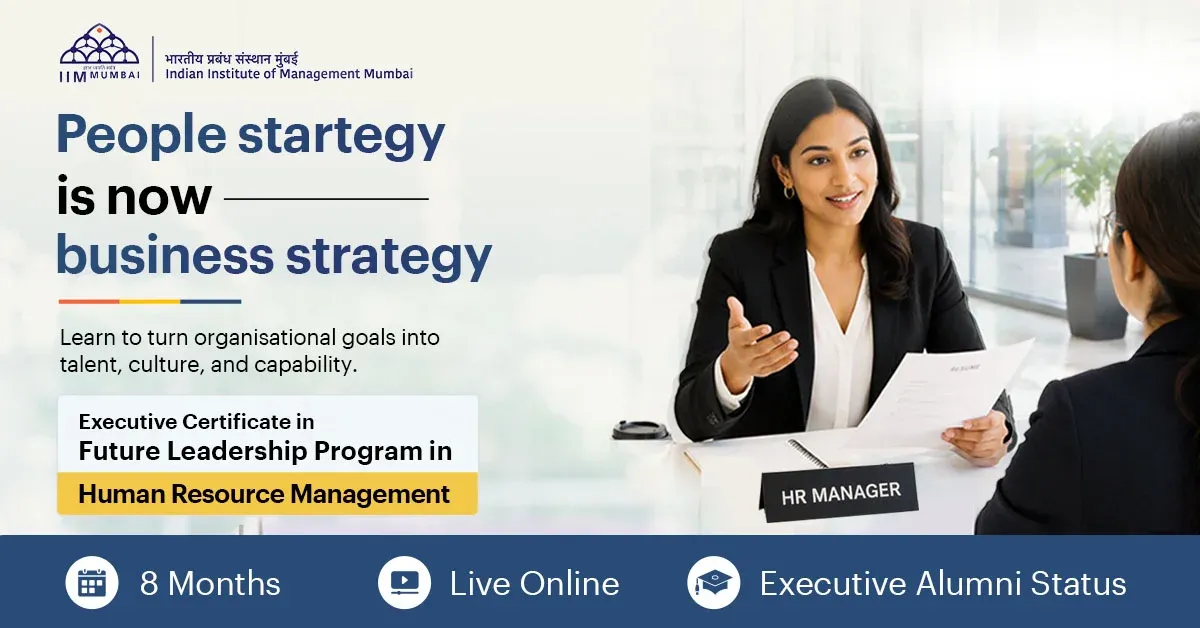
The Executive Certificate in Future Leadership Program in Human Resource Management by IIM Mumbai helps professionals build strategic, digital and leadership capabilities across the employee lifecycle. Its curriculum covers strategic HR, talent acquisition and retention, compensation, international HRM, people analytics, Human-AI integration, organisational design, change leadership and cross-functional business strategy.
Designed for professionals with at least three years of experience, the programme combines live online classes, expert sessions, case-based assignments and a faculty-guided capstone project. Participants learn to align HR strategy with business goals, use AI and people analytics for decision-making, lead digital transformation and build future-ready organisations. The learning format also includes weekend classes and a two-day campus visit at IIM Mumbai
Preparing for the Next Era of HR Leadership
HR leadership in 2026 will require more than functional expertise. Professionals must combine strategic thinking, people analytics and digital fluency with sound judgement, empathy and the ability to lead change. Those who build these interconnected capabilities will be better prepared to align workforce decisions with business goals and guide responsible human-AI collaboration.
The priority is not to predict every workplace shift, but to develop the adaptability and leadership depth required to respond effectively. For mid-career HR professionals, now is the time to move beyond managing processes and prepare to shape the future of work.
Frequently Asked Questions
1. What are the most important HR leadership skills for 2026?
Key capabilities include strategic business acumen, workforce planning, people analytics, AI and digital fluency, responsible AI, change leadership, organisational design, talent development, human-centred leadership and executive communication. Together, these skills help HR professionals connect people decisions with business outcomes.
2. Why do HR professionals need strategic business acumen?
Strategic business acumen helps HR professionals understand how their organisation creates value. It enables them to align workforce, talent and culture decisions with priorities such as growth, productivity, innovation and organisational resilience.
3. How is AI changing the skills required of HR leaders?
AI is shifting HR leadership from process administration towards workforce redesign and responsible human-AI collaboration. HR leaders must understand relevant AI applications, assess their business value and ensure that employee-related decisions remain fair, transparent and subject to human oversight.
4. Do HR professionals need technical expertise to use AI effectively?
HR professionals do not need to become AI engineers. However, they should understand how AI can support recruitment, learning, performance management and career planning. They must also recognise limitations involving bias, privacy, data quality and explainability.
5. Why is people analytics important for future HR leaders?
People analytics helps HR leaders move beyond reporting past activities. It enables them to identify workforce patterns, anticipate capability gaps and strengthen decisions related to hiring, retention, engagement and talent deployment.
6. How can mid-career HR professionals prepare for leadership roles?
They can gain cross-functional exposure, participate in transformation projects, strengthen commercial understanding and practise data-driven decision-making. A focused development plan covering strategy, analytics, AI, communication and change leadership can make this progression more systematic.
About the Author
TalentSprint
TalentSprint, Part of Accenture LearnVantage, is a global leader in building deep expertise across emerging technologies, leadership, and management areas. With over 15 years of education excellence, TalentSprint designs and delivers high-impact, outcome-driven learning solutions for individuals, institutions, and enterprises. TalentSprint partners with leading enterprises and top-tier academic institutions to co-create industry-relevant learning experiences that drive measurable learning outcomes at scale.
Explore Our Programme
Advance your career with the right program