The New Leadership Mandate for Senior Managers in the Age of AI

TL;DR:AI is redefining senior leadership beyond technology adoption. Managers need AI fluency, strategic judgement, responsible governance, and the ability to connect AI with business priorities. The strongest leaders will question AI outputs, orchestrate human-AI collaboration, make enterprise-wide decisions, and turn AI’s speed and capabilities into sustainable business value.
Every generation of managers has had to learn the language of its defining technology. For today's senior leaders, that language is AI, and it is changing faster than ever.
Investment is not a problem. According to Accenture's Pulse of Change survey, 82% of business leaders have committed funds to generative AI, yet only 23% see the returns they expected. The gap rarely sits in technology. It sits in leadership.
AI can analyse, recommend and even act. But deciding where it creates value, where human judgement must prevail and who owns the outcome remains a leadership responsibility. That is the new mandate: senior managers who understand AI well enough to deal with it, not just approve it.
Why is AI becoming a leadership mandate, not a technology choice?
AI is no longer a side project for the IT team. Industry reports show that 70% of leaders believe generative AI will fundamentally reshape business, and 75% of executives rank AI among their top strategic priorities.
Technology itself has also changed. AI systems no longer just retrieve information or generate content. They can now reason across complex inputs, recommend actions and complete tasks on their own. That pace puts pressure on leaders. Decision cycles that took years now take months, and executives must commit capital and restructure teams around a technology that keeps evolving.
When AI shapes strategy, operations and people, it can't be delegated. That's why AI literacy can no longer rest only with technologists. It now belongs at the leadership table.
Also Read: What is AI in Business?
What does the AI readiness gap look like at the senior level?
Ambition is there, but many leaders aren't ready to deliver on it yet. In a recent survey, only 36% of leaders said their senior leaders are prepared for today's challenges. Teams notice the gap too: only 25% of employees feel their leaders adequately support their use of AI. Industry reports also show that only 20% of organisations have high confidence in their leadership strength.
That gap is also an opportunity. Research found that well-prepared leaders give a company three times the competitive boost that more mature AI tools alone provide. Companies with both strong leaders and mature AI see an 80% lift in competitive performance.
The message for senior managers is clear. The real advantage comes from the leaders who use the technology, not from the technology itself.
Why does managerial judgement matter more in an AI-shaped enterprise?
AI doesn't make management's hardest questions go away. It makes them sharper: who decides, on what basis, at whose risk, and to what end?
At senior levels, these questions get harder because the enterprise no longer looks like a set of separate functions. Finance, operations, talent, customers and technology start to work as one system. An AI-led productivity push may free up capacity, but it can also change morale, roles and the future talent pipeline. Only leaders who see the whole system can weigh those trade-offs well.
As machines take on more analysis and execution, leadership moves towards decisions that can't be delegated. Those decisions involve reading context, questioning AI-generated conclusions and owning the outcomes.
This is where the techno-manager comes in. This leader isn't a technologist. They place AI within the wider system of strategy, economics, behaviour and institutional consequences.
The leaders who shape the next decade will be the ones who combine AI's speed with human judgement and turn powerful tools into lasting value for the enterprise.
What are the core roles of an AI-ready senior leader?
AI-ready leaders take on several connected roles and move between them as the situation demands.
- Visionary: Links AI to strategy and guides the organisation through each stage of its AI transformation, from Deploy to Reshape to Invent.
- Codeveloper: Uses AI hands-on. Leaders at companies with highly mature AI are 75% more likely to experiment regularly, ask for feedback and adapt.
- Steward: Builds clear accountability, responsible governance and real human oversight into how AI is used.
- Context-setter: Gives teams guardrails, such as clear values and decision rights, so they can handle AI-driven change. The old command-and-control style doesn't work here.
- Orchestrator: Brings people, priorities and decisions together across the enterprise and leads collaboration between people and AI.
- Sense-maker: Makes sense of complexity and guides AI-enabled systems instead of acting as the sole decision-maker.
Also Read: The Skills Managers Will Need Most in the Next 5 Years
How can senior managers build AI fluency without becoming technologists?
AI fluency doesn't require writing code. It means knowing enough to lead with confidence. Four practical habits can help senior managers build it.
- Question the system: Ask what an AI tool is optimising for, what assumptions sit behind its recommendations and where human judgement should step in.
- Use AI in your own work: Let AI help you think, not think for you. Executives who spend at least 10% of their time learning AI are 1.7 times more likely to lead companies with mature AI systems.
- Apply it to real business problems: Start with challenges that cut across functions, where analytics and AI can deliver measurable value.
- Shape governance early: Help set accountability, human oversight and responsible-use standards before AI scales.
The leaders who build these habits today will decide how AI creates value tomorrow.
How does IIM Mumbai's AI-enabled senior management programme prepare leaders for this mandate?
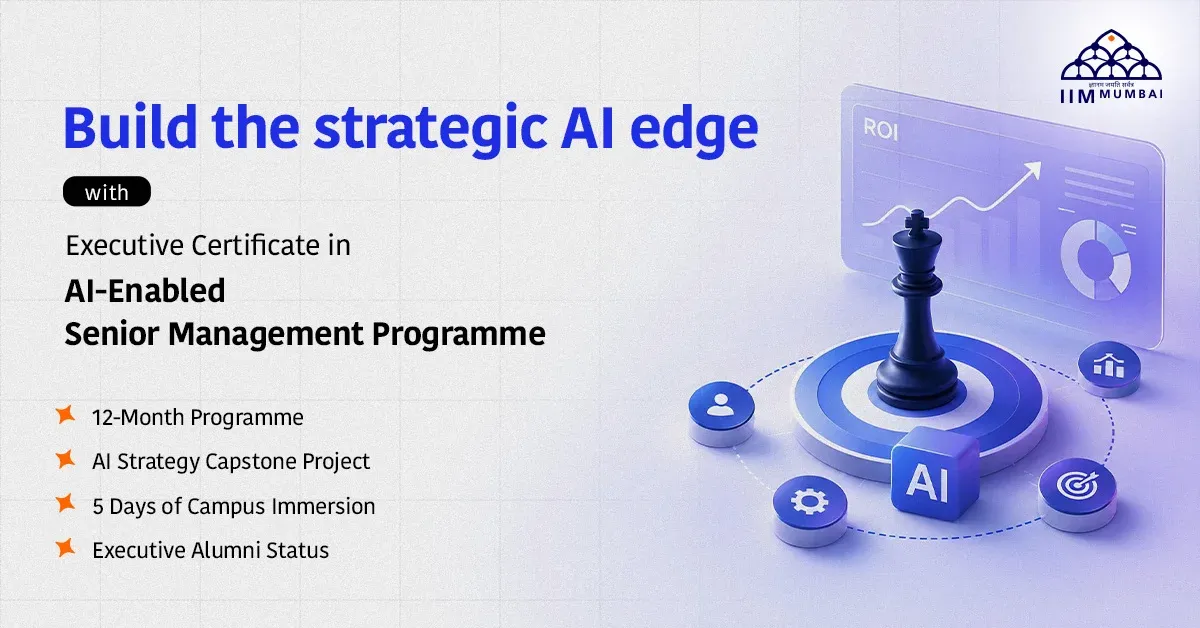
Building AI fluency works best when it sits inside the full scope of leadership. IIM Mumbai's Executive Certificate in AI-Enabled Senior Management Programme takes this approach. It is a 12-month strategic leadership programme that brings AI into every business function to prepare leaders for enterprise-wide impact.
Rather than treating AI as a standalone technical subject, the curriculum places it within the core responsibilities of senior leadership: strategy, markets, finance, operations, supply chains, talent, innovation, transformation and governance. Participants start with AI-Driven Leadership Foundations, which covers leading in the age of AI, strategic thinking with AI, and analytics for business decision-making.
Learning carries into practice through live interactive classes and a capstone project on real business challenges. The programme also includes a five-day campus visit and IIM Mumbai Executive Alumni status. For mid-career professionals, it is a structured way to move from managing functions to leading the AI-shaped enterprise.
Conclusion
AI is a tool. How it gets used is a leadership choice.
The next decade won't belong to the companies with the most advanced AI. It will belong to those whose leaders can link AI to strategy, question what it produces, govern it responsibly and turn its speed into lasting value.
For senior managers, the mandate is clear: build AI fluency now. AI keeps reshaping markets, operations and talent, so continuous learning is now part of the job.
Also Read: The Power of Continuous Learning: Why Senior Leaders Must Keep Evolving
IIM Mumbai's AI-Enabled Senior Management Programme gives you a structured way to keep pace with these changes. It combines strategic management with AI-powered decision-making. The leaders who start learning today will shape tomorrow's enterprise.
Frequently Asked Questions
1. Why is AI knowledge now a leadership mandate for senior managers?
AI now shapes strategy, operations and people decisions, so it can't be left to technologists alone. Leaders need enough AI fluency to question its outputs, recognise its limits and own the results of AI-informed decisions.
2. Do mid-career managers need coding or technical skills to dead with AI?
No. AI fluency for leaders means knowing what an AI system optimises for, what assumptions sit behind its recommendations and where human judgement should step in. It's about leading with AI, not building it.
3. What is a techno-manager?
A techno-manager is a leader who places AI within the wider system of strategy, economics, behaviour and institutional consequences. They don't treat it as a standalone tool.
About the Author
TalentSprint
TalentSprint, Part of Accenture LearnVantage, is a global leader in building deep expertise across emerging technologies, leadership, and management areas. With over 15 years of education excellence, TalentSprint designs and delivers high-impact, outcome-driven learning solutions for individuals, institutions, and enterprises. TalentSprint partners with leading enterprises and top-tier academic institutions to co-create industry-relevant learning experiences that drive measurable learning outcomes at scale.
Explore Our Programme
Advance your career with the right program