
What is responsible AI?

AI is stepping out of the background and into the decision-making seat. It curates our feeds, supports medical diagnoses, screens job applications, and influences financial choices.
As machines begin to make, or shape, human decisions, one question quietly takes center stage: who is AI working for?
We know, AI is taking up more responsibility now and with that maintaining the public trust has also become important as technical performance. According to a report by Accenture, only 35% of consumers trust how organizations are implementing AI.
This growing trust gap highlights why clear guidelines and responsible regulation aren’t obstacles to innovation, they’re essential to ensuring AI works for people, not against them.
This is where Responsible AI comes in the picture as it ensures intelligence is built with fairness, transparency, and accountability at its core, so automation enhances judgment instead of replacing it.
What is Responsible AI?
Responsible AI creates and assesses artificial intelligence systems that put safety, ethics, and trustworthiness first. Traditional AI development focuses on performance and efficiency, but responsible AI puts people and their goals at the heart of design. It values fairness, reliability, and transparency.
Also Read: What is Ethical AI?
Key principles of Responsible AI
- Accurate & Reliable
AI systems should produce outcomes that are trustworthy and dependable, with high standards of accuracy and consistent performance. - Fair & Human-Centric
AI should be designed with human values in mind and include diverse perspectives to reduce unfair discrimination or bias. - Safe & Ethical
Safety and ethical considerations, especially around human life, health, and the environment, should be prioritised when developing and deploying AI. - Continuous Learning & Development
Responsible AI is not static. Systems and teams should adapt through feedback loops, education, and regular compliance checks to stay aligned with evolving standards.
Why Responsible AI is important?
AI's real-life effects go way beyond technical capabilities. They raise basic questions about trust, fairness, and human rights. AI systems make more decisions that affect people and communities. Companies now see responsible AI as both an ethical choice and a business must-have.
Building trust in AI systems
Trust is the foundation for people to adopt AI-powered products and services. People won't use AI outputs if they don't trust them.
Preventing bias and discrimination
AI tools can make existing biases worse when they become part of everyday life. These biases come from many sources, but mainly from the historical data that trains AI models. AI systems learn from data that shows past discrimination. They create new inequalities or make existing ones worse.
Ensuring accountability and transparency
Accountability means companies must answer for how they design, develop, and use AI systems. Companies need clear governance frameworks. These define who oversees AI, track development, and check its effects regularly.
- Protecting user privacy and data
Privacy risks grow as technology advances. AI systems collect and process more personal information than ever. Privacy protection matters in every responsible AI project. Without good security, AI can leak sensitive data. This happens through training data retention, too much information in outputs, or weak security controls.
Also Read: Mastering Ethical AI: What Leaders Need to Know
Real-World Examples of Responsible AI in Action
Responsible AI has evolved from theory to ground applications that show its effect on businesses of all sizes. These real cases prove that responsible AI principles boost rather than limit breakthroughs by creating systems that are both powerful and trustworthy.
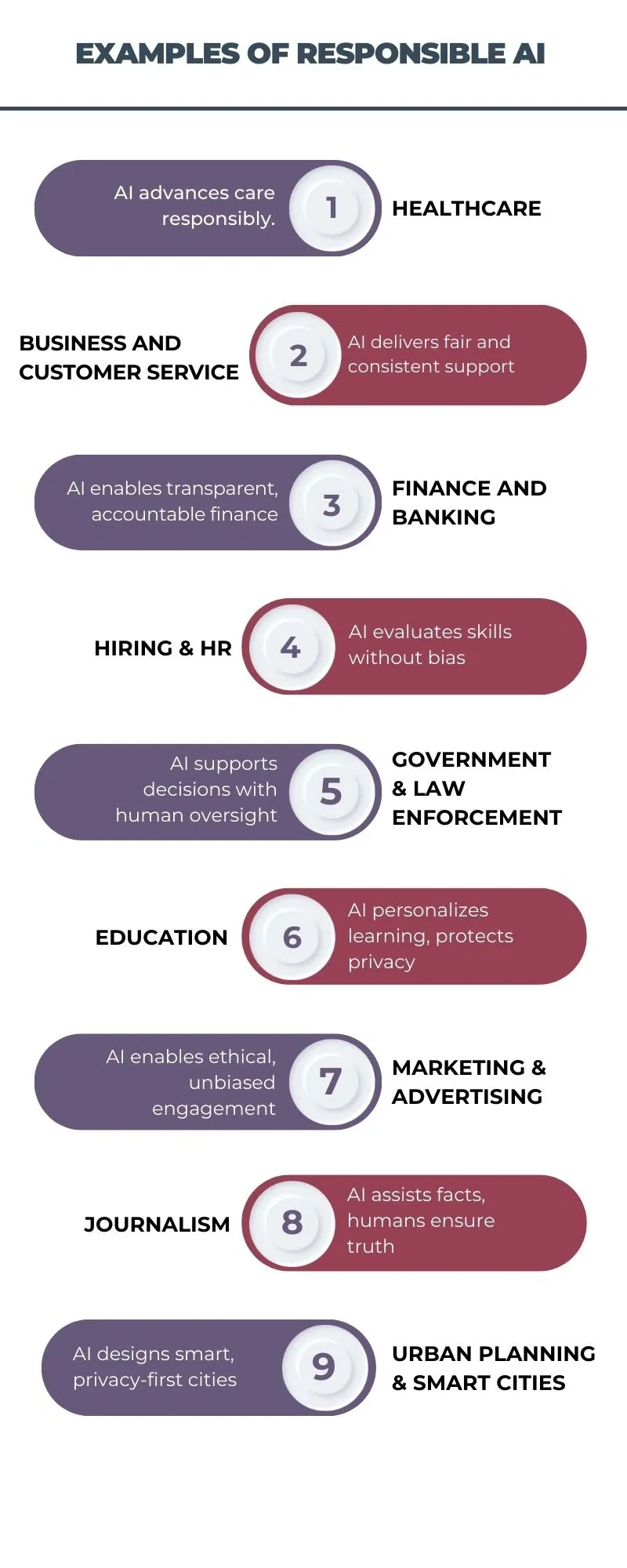
1. Responsible AI in Healthcare
In healthcare, responsible AI is about assisting clinicians, protecting patients, and earning trust, not replacing human judgment.
- Medical imaging: AI helps analyse X-rays and MRIs by highlighting areas of concern, while doctors make the final diagnosis.
- Clinical decision support: AI tools suggest possible treatment options based on patient history and research, but clinicians decide what’s best for the patient.
- Early risk detection: Hospitals use AI to identify patients at risk of complications or readmission, enabling timely follow-ups and preventive care.
2. Responsible AI in Business & Customer Service
In customer-facing roles, AI often becomes the first point of interaction. Responsible AI ensures these experiences remain fair and unbiased.
- AI chatbots are designed to provide consistent, respectful responses to all customers, regardless of background or language.
- Bias detection systems monitor customer interactions to spot patterns that may lead to unfair treatment.
- Agent-support tools provide objective feedback to customer service teams, helping improve performance without reinforcing bias.
Also Read: Beyond the Chatbot: How Smart AI Actually Makes Customer Service More Human
3. Responsible AI in Finance & Banking
AI plays a major role in financial decisions that can impact lives. Responsible AI promotes fairness and clarity.
- Fraud detection systems flag unusual activity without unfairly targeting specific groups.
- Loan approval models evaluate applications based on financial behaviour, not personal attributes, supporting financial inclusion.
- Transaction monitoring ensures compliance while maintaining accountability and auditability.
4. Responsible AI in Hiring & HR
HR teams increasingly rely on AI to manage large talent pools. Responsible AI keeps hiring fair and inclusive.
- Recruitment tools screen candidates based on skills and experience, not names or personal details.
- Performance analysis systems offer unbiased insights to support employee development.
- Decision-support frameworks ensure AI recommendations are reviewed and validated by HR professionals.
5. Responsible AI in Government & Law Enforcement
Public-sector use of AI demands extra care. Responsible AI ensures fairness, accountability, and respect for civil liberties.
- Predictive analytics help allocate resources without enabling racial profiling.
- Judicial support tools assist with research while keeping final judgments to be human led.
- Document analysis systems handle sensitive data securely and transparently.
6. Responsible AI in Education
In education, AI can expand access while respecting student rights.
- Adaptive learning platforms adjust content to individual learning needs without labelling or limiting students.
- Progress-tracking tools monitor learning outcomes without intrusive data collection.
- Assessment tools grade work consistently while supporting academic integrity.
7. Responsible AI in Marketing & Advertising
AI-driven marketing can influence behaviour at scale. Responsible AI keeps this influence ethical.
- Content generation tools avoid misleading or deceptive messaging.
- Diversity analysis systems help ensure campaigns reflect inclusive audiences.
- Customer segmentation models target responsibly without reinforcing stereotypes.
8. Responsible AI in Journalism
AI tools generate news from structured data, especially for financial or sports reporting.
- Responsible systems ensure transparency, clear sourcing, and fact-based reporting.
- Editorial oversight ensures AI-generated content remains accurate and unbiased.
9. Responsible AI in Urban Planning & Smart Cities
AI supports smarter cities by analysing traffic, energy, and public services.
- Smart city initiatives use AI to improve sustainability and efficiency.
- Responsible approaches prioritise citizen consent, data privacy, and transparency.
Benefits and Challenges of implementing responsible AI
Organisations want to implement responsible AI principles but don't deal very well with putting these ideals into practice. Technical, organisational, and regulatory challenges create friction between ethical goals and ground application.
Benefits | Challenges |
| Builds Trust & Transparency: Enhances user confidence through explainable and fair AI systems | Complex Model Explainability: Making advanced AI models transparent is technically difficult |
| Reduces Bias & Discrimination: Promotes ethical, inclusive decision-making | Data Bias Issues: Identifying and correcting biased data requires continuous monitoring |
| Regulatory Readiness: Helps organizations comply with evolving AI laws and policies | Changing Regulations – Keeping up with global AI regulations is resource-intensive |
| Strengthens Brand Reputation – Demonstrates ethical leadership and accountability | Higher Implementation Costs – Responsible AI frameworks need time, tools, and skilled talent |
| Supports Sustainable AI Adoption – Encourages long-term, human-centered innovation | Slower Deployment – Ethical checks can increase development time-to-market |
Benefits of Implementing Responsible AI
- Builds Trust & Transparency: Responsible AI ensures that AI decisions are explainable and fair, increasing confidence among users, customers, and stakeholders.
- Reduces Bias & Discrimination: By identifying and addressing biases in data and algorithms, responsible AI promotes ethical and inclusive outcomes.
- Regulatory Readiness: Organizations adopting responsible AI practices are better equipped to comply with evolving AI regulations and governance frameworks.
- Strengthens Brand Reputation: Ethical AI adoption enhances organizational credibility and positions the brand as a responsible and trustworthy innovator.
- Supports Sustainable AI Adoption: Responsible AI enables long-term, human-centered innovation while minimizing ethical and operational risks.
Challenges of Implementing Responsible AI
- Complex Model Explainability: Advanced AI models, especially deep learning systems, often lack transparency, making it difficult to explain decision-making processes.
- Data Bias Issues: Bias in training data can influence AI outcomes, requiring continuous monitoring, auditing, and mitigation efforts.
- Changing Regulations: Keeping pace with evolving and region-specific AI laws can be complex and resource-intensive.
- Higher Implementation Costs: Responsible AI requires investment in tools, skilled talent, governance frameworks, and compliance processes.
- Slower Deployment: Ethical evaluations, risk assessments, and human oversight can extend AI development and deployment timelines.
How organisations can promote responsible AI?
Organisations need systematic approaches to turn ethical principles into practical governance frameworks for responsible AI. Several proven strategies can help organisations ensure their AI initiatives follow ethical guidelines.
- Establishing AI ethics committees: AI ethics committees act as central governance mechanisms that guide responsible AI implementation. These committees need diverse expertise from technology, policy, ethics, and social advocacy to ensure multiple viewpoints.
- Training teams on AI ethics and fairness: AI ethics education plays a vital role in building an ethical AI culture. Teams at all levels need ongoing training to stay aware and adaptable. The training should go beyond basic compliance to focus on fairness, transparency, and human dignity. Well-designed programmes give employees practical tools to spot and reduce bias throughout AI development.
- Embedding ethics in the AI lifecycle: Ethics must spread through every stage of AI development, from start to finish. Risk assessment and ethical framework definition should happen during early planning. Design priorities should focus on human well-being, inclusivity, accessibility, and privacy.
Also Read: How to Learn AI the Right Way
Conclusion
Responsible AI is where innovation meets intention. It asks us to slow down just enough to ask the right questions:
Is this fair? Is it clear? Who benefits from this decision? Who might be left out?
When AI is designed with care, it becomes a collaborator, not a controller. It supports doctors instead of replacing them, widens opportunities instead of narrowing them, and builds trust rather than doubt.
The future of AI won’t be defined only by smarter algorithms, it will be shaped by the values we program into them today. Responsible AI reminds us of one simple truth: technology should serve people, not the other way around.
Frequently Asked Questions
Q1. What is responsible AI and why is it important?
Responsible AI is an approach to developing and deploying artificial intelligence systems that prioritises ethical principles, fairness, transparency, and accountability. It's crucial because it helps build trust in AI technologies, prevents bias and discrimination, and ensures that AI systems benefit society while minimising potential harm.
Q2. How does responsible AI differ from general AI development?
While general AI development often focuses primarily on technical performance and efficiency, responsible AI extends beyond these aspects to address ethical concerns and business risks. It incorporates governance, oversight, and practical strategies to mitigate risks throughout the entire AI lifecycle.
Q3. How can organisations promote responsible AI practices?
Organisations can promote responsible AI by establishing AI ethics committees, providing comprehensive training on AI ethics, embedding ethical considerations throughout the AI lifecycle, conducting regular audits of AI systems, and collaborating with external experts to gain diverse perspectives.
Q4. What challenges do organisations face when implementing responsible AI?
Key challenges in implementing responsible AI include the lack of standardised ethical frameworks, issues with data quality and representativeness, balancing innovation with regulation, the technical complexity of making AI systems explainable, and overcoming resistance to organisational change.
About the Author
TalentSprint
TalentSprint, Part of Accenture LearnVantage, is a global leader in building deep expertise across emerging technologies, leadership, and management areas. With over 15 years of education excellence, TalentSprint designs and delivers high-impact, outcome-driven learning solutions for individuals, institutions, and enterprises. TalentSprint partners with leading enterprises and top-tier academic institutions to co-create industry-relevant learning experiences that drive measurable learning outcomes at scale.
Advance your career with the right program