
The New Rules of Business Growth in the Digital and AI Era

TL;DR:The next era of growth belongs to leaders who sense change early, rebuild business models around AI, design for customer value and act before certainty arrives. With 83% of transformations missing targets, leadership capability is the real differentiator, and it can be built deliberately, starting now.
Growth used to follow a familiar formula. Add people, add markets, add campaigns, and the numbers eventually moved. That formula has not disappeared, but it has stopped being enough. AI has changed how quickly value shifts, and 69% of CEOs have already restructured a core business process around it.
Yet the results are uneven. Around 83% of leaders miss their transformation targets, and the gap sits in leadership, not technology. Meanwhile, digital and AI leaders are generating up to six times higher shareholder returns across sectors.
That distance between adoption and advantage is where the real story lies. The rules of business growth are being rewritten, and the leaders who understand the new ones will decide who compounds and who quietly falls behind.
Why has the old growth playbook stopped working?
For decades, growth followed a set of dependable equations. More people meant more capacity. More capital meant more scale. More marketing meant more customers, more products meant more revenue, and more processes meant more control. AI has quietly rewritten every one of those equations.
Scale is giving way to intelligence, efficiency to adaptability, products to outcomes, mass marketing to personalisation, information to insight, and automation to augmentation. Technology adoption itself is no longer the goal; business transformation is. Yet technology alone has never created advantage.
The organisations pulling ahead are those whose leaders can connect technology, strategy, people, execution and customer value into one coherent system. That connective ability, not the tool stack, is what separates growth leaders from fast followers.
Rule One: Growth starts with sensing
The first competitive act in the AI era is not investment. It is perception.
Disruption rarely announces itself. It shows up as a small shift in customer behaviour, an unfamiliar entrant with a different cost structure, or a capability that suddenly becomes cheap. By the time the shift is obvious enough to build a business case around, the advantage has already moved. Leaders who sense early buy themselves the one thing capital cannot purchase: time to respond deliberately.
Sensing well depends on three habits. The first is framing problems under ambiguity, resisting the pull to solve the wrong question precisely. The second is reading sectoral disruption patterns, recognising that AI reshapes banking, manufacturing and healthcare through different mechanics and on different clocks. The third is design thinking in the age of AI, staying anchored to real customer friction rather than technological novelty.
Rule Two: Business Models Are Being Rebuilt
Most organisations still treat AI as a feature to be added to an existing model. The more consequential move is rebuilding the model itself.
The evidence for that shift is already visible. Between 2013 and 2025, the share of companies leading or participating in a digital ecosystem rose from 30% to 81%, with matching gains in revenue growth and net profit. Ecosystem-driver models alone grew from 12% to 58% of businesses, and they were the only category of the original four digital models to consistently beat industry-average revenue growth.
What comes next is more fundamental. Research now points to business models becoming outcome-oriented and enabled by autonomous AI, spanning firms that augment an existing model with AI, those that deliver customer outcomes through AI-executed processes, and those that orchestrate entire ecosystems of complementary products and services.
For leaders, the strategic questions become sharper: What are customers actually paying us for? Can our current model scale with AI, or does it quietly cap us? Where could AI open revenue pools that do not exist today?
Rule Three: Customer Centricity Becomes the Real Differentiator
When technology makes scale cheap, the axis of competition moves. If every player can access the same automation, producing more stops being a differentiator. What separates winners is who responds faster, gets it more accurate, and makes it more personal.
That reframes the strategic test for any business: is our advantage something a machine can replicate quickly, or is it a value that only human judgment, relationship and context can create?
Customer centricity in the AI era is therefore less about sentiment and more about design. It means using AI to understand intent at an individual level, then building products, pricing and marketing around that understanding rather than around internal convenience.
The programme's Craft module works directly on this shift, through customer-centricity in the age of artificial intelligence and recrafting marketing in the digital era.
Rule Four: Execution Speed Is the New Defensible Advantage
Strategy is no longer scarce resource. Most leadership teams can see roughly the same opportunities at roughly the same time. What differs is how quickly an organisation can move from insight to action.
Agile structures now achieve reach that once required scale. Lean operations, fast experimentation and low overhead let a small team create impact previously available only to large companies.
Speed, however, is an organisational property rather than an individual one. It breaks down when product, finance, sales and customer success each carry a different definition of value. In large organisations that alignment is as much cultural as operational, and it is usually the hidden reason transformation targets slip.
The practical work for leaders is unglamorous: shorten decision cycles, agree on one shared measure of value, and give teams permission to test before certainty arrives.
Rule Five: The Leadership Gap Is the Real Bottleneck
The constraint on AI-led growth is rarely the technology. It is the number of leaders who can translate it into business results. Technical leaders are now expected to connect infrastructure decisions to monetisation strategy, not just system performance. The data reinforces the point: 83% of leaders miss transformation targets, and the gap is leadership, not tooling.
Four capabilities close it:
- Strategic framing: Asking the right question before funding the answer
- Digital and AI economics literacy: Understanding cost, pricing and value mechanics
- Business-model design: Rebuilding how value is created and captured
- Change leadership: Aligning teams around one definition of success
These are techno-managerial skills, and they can be built deliberately.
Building the Capability: Where IIM Calcutta's Digital and AI Business Leadership fits?
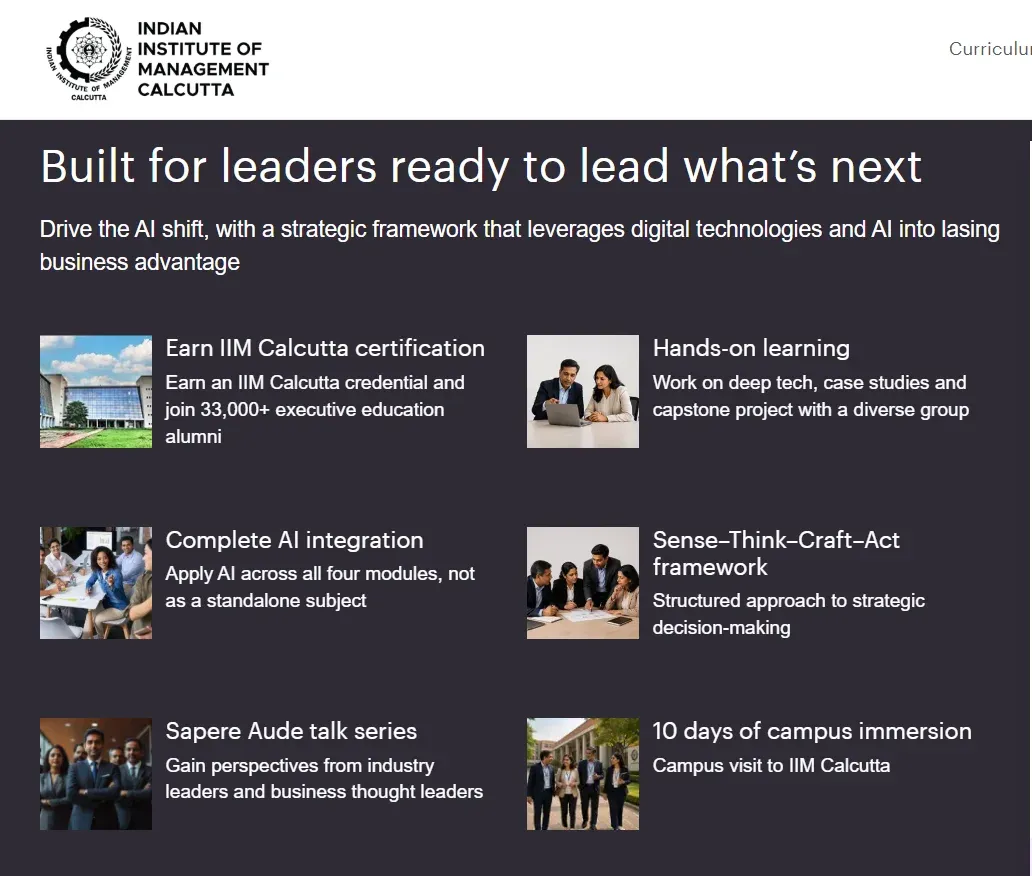
Capability of this kind is built structurally, not picked up in fragments. The Advanced Programme in Digital and AI Business Leadership from IIM Calcutta is designed around exactly that need.
What makes it relevant to the rules above:
- AI across all four modules, not taught as a standalone subject
- The Sense–Think–Craft–Act framework, a structured approach to strategic decision-making
- 12 months of live online sessions plus 10 days of campus immersion at IIM Calcutta
- Applied learning through deep tech work, case studies and a capstone project
- Sapere Aude talk series, bringing industry and thought-leadership perspectives
- IIM Calcutta certification and entry into a 33,000-plus executive education alumni network
It is built for technology leaders, technology-knowledgeable business leaders, entrepreneurs and business-technology consultants across IT, manufacturing, BFSI, consulting, FMCG and logistics.
Final Thoughts
The rules have not simply shifted; they have been rewritten. Growth now favours the organisation that senses change earliest, prices for outcomes, rebuilds its model rather than retrofitting it, and moves before certainty arrives. None of this is a technology problem.
It is a leadership one, and that is genuinely good news, because leadership capability can be built. Programmes like IIM Calcutta's Advanced Programme in Digital and AI Business Leadership exist to build exactly that.
Frequently Asked Questions
1. Why is the traditional growth playbook no longer effective?
Adding people, capital and campaigns no longer guarantees returns. AI has shifted growth from scale to intelligence, products to outcomes, and automation to augmentation.
2. What are the new rules of business growth in the AI era?
Sense changes early, rebuild the business model instead of adding AI as a feature, compete on customer centricity, execute faster, and close the leadership gap.
3. What capabilities do leaders need to drive AI-led growth?
Strategic framing, digital and AI economics literacy, business-model design, and change leadership. These techno-managerial skills can be built deliberately.
4. Who should consider the Advanced Programme in Digital and AI Business Leadership from IIM Calcutta?
Technology leaders, technology-knowledgeable business leaders, entrepreneurs and business-technology consultants across IT, manufacturing, BFSI, consulting, FMCG and logistics.
About the Author
TalentSprint
TalentSprint, Part of Accenture LearnVantage, is a global leader in building deep expertise across emerging technologies, leadership, and management areas. With over 15 years of education excellence, TalentSprint designs and delivers high-impact, outcome-driven learning solutions for individuals, institutions, and enterprises. TalentSprint partners with leading enterprises and top-tier academic institutions to co-create industry-relevant learning experiences that drive measurable learning outcomes at scale.
Explore Our Programme
Advance your career with the right program