
What Is Open Banking and How Is It Changing Financial Services?

TL;DR:Open banking enables secure sharing of financial data between banks and authorized providers through APIs. It is reshaping financial services by encouraging innovation, improving customer experiences, enabling personalized products, and simplifying payments and lending. As adoption grows, open banking is creating a more connected, competitive, and customer-centric financial ecosystem.
For decades, a customer's financial life stayed inside the walls of their bank. Their transactions, balances and credit history belonged, in practice, to one institution. That model is now giving way to something far more connected.
Open banking lets customers securely share their financial data with trusted third parties and start payments through them, all with explicit consent. The result is a financial ecosystem where banks, FinTechs and platforms work together, compete and innovate on a shared foundation of data.
For professionals in banking, FinTech and digital transformation, this shift raises the bar. Leading in an open financial ecosystem takes more than domain expertise. It calls for a new blend of skills in technology, data, regulation and strategy.
What is open banking?
Open banking is a model in which banks allow licensed third-party providers to access customer account information or initiate payments through secure Application Programming Interfaces (APIs), but only with the customer's explicit permission.
The idea is simple but powerful. The customer, not the institution, controls who sees their financial data and for what purpose.
Open Banking vs. Traditional Banking
| Traditional Banking | Open Banking |
| Customer data stays with one bank | Data can be shared securely with consent |
| Products built in-house | Products built through partnerships and ecosystems |
| Limited customer choice | Wider choice of tailored services |
| Bank owns the customer relationship | Relationship is shared across platforms |
Why it matters now?
Data has become one of the most valuable assets in financial services. Customers expect seamless, personalised and instant experiences, the kind they already enjoy on digital platforms. Open banking makes these experiences possible at scale.
How does open banking work?
APIs: The Backbone of Open Banking
Before open banking, many apps relied on "screen scraping," where customers handed over their banking credentials so an app could extract their data. The approach was fragile, insecure and hard to audit. Open banking replaces it with standardised, permission-based APIs that banks expose to authorised providers.
The Two Core Services
Most open banking use cases fall into two categories:
- Account Information Services (AIS): Read access to balances, transaction history and account details. These power budgeting apps, lending assessments and accounting integrations.
- Payment Initiation Services (PIS): The ability to initiate payments directly from a bank account, enabling "pay by bank" options at checkout.
The Consent Journey
Every open banking interaction begins and ends with customer consent:
- Consent: The customer chooses to connect their bank account in a third-party app.
- Authentication: They are redirected to their bank to log in securely and approve access.
- Token issued: The bank grants access that is limited in scope and time.
- Data access: The provider retrieves only the approved data or initiates the approved payment.
- Ongoing control: The customer can review or revoke consent at any time.
India's Digital Public Infrastructure Advantage
India's open banking journey is strengthened by its digital public infrastructure: UPI, Aadhaar, DigiLocker and the Data Empowerment and Protection Architecture (DEPA). The Digital Personal Data Protection (DPDP) Act, 2023 adds a further layer of data governance. Together, these give India one of the most ambitious consent-driven financial data ecosystems in the world.
How open banking is changing financial services?
Open banking is not a single innovation. It is a foundation that is reshaping almost every vertical of financial services.
1. Lending: Faster, Smarter Credit Decisions
With consent-based access to verified financial data, lenders can assess creditworthiness from real cash flows rather than from credit history alone. In India, frameworks such as the Account Aggregator and the Open Credit Enablement Network (OCEN) are enabling new co-lending models and broader credit access for individuals and small businesses.
Also Read: What Is Digital Lending? How Technology Is Changing the Credit Journey
2. Payments: Direct and Frictionless
Payment initiation lets customers pay directly from their bank accounts without card networks. This lowers costs for merchants and creates faster, simpler checkout experiences.
3. Wealth Management: A Unified Financial View
Customers can now see accounts, investments and insurance policies in one place. This lets WealthTech platforms offer more holistic, data-led advice, including robo-advisory services.
4. Insurance: Embedded and Personalised
With richer data insights, insurers can offer embedded insurance at the point of need and design products that reflect individual risk profiles more accurately.
5. Compliance: Technology as an Enabler
Consent management, audit trails and secure data flows are making RegTech central to how institutions manage compliance in an open ecosystem.
Also Read: What is RegTech? How It’s Reshaping Modern Business Compliance
6. Business Models: From Products to Platforms
Perhaps the biggest change is strategic. Banks are evolving from product providers into platforms. They partner with FinTechs, offer banking-as-a-service and compete on customer experience rather than on owning customer data.
Benefits and Risks Leaders Must Weigh
Open banking creates significant opportunity, but it also brings new responsibilities.
| Benefits | Risks |
| Greater customer choice and control | Data privacy concerns |
| Faster innovation through partnerships | Cybersecurity threats across a wider ecosystem |
| Improved financial inclusion | Inconsistent API quality and standards |
| Operational efficiency and lower costs | Consent fatigue among customers |
| More personalised products | Complex questions of liability and accountability |
For leaders, the takeaway is clear. In an open ecosystem, trust is the new competitive advantage. The institutions that thrive will pair innovation with strong governance, security and transparency.
Why open banking demands a new professional skillset?
Open banking changes not only how financial services work, but also what it takes to lead them. Professionals now need capabilities that cut across traditional boundaries.
- Data and AI fluency: Turning shared data into insight through AI-driven credit scoring, fraud detection, risk management and personalisation.
- Ecosystem thinking: Building and managing partnerships with FinTechs, Account Aggregators, technology providers and platforms.
- Regulatory and data governance literacy: Understanding consent frameworks, data protection laws and compliance obligations.
- Product and business model innovation: Designing new offerings across lending, payments, wealth and insurance.
- Entrepreneurial acumen: Evaluating, funding and scaling FinTech ventures in a fast-moving market.
These are no longer niche skills. They are becoming essential for anyone shaping the future of finance.
Building capability to lead in the open banking era
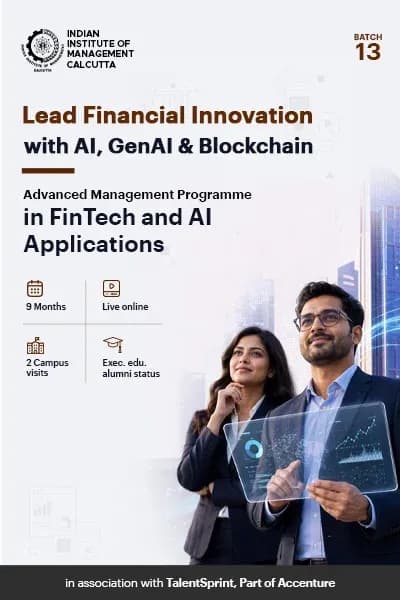
For professionals looking to build this cross-functional expertise in a structured way, the Advanced Management Programme in FinTech and AI Applications from IIM Calcutta, offered with TalentSprint, provides a strong pathway.
The programme covers the full spectrum of FinTech innovation. Modules include:
- India's FinTech ecosystem, including UPI and the Account Aggregator framework
- LendingTech innovations such as OCEN, co-lending and the Unified Lending Interface (ULI)
- Digital payments, WealthTech, InsurTech and RegTech
- Entrepreneurial finance and valuation of FinTech firms
It also explores how AI, Generative AI and Blockchain are transforming these domains.
Delivered over nine months through live, faculty-led weekend sessions, the programme includes two campus immersions at IIM Calcutta and a capstone project. Participants also earn IIM Calcutta executive education alumni status.
Conclusion
Open banking is redefining financial services. Value is shifting from owning customer data to earning customer trust and orchestrating seamless experiences across an interconnected ecosystem.
For banks, FinTechs and technology leaders, the opportunity is significant, and so is the responsibility. The professionals who will shape this future are those who can bring finance, technology, data and governance together. In the age of open and AI-powered finance, that capability is no longer optional. It is the edge.
Frequently Asked Questions
1. Is open banking safe for customers?
Yes. Open banking relies on secure APIs, strong authentication and explicit customer consent. Customers never share their banking passwords with third parties, and they can revoke access at any time.
2. How is India's Account Aggregator framework different from PSD2?
India's framework routes consent centrally through RBI-regulated Account Aggregators. It covers banking, securities, insurance and pensions, and it passes data on in encrypted form without storing it. PSD2 focuses mainly on bank account data shared through bank APIs.
3. What is the difference between open banking and open finance?
Open banking focuses on bank account data and payments. Open finance extends the same principle to investments, insurance, pensions and other financial products.
4. How does open banking affect traditional banks?
It pushes banks to compete on experience and partnerships rather than on owning data. Many are evolving into platforms that collaborate with FinTechs.
5. What skills do professionals need to work in open banking?
Key skills include AI and data analytics, an understanding of APIs and digital ecosystems, regulatory and data governance knowledge, product innovation and entrepreneurial thinking.
About the Author
TalentSprint
TalentSprint, Part of Accenture LearnVantage, is a global leader in building deep expertise across emerging technologies, leadership, and management areas. With over 15 years of education excellence, TalentSprint designs and delivers high-impact, outcome-driven learning solutions for individuals, institutions, and enterprises. TalentSprint partners with leading enterprises and top-tier academic institutions to co-create industry-relevant learning experiences that drive measurable learning outcomes at scale.
Explore Our Programme
Advance your career with the right program