Your career doesn't start after graduation actually, It starts during college

TL;DR:Career success rarely begins after graduation, it starts during college. Students who build projects, develop in-demand skills, gain practical experience, and explore real-world opportunities throughout their degree often stand out to employers. By combining academic learning with hands-on application, students can graduate with stronger portfolios, greater confidence, and a clearer path to future opportunities.
Ask any final-year student what's on their mind, and you'll probably hear the same things: resumes, interviews, internships, and job applications.
The pressure often feels sudden, but the truth is that the students who seem most confident during placement season usually didn't start preparing a few months before graduation. They spent years building projects, learning new skills, and gaining practical experiences along the way.
In today's job market, employers want more than academic knowledge. They want to see what students can create, solve, and contribute.
That's why the journey towards employment often begins long before graduation day.
What are employers really looking for in Fresh Graduates?
A degree may help students get noticed, but it is rarely what helps them stand out.
When recruiters evaluate fresh graduates, they are often trying to answer a simple question, "Can this person apply what they have learned?"
That is why many employers look beyond academic performance and assess a student's ability to solve problems, work collaboratively, communicate effectively, and adapt to new challenges.
They also pay close attention to evidence of initiative, such as projects, internships, certifications, hackathon participation, and practical work.
In many ways, graduates are no longer competing only on grades. They are competing on the experiences and skills they have built throughout college.
Why the final year is too late to start thinking about careers
Many students assume career preparation begins in their final semester.
That's usually when job applications start, placement drives begin, and LinkedIn profiles suddenly become active.
The challenge is that by this stage, students often find themselves trying to do everything at once: build a resume, learn new technologies, prepare for interviews, work on projects, and network with recruiters.
- Skills take time to develop.
- Confidence takes time to build.
- Experience takes time to earn.
Students who begin exploring opportunities earlier often have an advantage because they are building steadily rather than rushing at the finish line.
Career preparation is rarely a final-year activity. It is often the result of choices made throughout the college journey.
Every project you build becomes proof of your skills
One of the biggest challenges students face is proving what they can do.
A transcript may show what subjects a student has studied, but it does not always show how they apply that knowledge.
Projects help bridge that gap.
Whether it is:
- Developing an app,
- Building a website,
- Creating an AI model,
- Contributing to open-source software, or
- Participating in a hackathon.
Every project becomes a tangible demonstration of learning.
Projects also teach something classrooms cannot always replicate: how to work through uncertainty.
Students learn how to troubleshoot problems, collaborate with others, manage deadlines, and refine solutions through trial and error.
Over time, these experiences become valuable assets that students can showcase during interviews and recruitment processes.
Beyond marks: the skills that make students stand out
Technical knowledge remains important, especially in fields like computer science.
However, employers are increasingly looking for a balance between technical expertise and professional capabilities.
Students who stand out often possess a combination of:
Technical Skills
- Programming fundamentals
- Software development practices
- Database management
- Cloud technologies
- Emerging technology awareness
Professional Skills
- Communication
- Problem-solving
- Teamwork
- Critical thinking
- Adaptability
- Time management
As industries continue to evolve, exposure to growing fields such as Artificial Intelligence, Machine Learning, Data Science, and Cloud Computing can further strengthen a student's ability to navigate future opportunities.
The most successful graduates are often those who can combine technical competence with the ability to work effectively in real-world environments.
Can you secure opportunities before graduation?
Absolutely.
In fact, many students begin building their professional journey while they are still in college.
Internships, apprenticeships, industry projects, coding competitions, and professional networking opportunities often help students gain valuable exposure before graduation.
These experiences provide more than just resume points.
They help students understand workplace expectations, build confidence, and develop practical skills that employers value.
In many cases, internships and apprenticeship experiences can even create pathways to full-time opportunities.
The earlier students start engaging with real-world experiences, the greater their chances of entering the job market with a stronger foundation.
Why learning by doing is becoming the new advantage
For years, education was often viewed as a process of acquiring knowledge first and applying it later.
And today, that approach is changing as now, students increasingly want opportunities to practice what they learn while they are still studying.Employers want graduates who have already experienced solving real problems, working on projects, and applying technical concepts in practical situations.
This is why experiential learning is receiving growing attention. Hence, Hands-on labs, coding challenges, industry projects, hackathons, and collaborative assignments help students develop both competence and confidence.
So, the goal is not simply to understand concepts rather, it is to understand how those concepts work in the real world.
Learning beyond the classroom: a growing shift in higher education
One of the most noticeable changes in higher education today is the growing emphasis on learning through experience.
Traditionally, students spent several years attending classes, completing assignments, and earning a degree before looking for opportunities to gain professional experience. Increasingly, however, educational institutions are exploring ways to bring both learning and application together throughout the student journey.
This shift is driven by a simple reality: students often learn best when they can see how classroom concepts apply in real-world situations. Projects, practical assignments, industry interactions, apprenticeships, and hands-on experiences help bridge the gap between academic learning and workplace expectations.
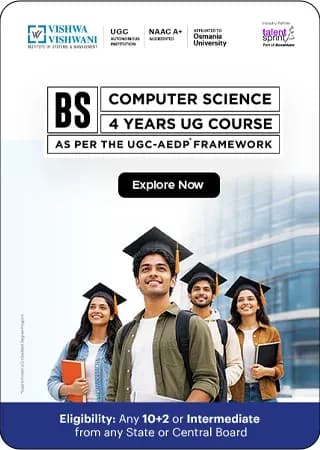
The BS in Computer Science by VVISM Hyderabad, offered in collaboration with TalentSprint (part of Accenture), reflects this evolving approach through the UGC-AEDP (Apprenticeship Embedded Degree Programme) framework, which combines an undergraduate degree with structured industry apprenticeship opportunities.
Instead of treating practical exposure as something students pursue after graduation, the programme integrates it into the learning journey itself.
What does this look like in practice?
Students have opportunities to:
- Learn through hands-on labs, coding bootcamps, and coding challenges
- Apply concepts through practical projects and hackathons
- Gain exposure to industry environments through apprenticeship experiences
- Build expertise in emerging domains such as AI, Machine Learning, Data Science, Cloud Technologies, SAP, and Pega
- Receive continuous mentorship and guidance for projects, certifications, and skill development
Beyond technical learning, the programme also recognises that career growth requires more than subject knowledge.
Students are supported through a learning ecosystem that encourages:
- Real-world problem solving
- Portfolio development
- Industry exposure
- Professional skill development
- Continuous learning and adaptability
More importantly, this approach reflects a broader shift taking place across higher education—one where students are increasingly encouraged to gain practical experience alongside academic knowledge, rather than waiting until graduation to begin building it.
Building a portfolio before paycheck
By the time students graduate, they often need more than a qualification.
They need evidence of what they can do.
A strong portfolio may include:
- Coding projects
- GitHub repositories
- Internship experiences
- Technical certifications
- Research work
- Open-source contributions
- Hackathon participation
Each project demonstrates initiative, curiosity, persistence, and technical ability.
A well-developed portfolio tells a story that marks alone often cannot.
This is one reason why practical experiences, apprenticeship opportunities, and project-based learning are becoming increasingly valuable. They help students graduate with work they can showcase rather than simply qualifications they can list.
Also read: How to Build a Strong Tech Portfolio Before Graduation
Building your future starts before graduation day
For today's students, college is no longer just about earning a degree. It is an opportunity to explore interests, develop skills, gain practical experience, and discover what they are capable of achieving.
The students who make the most of these years often graduate with more than academic knowledge. They leave with portfolios, project experience, industry exposure, professional networks, and the confidence to take on real-world challenges.
Success after graduation is rarely the result of a few months of preparation. It is built through consistent learning, hands-on experiences, and the willingness to keep growing throughout the college journey.
The goal is not simply to graduate. It is to graduate with the skills, experiences, and mindset needed to seize opportunities with confidence.
And for students who begin building those foundations early, graduation becomes more than a milestone, it becomes the launchpad for everything that comes next.
Frequently Asked Questions
Q1. When should students start preparing for their careers?
Students should begin career preparation during the early years of college rather than waiting until their final semester. Building skills, working on projects, gaining practical experience, and exploring internships gradually helps create a stronger foundation for future opportunities and reduces last-minute pressure.
Q2. What do employers look for in fresh graduates besides academic performance?
Employers increasingly look for evidence of practical skills, problem-solving ability, communication, teamwork, and initiative. Projects, internships, hackathons, portfolios, certifications, and real-world experiences often help students demonstrate how they can apply their knowledge beyond the classroom.
Q3. How can students make themselves stand out before graduation?
Students can stand out by building a portfolio of projects, participating in internships and coding competitions, earning relevant certifications, exploring emerging technologies, and gaining hands-on experience. These experiences showcase initiative, technical ability, and practical problem-solving skills that recruiters often value highly.
About the Author
TalentSprint
TalentSprint, Part of Accenture LearnVantage, is a global leader in building deep expertise across emerging technologies, leadership, and management areas. With over 15 years of education excellence, TalentSprint designs and delivers high-impact, outcome-driven learning solutions for individuals, institutions, and enterprises. TalentSprint partners with leading enterprises and top-tier academic institutions to co-create industry-relevant learning experiences that drive measurable learning outcomes at scale.
Explore Our Programme
Advance your career with the right program