What Skills Do Leaders Need to Lead at the Enterprise Level?

TL;DR:LEAD is for accomplished senior leaders with 15+ years of experience, close to the CEO, who are preparing to think, decide and lead for the whole enterprise.
Most senior leaders reach the top on the strength of one thing done exceptionally well. They ran a profitable business unit, built a strong sales engine or fixed a broken operation. Then the role changes. The decisions now involve capital, customers, talent, technology and risk all at once, and they affect parts of the business the leader has never managed directly.
This is where many accomplished professionals feel the gap. They have deep expertise, but the job now requires something different.
The short answer: Leading at the enterprise level requires seven capabilities:
- Seeing the organisation as one connected system
- Exercising judgement on high-consequence decisions
- Understanding how value is created and allocated
- Converting AI and digital investment into business results
- Reading a complex external context
- Influencing without direct authority
- Leading continuous change while sustaining trust
Functional excellence still matters, but it is no longer what sets leaders apart.
Why enterprise leadership skills matter more now?
The case for building these skills is not abstract. In PwC's 28th Annual Global CEO Survey, four in ten CEOs said their company would no longer be viable in ten years if it continued on its current path. The same survey found that almost 40% of companies had started competing in new sectors in the previous five years. On average, only 7% of revenue over that period came from new businesses.
The barriers are clear: weak decision-making processes, limited year-to-year reallocation of resources, and a mismatch between short leadership tenures and long-term forces. These are not technology problems. They are leadership problems at the enterprise level.
The skills landscape is shifting as well. Employers surveyed by the World Economic Forum expect 39% of workers' core skills to change by 2030. Among the core skills employers rate as essential today, analytical thinking comes first at nearly 70%. It is followed by resilience, flexibility and agility (67%) and leadership and social influence (61%).
The pattern is clear. The more a business has to reinvent itself, the more it depends on leaders who can think and act across the whole enterprise.
What is enterprise leadership?
Enterprise leadership is the ability to make decisions in the interest of the whole organisation rather than one function or business unit. A functional leader improves their own area. An enterprise leader makes trade-offs that may not favour their own team because the wider business needs them.
That shift changes what "good leadership" looks like. Below are the capabilities that matter most.
The 7 Core Enterprise Leadership Skills
1. Systems Thinking: Seeing the Enterprise as One Connected Whole
Every major decision travels. Repricing a product affects working capital, sales incentives, channel relationships and brand perception. Automating a process changes headcount plans, skills needs and risk exposure.
Systems thinking is the ability to trace these connections before acting. It means looking for recurring patterns rather than isolated events, and anticipating second-order effects. It also means finding the few points of leverage that improve outcomes across the business, such as decision rights, incentives or information flows.
In practice: Before approving a major initiative, ask which three other functions it will affect and how they are likely to respond.
2. Strategic Judgement: Making Decisions of Greater Consequence
At the enterprise level, the hard decisions rarely have a clean, data-backed answer. Leaders choose between competing priorities, often with incomplete information and with consequences that play out over years.
Good judgement is not the same as confidence. It involves separating reversible decisions from irreversible ones, being clear about the assumptions behind a choice, and knowing when to commit and when to wait for more evidence. It also means deciding what not to do. Research finding on low resource reallocation suggests that many organisations struggle with exactly this.
In practice: Review past decisions by comparing what you expected with what actually happened. Judgement improves through deliberate reflection, not experience alone.
3. Financial and Value-Creation Acumen
Enterprise leaders do not need to be finance experts, but they must understand how the business makes money. That includes P&L dynamics, capital allocation, unit economics and the link between operating choices and long-term value.
Without this, leaders tend to defend budgets rather than redirect them. With it, they can challenge investment cases, weigh trade-offs between growth and margin, and speak credibly with boards and CFOs.
4. AI and Digital Fluency: Turning Capability into Results
This is where the gap between ambition and results is widest. Recent global CEO research shows that fewer than a quarter of CEOs say AI is used extensively across major business areas, and most report limited financial returns so far. Earlier data shows the same gap. While 44% of CEOs reported efficiency gains from GenAI, only 24% saw an increase in profitability.
The lesson for leaders is not to learn to code. It is to understand what AI can and cannot do, connect use cases to measurable business outcomes, and redesign work, roles and decisions around the technology. Research concludes that the value depends on redesigning work, skills and roles alongside deploying technology.
Emerging trend not settled fact: Agentic AI is beginning to change how work is organised, but enterprise-wide results are still developing. Leaders should treat it as a priority to explore, not a proven playbook.
5. Reading a Complex External Context
Commercial decisions now carry regulatory, geopolitical, supply-chain and sustainability implications. The World Economic Forum identifies technological change, geoeconomic fragmentation, economic uncertainty, demographic shifts and the green transition as forces reshaping business through 2030.
Enterprise leaders need to understand how these forces affect their own industry. That means scenario thinking, tracking early signals, and building strategies that hold up under several possible futures rather than one forecast.
Also Read: What Will Define Enterprise Leadership in the Next Decade?
6. Influence Without Authority
The higher a leader rises, the less their results depend on direct control. Enterprise outcomes require alignment across peers, boards, partners, regulators and teams the leader does not manage.
Influence rests on credibility, clear communication and the ability to frame decisions in terms others care about. It fits with the WEF's finding that leadership and social influence ranks among the top core skills employers value. Negotiation and constructive conflict resolution belong here too. Enterprise decisions almost always involve competing interests.
7. Leading Continuous Change While Sustaining Trust
Transformation is no longer a one-off programme. It is a permanent condition. Workforce research points to a clear human cost: many workers feel overwhelmed on a regular basis, while skills gaps and declining trust are limiting performance.
Enterprise leaders must set direction while protecting the organisation's capacity to absorb change. That means clear priorities, honest communication about trade-offs, and a credible plan for reskilling. It also requires self-management, meaning the resilience and self-awareness to stay steady when the organisation is not.
Also Read: How to Build an AI-First Culture Without Losing Your Team's Trust?
How the skills fit together?
These capabilities reinforce one another. Systems thinking without judgement leads to analysis paralysis. Judgement without financial acumen leads to poorly funded strategy. AI fluency without the ability to lead change produces pilots that never scale.
| Capability | The question it helps leaders answer |
| Systems thinking | What else will this decision affect? |
| Strategic judgement | Which choice matters most, and what should we stop doing? |
| Financial acumen | Where will this create or destroy value? |
| AI and digital fluency | How does this technology change how we work and compete? |
| External context | What forces outside our control could change the outcome? |
| Influence | Who must align for this to succeed? |
| Leading change | Can the organisation carry this through? |
How experienced leaders can build enterprise leadership capabilities?
The difficulty is that these skills are hard to build on the job alone. Day-to-day roles reward functional delivery, and few leaders get structured time to step back and look at the whole enterprise. Practical ways to close the gap include:
- Cross-functional exposure: Lead initiatives that span several functions, or sit on committees outside your own remit.
- Decision reviews: Regularly revisit major decisions to test your reasoning, not just the outcome.
- External perspective: Learn from leaders in other industries who face different constraints and use different models.
- Structured reflection: Set aside time to connect new ideas to your own enterprise challenges.
- Learning from those who have done it: Talk with CEOs and senior leaders about the decisions they would make differently.
Building enterprise perspective with LEAD by IIM Calcutta
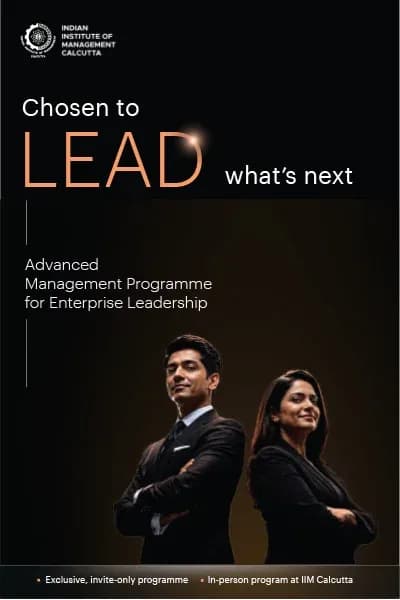
For leaders preparing for wider responsibility, a structured learning environment can speed up this shift. LEAD, the Advanced Management Programme for Enterprise Leadership by IIM Calcutta, is built around four connected dimensions:
- Learn: Broaden perspective across enterprise fundamentals such as finance, brand building, supply chains and human capital.
- Enhance: Strengthen strategic thinking, design thinking, negotiation, conflict resolution and management of self.
- Aspire: Engage with customer-centricity, innovation, digital and AI, and global opportunities amid geopolitical shifts.
- Deliver: Translate leadership intent into impact through leadership, change management, growth and communication strategy.
The 12-month, 141-hour programme is delivered through four in-person residencies at IIM Calcutta. It includes a Learning Diary, an Organizational Manifesto and The CEO Looks Back, which brings in perspectives from current and former CEOs. It is designed for professionals with 15+ years of experience in reputed enterprises.
Conclusion
Enterprise leadership skills are not a more advanced form of functional expertise. They are a different set of capabilities: seeing the whole system, making high-consequence choices, understanding value, putting AI to work, reading the external context, influencing across boundaries and leading continuous change.
The data suggests that organisations are limited less by intent than by these capabilities. For experienced leaders, the opportunity is to build them deliberately, before the role requires them.
Frequently Asked Questions
1. What is the difference between functional and enterprise leadership?
Functional leaders improve the performance of their own area. Enterprise leaders make decisions for the whole organisation, including trade-offs that may not favour their own function.
2. Which skill matters most for enterprise leaders?
There is no single answer, but strategic judgement is central. It is what turns systems thinking, financial acumen and AI fluency into sound decisions.
3. Do senior leaders need technical AI skills?
No. They need enough AI fluency to judge opportunities, ask the right questions, govern risk and redesign work. Building models is not part of the role.
4. Can enterprise leadership skills be developed?
Yes. They grow through cross-functional exposure, structured reflection, peer learning across industries, and programmes designed for senior leaders.
About the Author
TalentSprint
TalentSprint, Part of Accenture LearnVantage, is a global leader in building deep expertise across emerging technologies, leadership, and management areas. With over 15 years of education excellence, TalentSprint designs and delivers high-impact, outcome-driven learning solutions for individuals, institutions, and enterprises. TalentSprint partners with leading enterprises and top-tier academic institutions to co-create industry-relevant learning experiences that drive measurable learning outcomes at scale.
Explore Our Programme
Advance your career with the right program