
What After JIPMAT 2026? A Guide to Management Education Options After Class 12

TL;DR:After JIPMAT, students can pursue management-focused undergraduate programs such as BBA and IPM degrees. The right choice depends on career goals, curriculum, industry exposure, and future learning opportunities. Understanding different pathways can help students make informed decisions and build a strong foundation for a successful management career.
Joint Integrated Programme in Management Admission Test (JIPMAT) 2026 marks the end of months of preparation, but for many students, it also marks the beginning of a new set of questions. Did I perform well enough? What are my chances of admission?
Whether you're confident about your score or unsure about the outcome, this is the time to evaluate your next steps. Many students focus only on results, but the smartest approach is to explore multiple management education pathways that can help build a strong career in business and management.
These concerns are natural. While waiting for results and admission announcements, many students find themselves evaluating their next academic move. However, this period should not be viewed as merely a waiting phase.
It is an opportunity to explore the management education pathways available after Class 12 and make informed decisions about your future.
Read More: Everything about JIPMAT
What happens after JIPMAT 2026?
Once you have appeared for JIPMAT 2026, the next few weeks become crucial for making informed academic decisions. While many students focus only on their results, this period should also be used to explore different management education opportunities and prepare for multiple outcomes. A proactive approach can help you avoid last-minute decisions and identify the programme that best aligns with your interests and career aspirations.
Key stages after the exam
1. Waiting for Results and Admission Announcements: After the examination, candidates typically await the release of results, merit lists, and admission-related updates. Instead of passively waiting, students can use this time to research potential colleges, programmes, and career pathways in management.
2. Understanding Cut-offs and Admission Processes: Admission to management programmes often depends on factors such as entrance test scores, cut-offs, eligibility requirements, and selection criteria. Reviewing these aspects early can help students understand their chances and prepare the necessary documents for the admission process.
3. Evaluating Available Management Programmes: JIPMAT is only one route into management education. Students should explore various options, including Integrated Programmes in Management (IPM), BBA degrees, eBBA programmes, and other business-focused undergraduate courses. Comparing curricula, industry exposure, learning outcomes, and future opportunities can lead to a better choice.
4. Preparing Backup Options and Alternative Pathways: Relying on a single admission outcome can be risky. Having alternative options ensures that students can continue their management education journey even if their preferred programme does not work out as planned.
Why should students start planning early?
Planning ahead offers several advantages:
- Better decision-making: Students get sufficient time to evaluate programmes based on academic quality, career prospects, and personal interests.
- More programme choices: Early research helps identify a wider range of opportunities before application deadlines pass.
- Less dependency on a single admission outcome: Exploring multiple pathways reduces uncertainty and provides greater flexibility in choosing the right programme.
The period after JIPMAT should be viewed not merely as a waiting phase, but as an opportunity to build a clear roadmap for your management education journey.
How to decide your next step after JIPMAT 2026?
Your JIPMAT 2026 score can give you a broad sense of where you stand, but it should not be the only factor guiding your next move. The most useful approach is to look at your expected score alongside your interests, learning preferences, and long-term career goals. Here is how students can think about the road ahead based on different score scenarios.
Scenario 1: If you expect a high score
A high score gives you access to a wider set of IPM programmes, but it still requires careful evaluation. If you are confident about your score:
- Shortlist IPM colleges based on curriculum, campus culture, and long-term outcomes
- Prepare for the next stages of admission, such as personal interviews or written assessments
- Explore parallel options like BBA and eBBA degrees to compare learning models and career pathways
A strong score expands your choices, but the right decision still depends on how well a programme aligns with your goals.
Scenario 2: If you expect a moderate score
A moderate score keeps several strong options open and encourages a broader evaluation of programmes. If you are uncertain about clearing the cut-off:
- Apply to a mix of IPM colleges suited to your expected score range
- Explore BBA and eBBA programmes at reputed institutions that offer strong industry exposure
- Compare programmes on curriculum, learning format, and career outcomes rather than only brand recognition
This scenario often benefits from balanced planning, since a well-chosen alternative can offer equally strong learning and career value.
Scenario 3: If you expect a lower score
A lower score simply shifts the focus toward other well-established management pathways available after Class 12:
- Consider BBA programmes at recognised universities and business schools
- Explore eBBA degrees that offer flexibility along with a structured business learning experience
- Look at other undergraduate business programmes focused on entrepreneurship, marketing, or finance
At this stage, the priority is choosing a programme that aligns with your interests, learning style, and long-term career direction.
IPM vs BBA vs eBBA: How to Choose the Right Path
Choosing between an IPM, a BBA, and an eBBA is one of the most common questions students face after JIPMAT 2026. Each pathway offers a different structure, learning experience, and career trajectory.
The table below highlights how they compare across key parameters, making it easier to identify the option that best fits your goals.
| Parameter | IPM (Integrated Programme in Management) | BBA (Bachelor of Business Administration) | eBBA (Online Bachelor of Business Administration) |
| Duration and Structure | A five-year integrated undergraduate and postgraduate programme leading to a dual degree | A three-year undergraduate business degree offered by universities and business schools | A four-year online honours degree combining academic rigour with digital flexibility |
| Learning Experience | Full-time, campus-based experience with early exposure to management concepts | Conventional classroom format focused on core business subjects | Blend of live online sessions, self-paced modules, and industry-integrated learning |
| Industry Exposure | Strong peer networks and campus placements after the postgraduate stage | Varies widely across institutions in terms of depth and engagement | Emphasises experiential learning, live projects, and early exposure to real business environments |
| Flexibility | Requires a full-time, on-campus commitment | Follows a fixed classroom schedule | Offers the flexibility to study from anywhere within a structured undergraduate framework |
| Best Suited For | Students certain about a long-term, integrated management path | Students seeking a foundational business degree with flexibility to choose specialisations later | Learners who want an IIM-associated ecosystem along with the accessibility of an online degree |
Option 1: Consider IIM Jammu's eBBA (Hons.) Degree
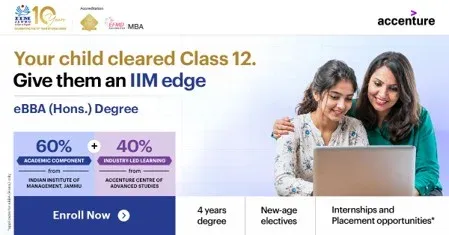
Students exploring management education after JIPMAT 2026 may also consider IIM Jammu's eBBA Degree, an undergraduate programme designed to help learners build strong business and professional foundations from the start of their academic journey.
One of the programme's key differentiators is its collaboration between IIM Jammu and the Accenture Centre of Advanced Studies (ACoAS), which aims to combine academic rigor with industry relevance. The curriculum is designed to provide exposure to core business domains while helping students develop practical problem-solving, analytical, and leadership skills.
The programme emphasises:
- Industry-aligned learning
- A future-focused business curriculum
- Hands-on projects and experiential learning
- Guidance from leading academics and industry practitioners
- Exposure to emerging business and technology trends
For students who want to gain management knowledge while developing workplace-ready skills, the programme offers an opportunity to experience the IIM learning ecosystem immediately after Class 12. It can be a suitable option for learners seeking a blend of academic excellence, industry engagement, and long-term career readiness in an increasingly dynamic business environment.
Also Read: What is industry-integrated education?
Option 2: Explore BBA and other management degrees
For students wondering what to do after JIPMAT 2026, pursuing a Bachelor of Business Administration (BBA) or a related management degree is one of the most popular options. These programmes provide an early introduction to the world of business and management while helping students develop essential professional skills.
A BBA programme typically builds a strong foundation in core business disciplines such as marketing, finance, entrepreneurship, operations, and management. This broad exposure allows students to understand different aspects of running and managing organisations before choosing a specialisation later in their academic or professional journey.
Option 3: Explore IPM Degrees
For students aiming to commit to management education early, an Integrated Programme in Management (IPM) can be a strong pathway to consider after JIPMAT 2026. Offered by IIMs and select institutions, IPM is a five-year programme that combines undergraduate and postgraduate management education into a single, structured journey.
The curriculum typically blends foundational subjects such as economics, mathematics, and communication in the early years with core management areas like marketing, finance, strategy, and operations later on. Students also gain exposure to case-based learning, industry interactions, and peer networks built within the IIM ecosystem.
IPM suits learners seeking an immersive, long-term academic experience with early clarity on their management career path.
How to evaluate a management programme after JIPMAT?
With multiple management education pathways available after JIPMAT 2026, choosing the right programme can feel overwhelming. Rather than focusing only on brand names or admission outcomes, it is important to evaluate programmes based on the learning experience and long-term value they offer.
When comparing different management programmes, consider the following factors:
- Industry Relevance: Look for programmes that are designed to keep pace with evolving business needs. Industry-aligned learning can help students develop practical skills that remain valuable in a rapidly changing professional landscape.
- Business-Focused Curriculum: A strong management programme should provide a solid foundation in areas such as marketing, finance, operations, entrepreneurship, strategy, and business communication while encouraging a broader understanding of how organizations operate.
- Experiential Learning Opportunities: Learning is often most effective when students can apply concepts in real-world contexts. Programmes that incorporate projects, case studies, industry interactions, simulations, and hands-on learning experiences can help bridge the gap between theory and practice.
- Flexibility and Accessibility: Students today have diverse learning preferences and career aspirations. Consider whether the programme offers the flexibility to learn effectively while accessing high-quality academic resources, faculty expertise, and collaborative learning experiences.
- Career Readiness: Beyond academic knowledge, the right programme should help students build workplace-ready competencies such as communication, leadership, problem-solving, analytical thinking, teamwork, and decision-making.
- Exposure to Technology and Innovation: Modern business environments increasingly require an understanding of technology, digital transformation, and data-driven decision-making. Programmes that offer exposure to emerging trends can better prepare students for future careers.
By comparing management programmes across these parameters, students can make more informed decisions and identify a pathway that supports both their current interests and long-term professional goals.
For students evaluating modern management education pathways, programmes such as IIM Jammu's eBBA (Hons.) Degree reflect many of these qualities by combining business fundamentals, industry-relevant learning, experiential exposure, technology awareness, and the flexibility of an online learning format. This allows learners to begin building management and professional skills early while benefiting from a structured undergraduate business education.
Conclusion
JIPMAT 2026 is an important milestone, but it is only the beginning of your management education journey. The choices you make after the exam can shape your academic development, skill-building, and future career opportunities.
Rather than focusing only on results, use this time to evaluate programmes that offer strong business foundations, practical learning, and long-term career relevance. By choosing a programme aligned with your interests and aspirations, you can begin building the knowledge, skills, and professional mindset needed to succeed in an evolving business environment.
Frequently Asked Questions
1. What should I do after appearing for JIPMAT 2026?
After appearing for JIPMAT 2026, students should use the waiting period to research management programmes, understand admission processes, compare different learning pathways, and evaluate options that align with their long-term career goals.
2. Is JIPMAT the only pathway to management education after Class 12?
No. While JIPMAT is an important route to management education, students can also explore management-focused undergraduate programmes such as BBA and other business education pathways that help build business and leadership skills after Class 12.
3. Why is it important to explore multiple options after JIPMAT?
Exploring multiple pathways reduces dependence on a single admission outcome and helps students identify programmes that best match their interests, learning preferences, and long-term career aspirations.
4. What should students look for in a future-ready management programme?
A future-ready management programme should combine strong business fundamentals with practical learning, industry exposure, technology awareness, innovation-focused thinking, and opportunities to build workplace-ready skills.
About the Author
TalentSprint
TalentSprint, Part of Accenture LearnVantage, is a global leader in building deep expertise across emerging technologies, leadership, and management areas. With over 15 years of education excellence, TalentSprint designs and delivers high-impact, outcome-driven learning solutions for individuals, institutions, and enterprises. TalentSprint partners with leading enterprises and top-tier academic institutions to co-create industry-relevant learning experiences that drive measurable learning outcomes at scale.
Explore Our Programme

Advance your career with the right program