Is a Traditional degree enough for today’s job market?

TL;DR:A traditional degree remains valuable for building academic knowledge and strong fundamentals, but today's employers also expect practical skills, industry exposure, and real-world problem-solving abilities. Choosing a program that combines theory with hands-on learning, internships, and career support helps students become job-ready and better prepared for an evolving workplace.
The world of work is evolving, and education is evolving with it, careers today do not look the same as they did even a decade ago.
Organisations across industries are adapting to:
rapid technological advancement
increased reliance on data and digital systems
changing business models and global competition
This shift has created something important:
A broader and more dynamic set of opportunities for students.
At the same time, it has also redefined what “being prepared for a job” actually means.
Which brings us to an important and very relevant question:
Is a traditional degree enough for today’s job market?
A degree still matters, but expectations have changed as a traditional degree continues to play a critical role in higher education.
It provides:
foundational knowledge
conceptual clarity
academic discipline
These are important building blocks.
However, employers today are increasingly looking for something beyond these fundamentals.
What has changed in the job market?
The expectations from entry level talent have evolved significantly in recent years.
According to a recent Indeed survey reported by The Times of India, 72% of job seekers believe that even entry level roles now require prior experience, while 70% feel that securing a first job is more difficult today than it was a few years ago. The findings point to a growing gap between academic qualifications and workplace expectations.
As a result, organisations are placing greater emphasis on:
the ability to apply knowledge in real world situations
problem solving and decision making skills
hands on experience through projects, internships, or industry exposure
familiarity with workplace tools and business environments
the capacity to adapt, learn, and grow continuously
This shift reflects a broader change in how talent is evaluated.
A degree is no longer assessed only by what a student has studied, but also by how effectively they can translate that knowledge into action. Employers increasingly value evidence of practical capability alongside academic achievement, making industry exposure and experiential learning an important part of career preparation.
Why do many graduates still feel unprepared?
This is not necessarily due to lack of effort or ability as in many cases, the gap arises because of how learning is structured.
Traditional programmes often prioritise:
theory over application
exams over experience
delayed exposure to real-world environments
This creates a mismatch where students understand concepts, but may not always be confidently apply them in practical situations.
So, the question is not whether a degree is enough rather It is “What kind of degree makes it enough?”
A relevant degree today should ideally:
combining academic depth with practical exposure
help students connect concepts with real-world use cases
introduce them to how industries operate
build confidence through experience, not just evaluation
Also Read: Difference between traditional and industry-integrated degrees
This is where we are seeing a shift in how programmes are designed
Higher education is gradually evolving to reflect this reality.
The National Education Policy (NEP) 2020, for instance, highlights the importance of:
industry–academia collaboration
experiential learning
skill integration within academic programmes
This has led to the emergence of industry-integrated degree models.
What does an industry-integrated degree actually look like?
Rather than separating theory and application, these programmes attempt to combine both.
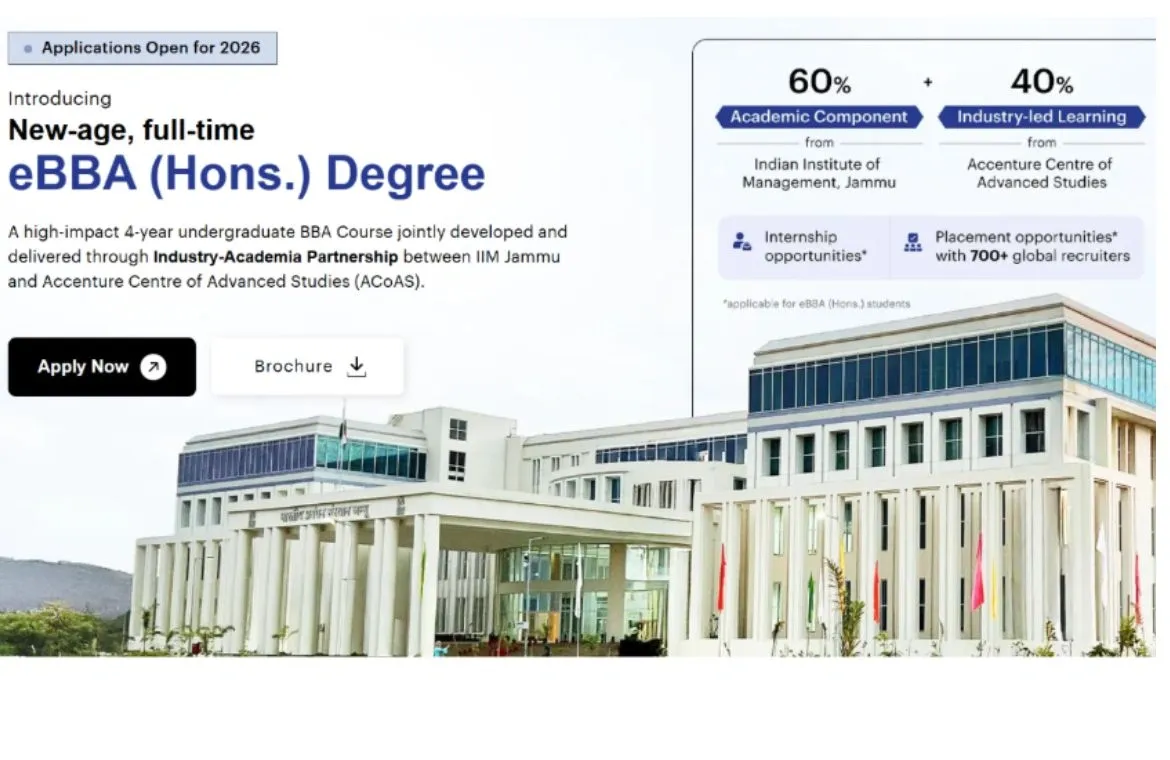
the online BBA by IIM Jammu, the programme is structured to reflect this integration.
Also Read: What is industry-integrated education? and why more students are choosing it after 12th
Bridging theory and practice through design
The programme follows a structured approach where:
60% of the learning is delivered by IIM Jammu faculty, focusing on academic rigour, business fundamentals, and conceptual understanding
40% is delivered through the Accenture Centre of Advanced Studies (ACoAS), bringing in industry-led learning, practical applications, and real-world problem contexts
This ensures that:
Students move beyond understanding concepts to applying them in business-relevant situations.
Embedding real-world exposure within the degree
Another key aspect is when exposure begins.
Instead of being limited to final-year internships, students are exposed to:
structured internship opportunities
hands-on projects and simulations
interaction with industry practitioners
This plays a crucial role in building:
confidence
familiarity with workplace expectations
practical understanding of business processes
Aligning learning with how businesses operate today
Modern business environments are influenced by:
data and analytics
digital infrastructure
emerging technologies like AI
As a result, programmes are beginning to integrate:
data-driven decision-making
AI in business use cases with cloud and data services.
technology-enabled processes
This helps students understand, how decisions are made, not just what needs to be studied
Connecting learning to opportunity
Beyond skills and exposure, access to opportunity is another important factor.
Programmes that are built in collaboration with industry often provide:
exposure to a wide ecosystem of recruiters with 800+ companies.
visibility across diverse roles and industries
This helps bridge the gap between, education and employment outcomes
Preparing for long-term career pathways
Importantly, such programmes do not limit students to a single track.
Graduates often have multiple options, including:
pursuing higher education like MBA or postgraduate degrees.
joining domestic or global organisations.
exploring entrepreneurship.
entering research or academic domains.
This flexibility is essential because, Careers today are dynamic and evolve over time.
So, is a traditional degree enough?
A more accurate way to look at this is, A degree is enough, when it evolves with the demands of the real world.
Not all programmes are designed in the same way.
What matters is whether the learning experience:
builds strong fundamentals
enables practical application
provides real-world exposure
and prepares students for continuous change
Conclusion
The role of a degree has not diminished.
But its meaning has expanded.
Today, the value of a degree lies not just in, what it teaches. but in, what it enables
To think critically.
To apply confidently.
To adapt continuously.
And to grow in an evolving world.
Because ultimately, Success in today’s job market is not just about what you know, but what you can do with it.
Frequently Asked Questions
Q1. Is a traditional degree enough to get a job today?
A traditional degree provides essential academic knowledge, but employers increasingly value practical skills, industry exposure, and problem-solving abilities. Combining theory with real-world experience significantly improves career readiness and employability.
Q2. What makes an industry-integrated degree different?
An industry-integrated degree combines academic learning with internships, live projects, industry mentorship, and practical applications. This approach helps students develop workplace skills while gaining confidence and understanding of real business environments.
Q3. Why is practical experience important during a degree?
Practical experience enables students to apply theoretical concepts, develop workplace competencies, and understand industry expectations. It strengthens critical thinking, adaptability, and employability, making graduates better prepared for evolving career opportunities.
About the Author
TalentSprint
TalentSprint, Part of Accenture LearnVantage, is a global leader in building deep expertise across emerging technologies, leadership, and management areas. With over 15 years of education excellence, TalentSprint designs and delivers high-impact, outcome-driven learning solutions for individuals, institutions, and enterprises. TalentSprint partners with leading enterprises and top-tier academic institutions to co-create industry-relevant learning experiences that drive measurable learning outcomes at scale.
Explore our Programme
Advance your career with the right program